

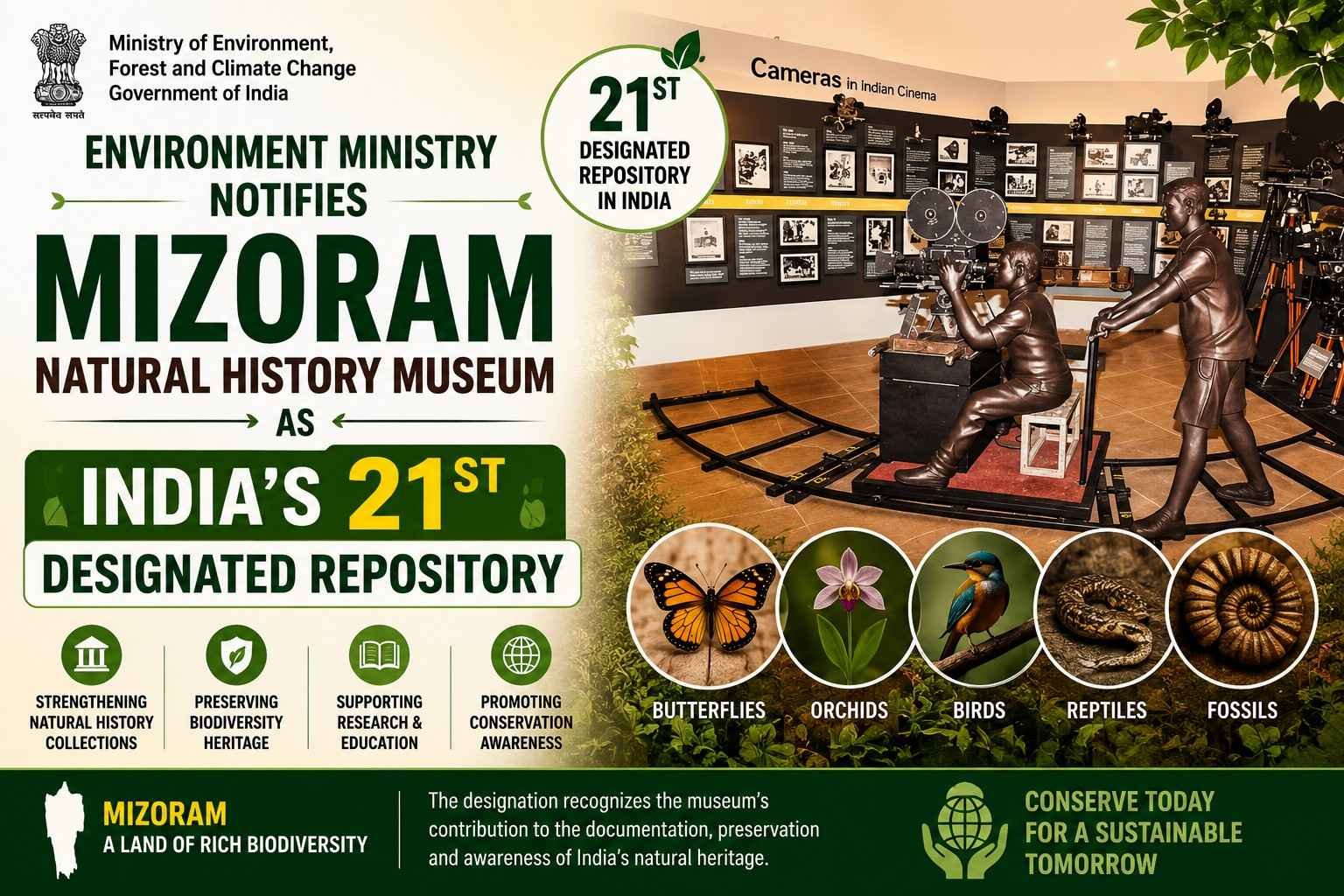
- The Ministry of Environment, Forest and Climate Change (MoEFCC) has officially notified the Natural History Museum (NHM), Mizoram as India’s 21st Designated Repository under the Biological Diversity Act, 2002.
- The designation enhances India’s scientific infrastructure for preserving biological specimens and highlights the ecological importance of the biodiversity-rich Northeast region.
Mizoram Museum Receives National Recognition
- The notification was issued on June 19, 2026, following recommendations from the National Biodiversity Authority (NBA).
- With this recognition, the Natural History Museum at Mizoram University joins an exclusive network of institutions responsible for preserving authenticated biological specimens collected under India’s biodiversity laws.
- The move strengthens India’s biodiversity governance and supports long-term scientific research.
What is a Designated Repository?
A Designated Repository is an institution officially notified by the Central Government under the Biological Diversity Act, 2002 to preserve biological specimens collected during research and biodiversity-related activities.
These repositories:
- Preserve authenticated biological specimens.
- Maintain reference collections for scientific research.
- Support species identification.
- Protect India’s biological resources.
- Assist biodiversity conservation and restoration.
They form an essential part of India’s biodiversity management framework.
What Will the Mizoram Repository Preserve?
The Natural History Museum will maintain voucher specimens of important plant and animal groups found in the Northeast.
Flora
The repository will preserve:
- Pteridophytes (ferns and related plants)
- Macrofungi
Fauna
The museum will maintain authenticated collections of:
- Reptiles
- Amphibians
- Freshwater fishes
- Moths
- Beetles
- Butterflies
The institution will also preserve type specimens of newly discovered species from the region.
Importance of Type Specimens
Type specimens serve as the official scientific reference for newly identified species.
Their preservation helps:
- Confirm species identity.
- Support taxonomic research.
- Maintain scientific accuracy.
- Facilitate future biodiversity studies.
The repository will therefore play a crucial role in documenting India’s biological wealth.
Why Mizoram is Ecologically Important
Established in 2022 under Mizoram University, the Natural History Museum is located within the globally significant Indo-Burma Biodiversity Hotspot.
The region is exceptionally rich in biodiversity.
According to the Environment Ministry:
- More than 7,500 species of flowering plants
- Over 2,000 faunal species
are found across Mizoram and the wider Northeast region.
The museum also possesses specialised expertise in several lesser-studied taxonomic groups, filling important scientific gaps in India’s biodiversity documentation.
Conservation of Endemic Species
The repository will contribute to documenting and conserving species unique to Northeast India.
One notable example is Leptobrachella tamdil, a recently described amphibian species discovered in the forests of Mizoram.
The preservation of such endemic species strengthens India’s efforts to protect globally important biodiversity.
Supporting National Biodiversity Goals
The notification complements the work of existing repositories maintained by institutions such as:
- Botanical Survey of India (BSI)
- Zoological Survey of India (ZSI)
- Other notified research institutions
The designation also advances National Biodiversity Target 4 under India’s National Biodiversity Strategy and Action Plan (2024–2030).
The initiative aligns with Target 4 of the Kunming-Montreal Global Biodiversity Framework, which focuses on conserving genetic diversity through effective ex situ conservation.
Role in Scientific Research and Restoration
The repository will support:
- Biodiversity documentation.
- Ecological research.
- Species identification.
- Genetic conservation.
- Habitat restoration.
- Long-term specimen preservation.
These collections can become invaluable in restoring ecosystems affected by habitat loss, climate change or natural disasters.
Conclusion
The designation of the Natural History Museum in Mizoram as India’s 21st Designated Repository marks another important milestone in the country’s biodiversity conservation efforts. By preserving authenticated biological specimens from one of the world’s richest biodiversity hotspots, the institution will play a vital role in advancing scientific research, conserving endemic species and supporting India’s national and global biodiversity commitments.