

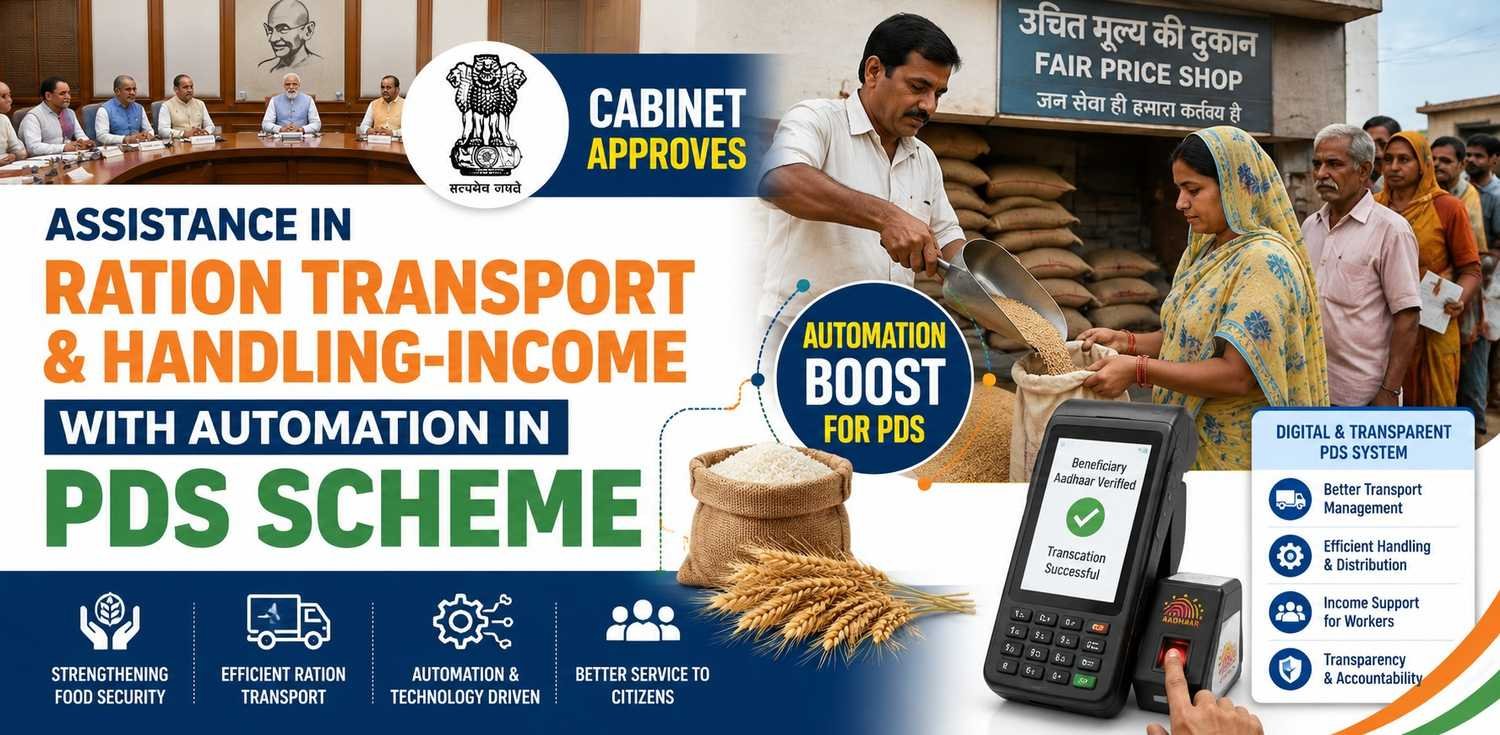
- The Cabinet Committee on Economic Affairs approved the continuation of a scheme to help with food transport and handling in the Public Distribution System (PDS).
- This scheme is called SARTHAK-PDS.
- The committee agreed to continue this scheme during a period with a budget of 25,530 crore rupees from the central government.
- It will also support price shops and help modernize the public distribution system.
- The scheme will have three parts that use artificial intelligence (AI).
These parts are called:
(i) NIRMAL, (ii) ASHA, and (iii) SAKSHAM.
- NIRMAL is a registry of people who get food through the PDS.
- It uses AI to work in real-time.
- ASHA is a platform that helps people interact with the government in their language and complain if needed.
- SAKSHAM is a platform that tracks the supply chain and movement of food using AI and vehicle tracking.
The Cabinet Committee also decided to change the rules for assistance to states and union territories.
This change will help with the costs of moving food grains within states and the margins of price shop dealers.
This scheme will help the government keep its promise to 81.35 crore people who are covered under the National Food Security Act.
This new scheme is not replacing the existing PDS scheme.
All about Public Distribution System (PDS):
- The Public Distribution System (PDS) in India is a crucial component of the country’s food security policy.
- It aims to ensure that essential food grains and other commodities are distributed to vulnerable households at subsidized prices.
- The PDS operates through a network of Fair Price Shops (FPSs) and has evolved over the years to address various challenges and improve the reach of food distribution.
The system is managed jointly by the:
- Central Government
- State Governments
- Food Corporation of India (FCI)
It is one of the world’s largest food distribution programs.
Key functions of the PDS include:
- Procurement, storage, and transportation of food grains.
- Subsidized distribution of food grains to eligible families.
- Supervision of FPSs and issue of Ration Cards.
- Support to farmers by procuring food grains at Minimum Support Prices (MSP).
- Buffer stock management to ensure continuous availability of food grains during emergencies.
Types of Ration Cards
- Priority Household (PHH): For economically weaker families under NFSA.
- Antyodaya Anna Yojana (AAY): For the poorest families with highest subsidy benefits.
- Non-Priority Cards: Issued by some states for additional welfare schemes.