

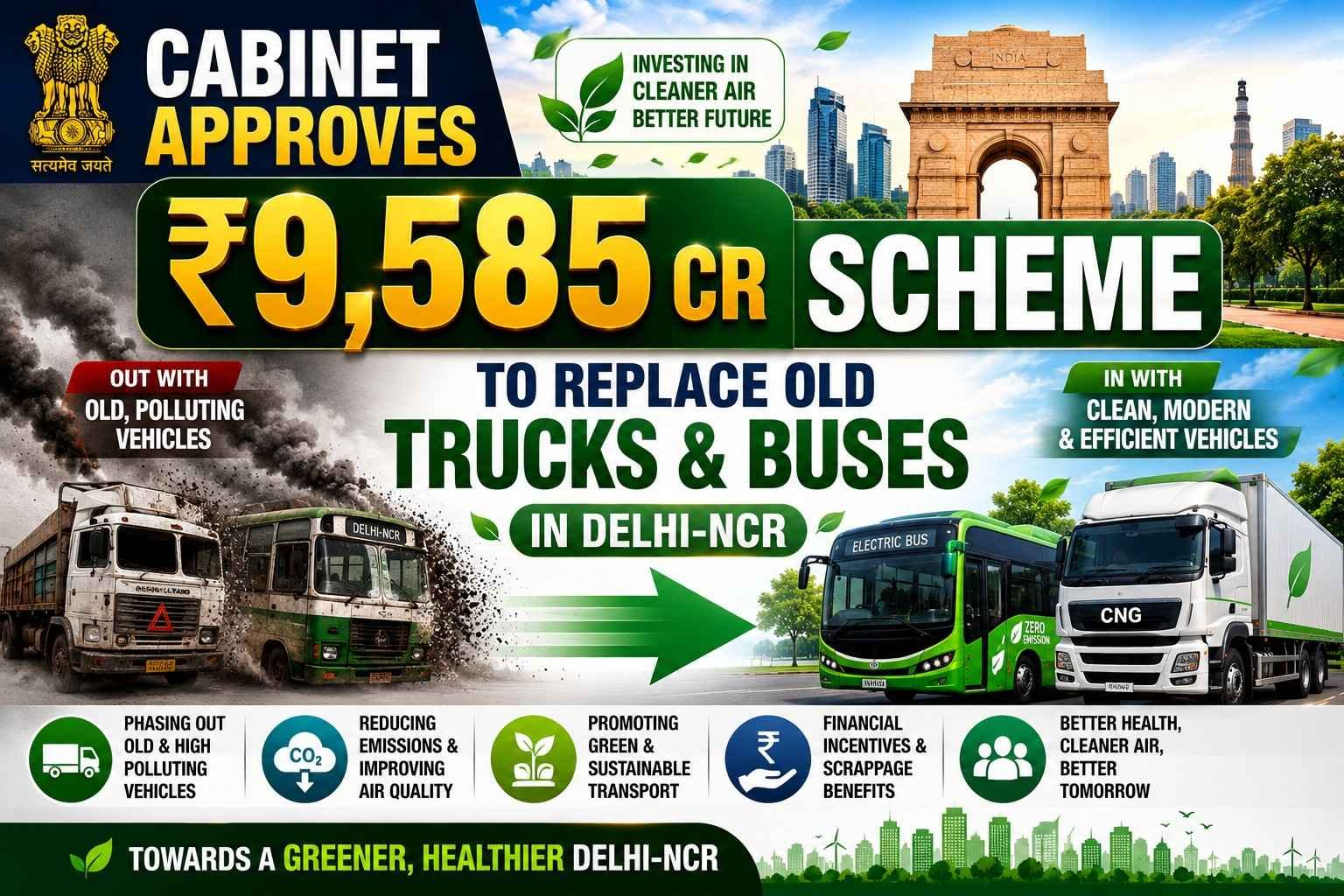
- The Union Cabinet, chaired by Prime Minister Narendra Modi, has approved a landmark two-year scheme aimed at reducing vehicular pollution in the Delhi-NCR region by incentivizing the replacement of old trucks and buses with cleaner, BS-VI-compliant or electric vehicles (EVs).
- The scheme will be funded through the National Capital Region Planning Board under the Ministry of Housing and Urban Affairs and implemented jointly by the Ministry of Road Transport and Highways (MoRTH) and the Ministry of Petroleum and Natural Gas (MoPNG), in collaboration with the governments of Delhi, Haryana, Rajasthan, and Uttar Pradesh.
Financial Outlay
The scheme has a total financial outlay of ₹9,585 crore, comprising:
- ₹5,041 crore from the Central Government.
- Approximately ₹1,601 crore in tax concessions from participating states.
- Additional support from automobile manufacturers and financial incentives.
Objective of the Scheme
The primary objective is to accelerate the replacement of:
- BS-IV vehicles and older vehicles
- Pre-BS vehicles
- Aging trucks and buses
with:
- BS-VI compliant vehicles
- Vehicles meeting stricter emission standards
- Electric vehicles (EVs)
The initiative is expected to significantly reduce vehicular emissions and improve air quality across the Delhi-NCR region.
Why Is the Scheme Needed?
Delhi-NCR continues to face severe air pollution, especially during winter.
According to a study conducted by:
- Automotive Research Association of India
- The Energy and Resources Institute
the transport sector contributes:
- 14% of PM2.5 emissions
- 40% of Carbon Monoxide (CO) emissions
- 63% of Nitrogen Oxide (NOx) emissions
within the Delhi-NCR region.
Heavy Vehicles Are Major Polluters
Although trucks and buses constitute only about 3% of the total vehicle fleet, they contribute approximately:
- 36% of PM2.5 emissions
The study also found:
- One Pre-BS heavy-duty vehicle emits pollution equivalent to 14 BS-VI vehicles.
- A BS-IV vehicle emits approximately 2.7 times more pollutants than a BS-VI vehicle.
Eligibility and Vehicle Replacement Conditions
For BS-III and Older Vehicles
Owners must Scrap the vehicle at a Registered Vehicle Scrapping Facility (RVSF).
For BS-IV Vehicles
- Owners can either Scrap the vehicle, or Sell it outside NCR to non-NCAP cities/towns.
- After disposal, owners must purchase and register:
- A BS-VI or stricter emission-compliant vehicle, or
- An electric vehicle within NCR.
Special Conditions for Delhi
- In Delhi Light Goods Vehicles purchased under the scheme must be electric only.
- Buses must be either BS-VI CNG, or Electric buses.
- Government-owned vehicles are excluded from the scheme.
Benefits Under the Scheme
Central Government Incentives: Eligible vehicle owners will receive:
- Interest Subvention: 5% interest subsidy on vehicle loans for five years.
- Fuel Vouchers: Monthly fuel vouchers worth up to ₹4,800 per month depending on vehicle category.
- EV Incentives Lump-sum incentives for purchasing EVs.
- Benefits through Certificate of Deposit trading mechanisms.
State Government Incentives
Participating states will provide:
Registration Fee Waiver
- Complete waiver of registration fees for new vehicles.
Motor Vehicle Tax Concessions
- Up to 100% tax concession on new vehicles for 10 years.
- 50% tax concession on used vehicles for 10 years.
Liability Waiver
- Waiver of pending liabilities on old vehicles participating in the scheme.
Support from Automobile Manufacturers
Participating automobile Original Equipment Manufacturers (OEMs) will provide:
- 8% discount on ex-showroom prices of eligible vehicles.
This will reduce the replacement cost burden for vehicle owners.
Digital Implementation Platform
The scheme will be implemented through a fully integrated digital platform that will provide:
- Real-time eligibility verification.
- Automated interest subsidy processing.
- Monthly fuel voucher credits.
- Monitoring of pollution reduction outcomes.
- Transparent tracking of benefits.
Central Government benefits will continue for five years from the date of registration of the new vehicle, ensuring long-term support.
Monitoring Mechanism
Empowered Committee
A high-level Empowered Committee will oversee implementation.
The committee will be chaired by:
- Cabinet Secretary of India
Members include:
- CEO, NITI Aayog
- Secretaries of MoHUA, MoRTH, MoPNG, and DFS
- Chief Secretaries of Delhi-NCR states
- Member Secretary of NCRPB
District-Level Monitoring
District Collectors and District Magistrates will supervise implementation at the local level.
Expected Outcomes
The scheme is expected to:
- Reduce PM2.5, NOx, and CO emissions.
- Accelerate fleet modernization.
- Promote EV adoption.
- Improve public health outcomes.
- Strengthen regional air quality management.
- Support sustainable transportation.
Additionally, it will help sustain:
- Air cargo movement
- Tourism
- Logistics
- Trade
- Regional economic growth while improving environmental quality in one of India’s most polluted regions.