

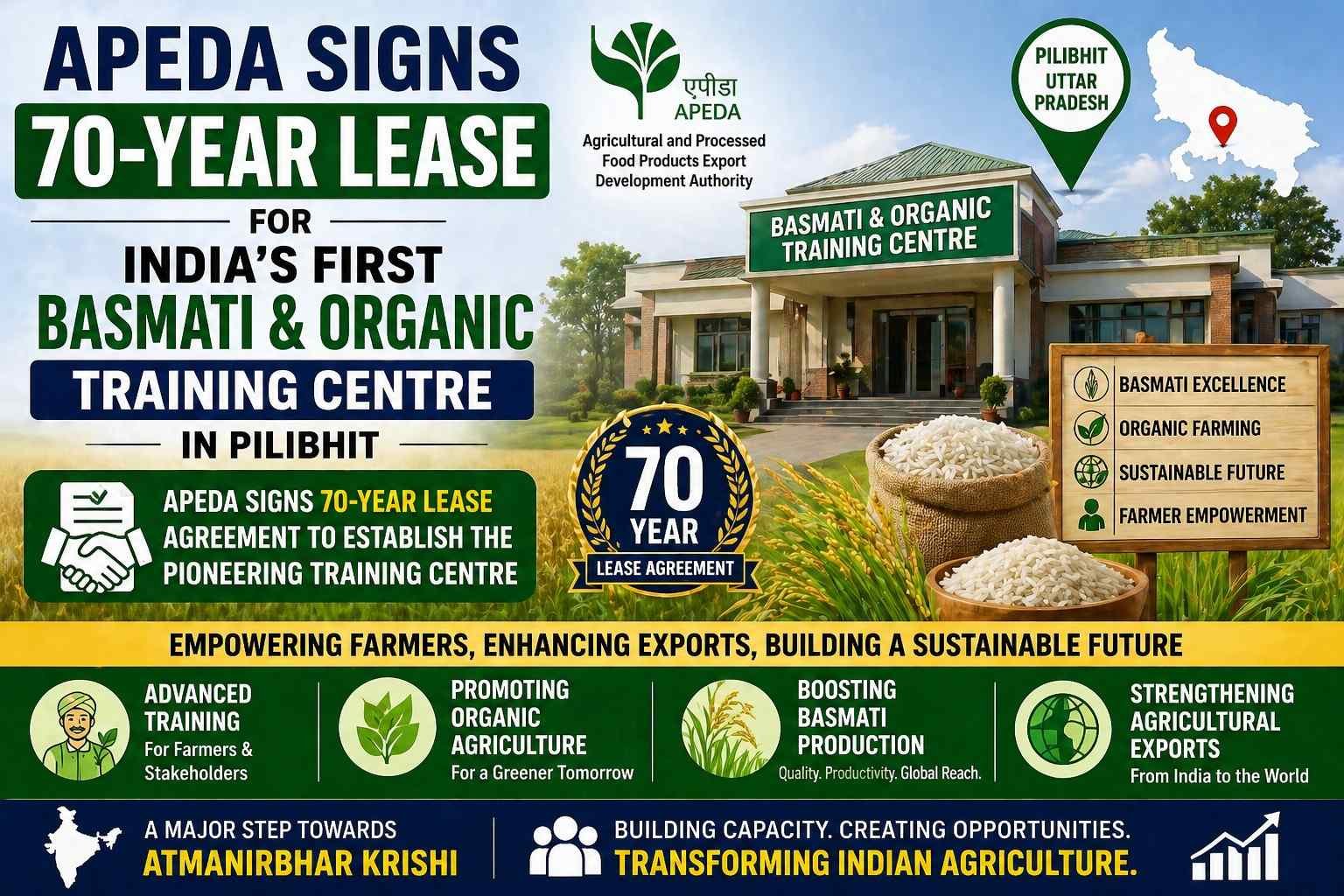
In a major push to strengthen India’s Basmati rice ecosystem and organic farming, the Agricultural and Processed Food Products Export Development Authority has signed a 70-year lease agreement with the Department of Agriculture and the Government of Uttar Pradesh to establish a Basmati & Organic Training Centre-cum-Demo Farm in Pilibhit.
This initiative is expected to boost farmer training, research, and export competitiveness in one of India’s most important agricultural sectors.
Key Features of the Proposed Centre
The centre will be developed over ~7 acres at Tanda Bijaisi and will include:
- Auditorium for training sessions
- Museum & gallery on Basmati and organic farming
- Laboratory facilities
- Conference rooms
- Storage for organic inputs
It will serve as a training hub for farmers, researchers, and students, focusing on both conventional and organic Basmati cultivation.
First-of-Its-Kind Initiative in India
Once operational, the facility will become:
- India’s first integrated Basmati & organic training centre
- A demonstration farm for best agricultural practices
- A resource hub for stakeholders in Uttar Pradesh and Uttarakhand
This marks a significant step toward modernising Basmati cultivation and promoting sustainability.
AI-Based Basmati Paddy Survey Project Launched
Alongside the centre, an innovative AI-driven survey project (2026–2028) has been launched by APEDA in collaboration with the All-India Rice Exporters Association.
Key Highlights of the Project:
- Covers ~4 million hectares
- Uses 150,000+ ground-truth data points
- Engages 500,000+ farmers
Objectives:
- Accurate crop assessment
- Varietal identification
- Better export planning
- Scientific advisory services
This project will bring data-driven precision agriculture into Basmati farming.
AICRP Recognition: Boost for Research
The upcoming centre has been designated as an AICRP (All India Coordinated Research Project) centre.
This makes Pilibhit:
- The third AICRP centre in Uttar Pradesh’s Basmati GI zone
- After:
- Nagina
- Modipuram
This will enable scientific testing of new Basmati varieties suited to local agro-climatic conditions.
India’s Basmati Export Strength
Basmati rice continues to be a major export driver:
- Export value: USD 5.67 billion (2025–26)
- Volume: ~6.5 million metric tonnes
Key Markets:
- Middle East
- Europe
- North America
Being a Geographical Indication (GI) product, Basmati rice enjoys global recognition and premium pricing.
Conclusion:
The establishment of a Basmati & Organic Training Centre in Pilibhit, combined with an AI-powered crop survey, marks a transformative step for India’s agricultural sector.
By integrating technology, research, and farmer training, this initiative will not only enhance productivity but also strengthen India’s position as a global leader in premium Basmati rice exports.