

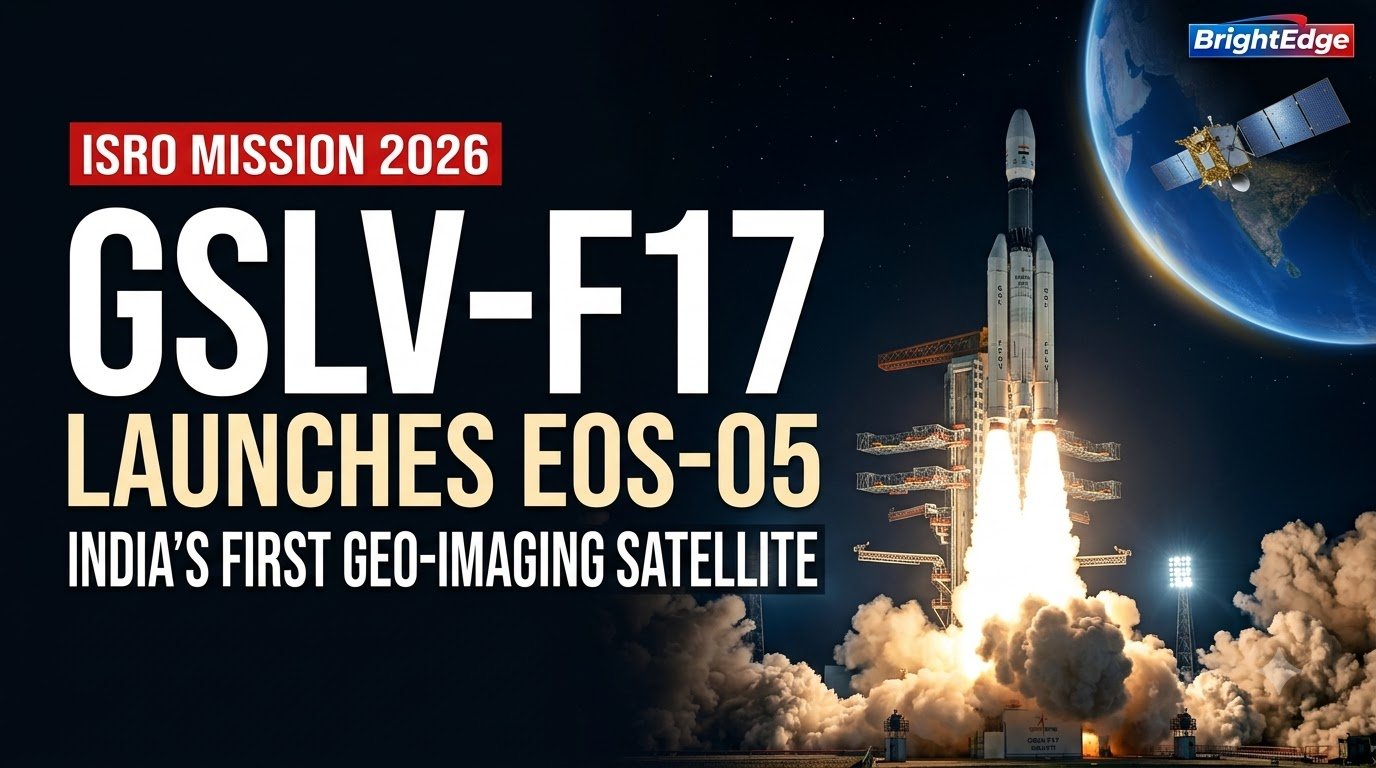
On 4th September 2026, ISRO’s GSLV-F17 EOS-05 launch marks a major step for India’s Earth-observation capability.
The Geosynchronous Satellite Launch Vehicle lifted off from the Second Launch Pad at Sriharikota and placed EOS-05 into its intended sub-geosynchronous transfer orbit.
The mission is significant because EOS-05 is India’s first dedicated imaging satellite designed to operate from geosynchronous orbit. Unlike many Earth-observation satellites that circle the planet in low-Earth or polar orbits, EOS-05 is intended to provide frequent views of a broad region from a much higher vantage point.
ISRO GSLV-F17 EOS-05 launch: the key facts
- Launch vehicle: GSLV-F17
- Payload: EOS-05
- Launch site: Second Launch Pad, Satish Dhawan Space Centre, Sriharikota
- Mission type: Earth observation
- Orbit achieved after launch: Sub-geosynchronous transfer orbit
- Major milestone: India’s first imaging satellite from geosynchronous orbit
- GSLV milestone: 19th flight of the GSLV programme
ISRO confirmed that GSLV-F17 successfully accomplished the mission and placed EOS-05 into the intended orbit. The launch vehicle used a 4-metre composite ogive payload fairing. ISRO’s official mission update
What makes EOS-05 important?
- EOS-05 is built to strengthen India’s ability to observe the Earth from geosynchronous orbit. This position is valuable because it can support repeated imaging of the same large area, rather than relying only on satellites that pass over a location at fixed intervals.
- That capability can be useful for monitoring changing conditions across land and water, as well as supporting response planning when fast, repeat observations are needed. ISRO describes EOS-05 as a state-of-the-art Earth-observation spacecraft and India’s first imaging satellite from geosynchronous orbit.
- The satellite will undergo a series of planned orbit-raising manoeuvres after its initial injection. Reports from the launch say the satellite was placed into a transfer orbit and will use onboard thrusters to reach its operational position.
Why the GSLV-F17 mission matters for India
The GSLV-F17 EOS-05 launch is also important for India’s launch-vehicle programme. It was the 19th flight of the GSLV, a vehicle family that has played a central role in placing heavier satellites into high-energy and geostationary transfer trajectories.
The mission demonstrates the continuing relevance of India’s indigenous launch capability for complex Earth-observation missions. According to launch reporting, the vehicle was approximately 51.7 metres tall and carried EOS-05, a payload of about 2,367 kg—reported as the heaviest payload launched by GSLV to date.
For students preparing for UPSC, SSC, state PSC and other current-affairs examinations, this mission connects three important topics:
- India’s space-launch capability
- Earth-observation applications
- The strategic value of geosynchronous imaging
GSLV-F17 vs other Earth-observation missions
- Most remote-sensing satellites operate in low-Earth or sun-synchronous polar orbits. These orbits are highly useful for mapping and detailed observation, but they do not keep the same region continuously within view.
- A geosynchronous imaging satellite works differently. Its high-altitude position can enable frequent observation of a wide region. That makes EOS-05 a notable addition to India’s space-based observation architecture.
- ISRO’s previous Earth-observation missions have supported applications across weather monitoring, agriculture, water resources, disaster management, urban planning and environmental assessment. EOS-05 adds a new orbit-based capability to that larger ecosystem.
What happens next?
- After launch into the transfer orbit, the next phase is orbit raising and commissioning. The spacecraft must reach its planned operational orbit, deploy and test systems, and undergo payload calibration before regular use.
- The success of the GSLV-F17 EOS-05 launch does not mean operational services begin immediately. The commissioning process is essential before the satellite’s imagery can support end users.
More Upcoming Launches:
| Destination | Craft name | Launch vehicle | Year |
|---|---|---|---|
| Moon | Chandrayaan-4 | 2 × LVM3 | 2027 |
| Moon | LUPEX | H3 | 2028-29 |
| Venus | Venus Orbiter Mission | LVM3 | 29 March 2028 |
| Mars | Mars Lander Mission | LVM3 | NET 2030 |
Note:
- ISRO aims to put an Indian astronaut on the lunar surface by 2040.
- Gaganyaan mission team includes Group Captain Prasanth Balakrishnan Nair, Group Captain Ajit Krishnan, Group Captain Angad Pratap, and Wing Commander Shubhanshu Shukla.
Major Launch and Rocket Centers
- Satish Dhawan Space Centre (SDSC) SHAR (Sriharikota, Andhra Pradesh) – India’s primary orbital launch site.
- Vikram Sarabhai Space Centre (VSSC) (Thiruvananthapuram, Kerala) – The main hub for launch vehicle (rocket) development.
- India’s new major space centre is the Second Spaceport, currently under construction in Kulasekarapattinam, Thoothukudi district, Tamil Nadu.
About ISRO:
- The Indian Space Research Organisation (ISRO) is India’s national space agency.
- Headquartered in Bengaluru, Karnataka.
- Founded on August 15, 1969
- Founding Father: Dr. Vikram Sarabhai
- Parent Agency: Department of Space, Government of India
- Current Chairman: V. Narayanan (2026)
Click Here to Read:
Gaganyaan Achieves Human-Rating Milestones: ISRO Clears Key Tests
Former ISRO Chief S Somanath Joins Agnikul Cosmos Ahead of Reusable Rocket Mission 02