

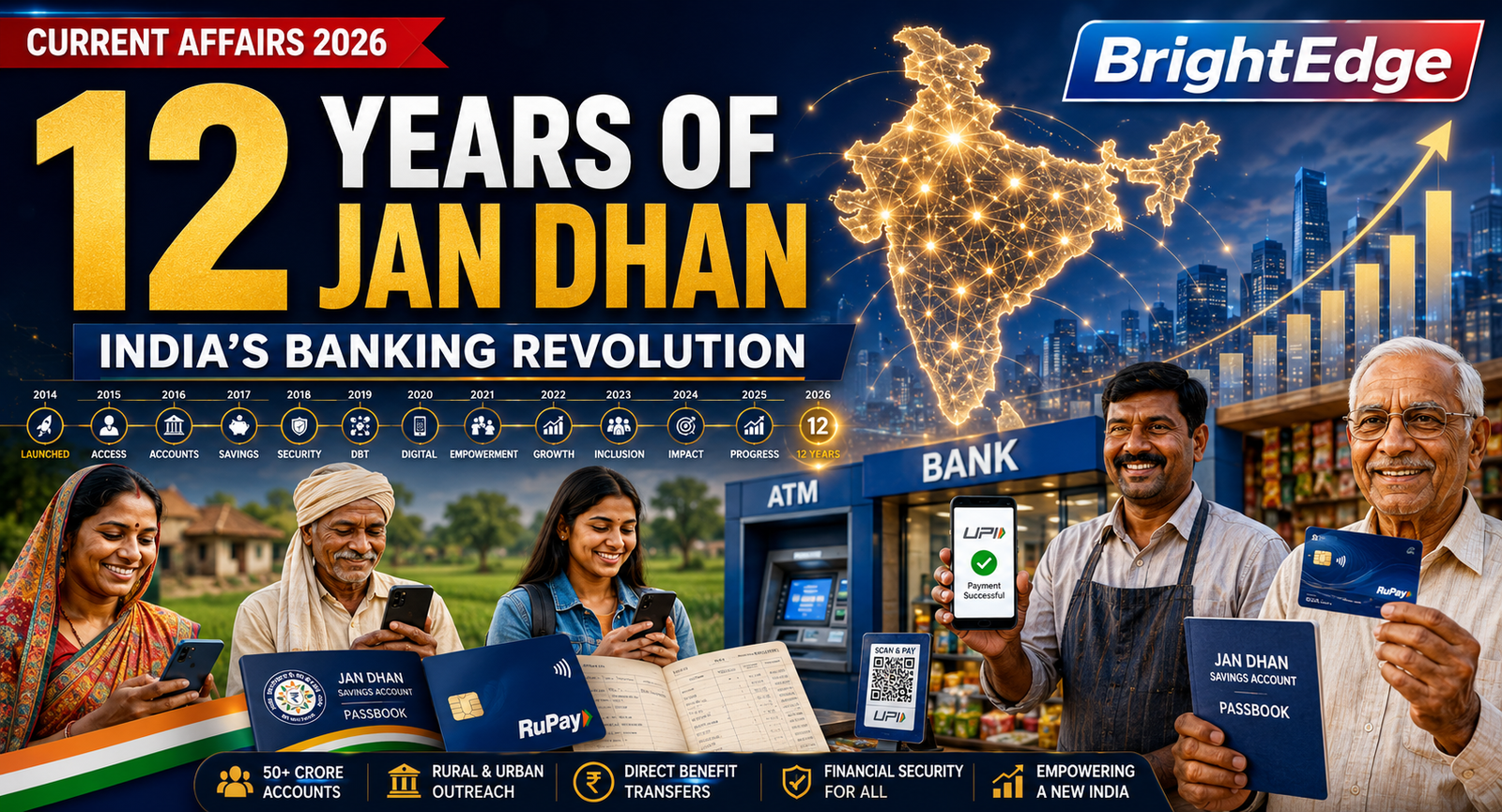
The Pradhan Mantri Jan Dhan Yojana (PMJDY) has completed 12 years, marking a major milestone in India’s financial inclusion journey. Launched in August 2014, the flagship scheme was designed to bring unbanked sections of society into the formal banking system and provide access to basic financial services.
Over the past 12 years, Jan Dhan accounts have become an important gateway to banking, savings, digital payments, insurance and government benefit transfers, particularly for households that previously had limited or no access to formal financial services.
What Is Pradhan Mantri Jan Dhan Yojana?
The Pradhan Mantri Jan Dhan Yojana is a national financial inclusion programme launched by the Government of India on 28 August 2014.
Its central objective is to ensure that every household has access to basic banking facilities and can participate in the formal financial system.
The scheme focuses on providing access to a range of financial services, including:
- Basic savings bank accounts
- Remittance facilities
- Credit access
- Insurance
- Pension-related services
- Direct Benefit Transfer (DBT)
- Digital financial services
The programme has therefore evolved beyond simply opening bank accounts and has become an important part of India’s broader financial-inclusion infrastructure.
Why Was Jan Dhan Yojana Launched?
- Before the launch of PMJDY, a significant section of India’s population faced barriers to formal banking.
- People in rural and economically underserved areas often had limited access to bank branches, formal credit and other financial products.
- The government launched PMJDY to address these challenges and create a more inclusive financial ecosystem.
- The broader objective was to ensure that people could save securely, receive government benefits directly, make payments digitally and access formal financial services.
12 Years of Financial Inclusion
- The completion of 12 years represents more than an anniversary. It highlights the transformation of India’s financial-access landscape.
- Jan Dhan accounts have helped connect previously underserved citizens with formal banking channels. The scheme has also worked alongside India’s expanding digital-payment infrastructure.
- A major development has been the increasing integration of bank accounts with Aadhaar-based identification and mobile connectivity, popularly described as the JAM trinity — Jan Dhan, Aadhaar and Mobile.
- This ecosystem has helped facilitate more efficient delivery of government benefits and financial services.
Key Benefits of PM Jan Dhan Yojana
1. Access to a Bank Account
One of the most important features of PMJDY is the availability of basic bank accounts for people who previously remained outside the formal banking system.
This provides a secure avenue for saving and receiving money.
2. Direct Benefit Transfers
Jan Dhan accounts can serve as channels for receiving eligible government benefits directly into beneficiaries’ bank accounts.
Direct transfers can reduce dependence on intermediaries and improve the efficiency of welfare delivery.
3. RuPay Debit Card
Eligible PMJDY account holders are provided access to a RuPay debit card, subject to the applicable scheme conditions.
This supports electronic transactions and greater participation in the formal payment system.
4. Overdraft Facility
PMJDY also provides for an overdraft facility for eligible account holders, subject to applicable conditions.
This feature is intended to provide a limited formal credit facility to qualifying customers.
5. Insurance and Pension Linkages
PMJDY has also helped connect eligible account holders with government-backed social-security and financial products, including insurance and pension schemes.
This strengthens the broader financial-security ecosystem.
PMJDY and India’s Digital Financial Revolution
- The significance of Jan Dhan Yojana has increased alongside India’s rapid adoption of digital payments.
- Bank accounts provide the foundation through which citizens can access various digital financial services.
- The combination of: Jan Dhan + Aadhaar + Mobile + Digital Payments
- PMJDY has helped create an ecosystem capable of connecting citizens with financial services at a much larger scale.
- This transformation has been particularly important for rural and semi-urban communities.
PM Jan Dhan Yojana and Women
- Financial inclusion has also had an important gender dimension.
- Access to an individual bank account can give women greater control over their own financial transactions and savings.
- Women receiving eligible government benefits directly into their accounts can potentially gain greater financial independence and visibility within the formal banking system.
- Thus, PMJDY is not only a banking initiative but also an important instrument supporting broader economic participation.
Click Here to Read: Three Jan Suraksha Schemes Complete 11 Years