

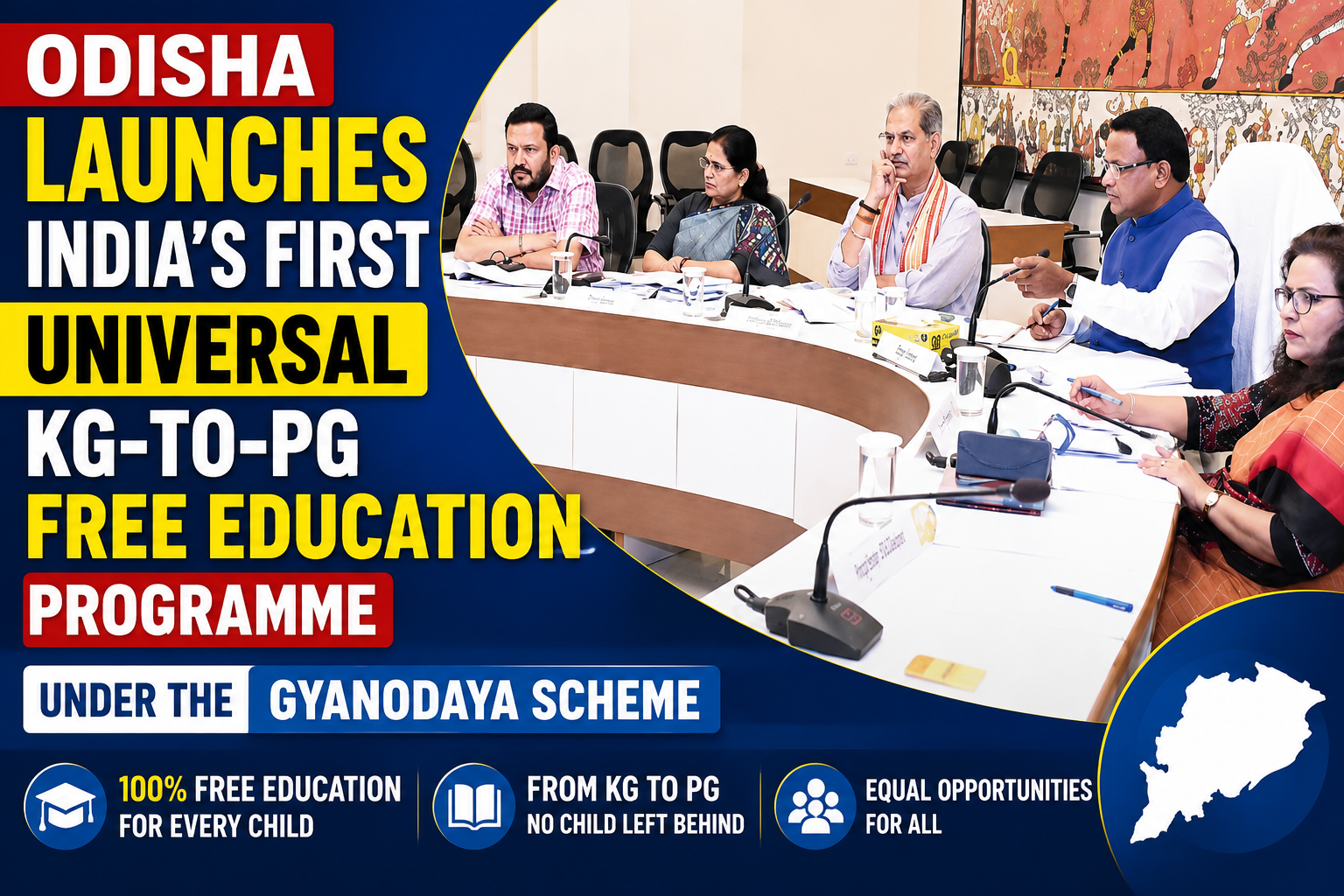
- The Odisha Cabinet has approved India’s first universal free education programme from Kindergarten (KG) to Postgraduate (PG) level.
- The initiative, launched under the Gyanodaya–Shiksharu Samruddhi Scheme, will provide free education to students enrolled in government and government-aided institutions across the state from the 2026–27 academic session.
- The decision, chaired by Chief Minister Mohan Charan Majhi, is being hailed as one of the most significant education reforms in Odisha’s history, with the objective of ensuring that no student is deprived of education due to financial constraints.
A Historic Education Reform
Under the newly approved scheme, all tuition and academic fees will be waived for students pursuing regular courses in government and government-aided institutions.
Earlier, free education in Odisha was available only from Kindergarten to Class VIII. The new programme significantly expands the coverage by including:
- Classes IX to XII
- Undergraduate (UG) programmes
- Postgraduate (PG) programmes
The scheme will apply to all eligible students studying in government schools, government colleges, government universities and government-aided educational institutions.
Gyanodaya–Shiksharu Samruddhi Scheme
Chief Minister Mohan Charan Majhi described the initiative as more than just a fee-waiver programme.
According to the Chief Minister, the scheme represents the government’s commitment to ensuring equal educational opportunities for every child, irrespective of economic background.
He emphasised that no student in Odisha should be forced to discontinue education because of financial hardship.
The programme seeks to make education:
- Affordable
- Accessible
- Inclusive
- Equitable
while improving the overall quality of human capital in the state.
Financial Outlay
The Odisha Government has allocated substantial financial resources for implementing the scheme.
Key financial details include:
- ₹895.57 crore allocated for the first year.
- ₹5,467.55 crore earmarked over five years.
The government expects the programme to benefit more than 32 lakh students every year, making it one of the largest state-funded education initiatives in India.
Institutions Covered
The scheme covers:
- Government schools
- Government colleges
- Government universities
- Government-aided educational institutions
However, it does not apply to:
- Private unaided institutions
- Self-financing courses
- Professional and technical programmes
- Public-Private Partnership (PPP) institutions
Only students enrolled in regular academic courses will be eligible.
Expected Benefits
The government believes the initiative will have far-reaching social and economic benefits.
The scheme is expected to:
- Increase school and college enrolment.
- Improve attendance.
- Reduce dropout rates.
- Encourage higher education.
- Ease the financial burden on families.
- Support economically weaker and socially disadvantaged students.
By eliminating financial barriers, Odisha aims to create a more educated and skilled workforce.
Alignment with National Goals
The Gyanodaya Scheme aligns closely with several long-term policy objectives, including:
- National Education Policy (NEP) 2020
- Odisha Vision 2036
- Odisha Vision 2047
The initiative reflects the state’s commitment to investing in education as a key driver of inclusive development and economic progress.
A Major Investment in Human Capital
- Education experts view the decision as a transformative investment in Odisha’s future.
- Universal access to education from KG to PG is expected to improve literacy, enhance employability and strengthen the state’s knowledge economy.
- If implemented effectively, the programme could become a model for other Indian states seeking to expand educational opportunities.
Conclusion
- Odisha’s decision to introduce India’s first universal KG-to-PG free education programme marks a historic milestone in the country’s education sector.
- Through the Gyanodaya–Shiksharu Samruddhi Scheme, the state has demonstrated a strong commitment to educational equity, social inclusion and long-term human capital development.
- With more than 32 lakh students expected to benefit every year, the initiative has the potential to transform the educational landscape of Odisha while inspiring similar reforms across India.