

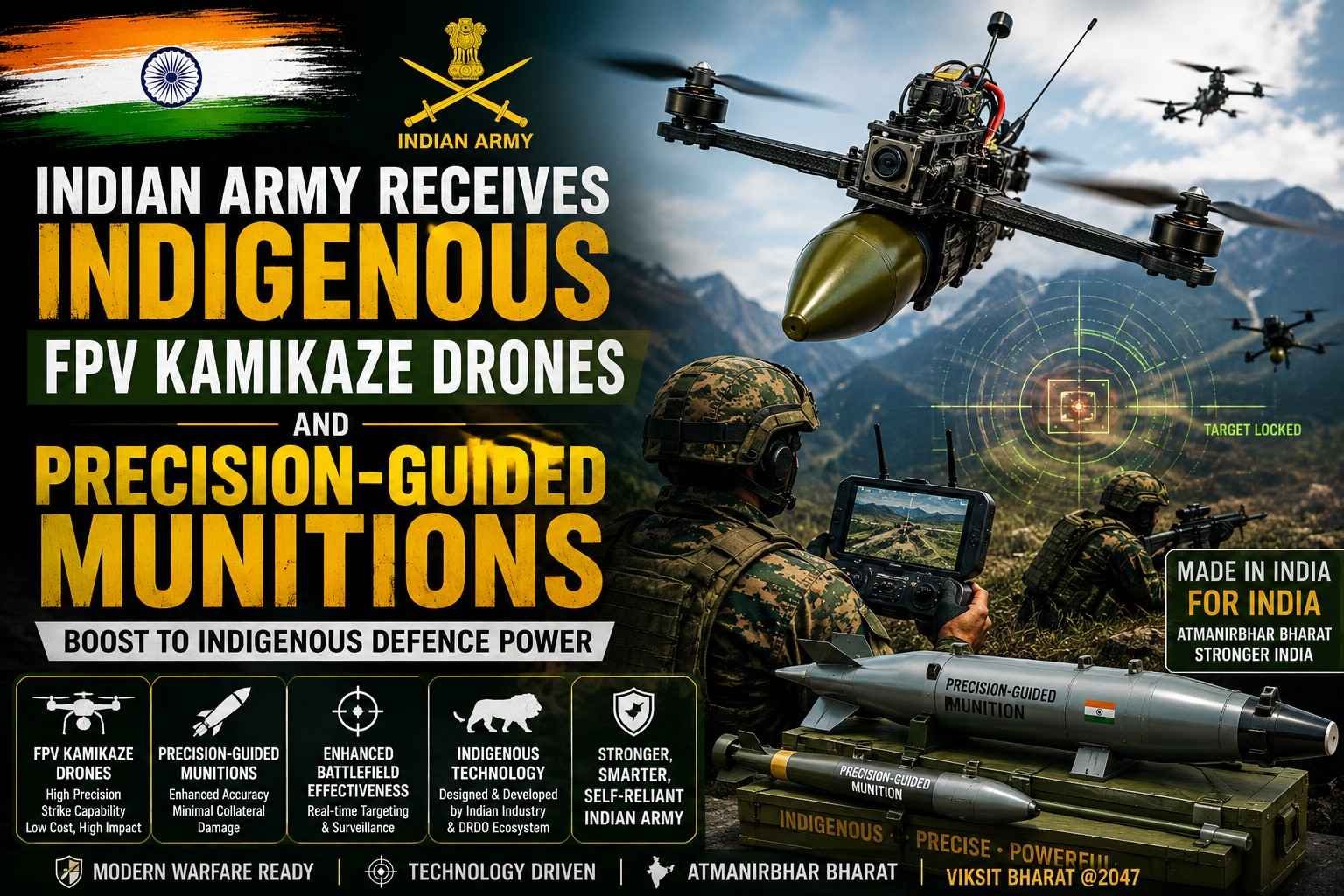
The Indian Army has inducted two new indigenous combat systems under the Emergency Procurement (EP-6) programme:
- the UAV-Launched Precision Guided Munition (ULPGM), and
- the AGNIKAA VTOL-1.
The systems were handed over in Hyderabad in the presence of officials from the Army’s Western Command after successful high-altitude, electronic warfare, and precision-strike trials.
ULPGM: India’s Indigenous Loitering Munition
The ULPGM has been jointly developed by the Defence Research and Development Organisation and Adani Defence & Aerospace.
It is considered India’s first indigenous loitering munition in its category.
Key Features of ULPGM
- Equipped with an Imaging Infrared (IIR) seeker.
- Can target both stationary and moving targets.
- Operational UAV range of up to 20 km.
- Munition strike range of about 2.5 km.
- Capable of operating during day and night and in all weather conditions.
- Functions effectively in GPS-denied and communication-jammed environments.
- Includes anti-jamming and anti-spoofing capabilities.
The system carries a 2-kg warhead capable of destroying both soft and hardened targets with high precision.
Its reported accuracy is about one metre CEP (Circular Error Probable), making it highly effective for precision strikes.
The missile has also been integrated with retractable UAV platforms, increasing operational flexibility in contested battlefield conditions.
AGNIKAA VTOL-1 FPV Kamikaze Drone
The AGNIKAA VTOL-1 has been described as India’s first First-Person View (FPV) kamikaze drone in its class.
The drone has been developed primarily for:
- anti-personnel precision strikes,
- urban warfare,
- confined-space combat,
- and open battlefield operations.
Key Capabilities
- Operational range of up to 5 km.
- Flight endurance of around 30 minutes.
- Maximum speed of 60 kmph.
- Lethality radius of about 5 metres against personnel and soft-skinned vehicles.
- Capable of functioning in GPS-denied and electronic warfare environments.
The drone has also undergone successful high-altitude and electronic warfare trials, confirming its operational readiness for deployment in difficult terrains.
Advanced Safety Features
The AGNIKAA VTOL-1 is equipped with:
- a three-layered trigger mechanism,
- and a four-layer trigger safety system.
These systems are intended to ensure mission reliability and operator safety during combat deployment.
Boost to Indigenous Defence Capability
The induction of these systems marks another major step in India’s push towards indigenous defence manufacturing and modern battlefield technologies under the Atmanirbhar Bharat initiative.
The systems are expected to significantly strengthen the Indian Army’s:
- precision-strike capability,
- electronic warfare resilience,
- tactical surveillance,
- and battlefield lethality.
Their ability to operate in GPS-denied and jammed environments is particularly important in modern warfare scenarios where electronic warfare and drone-based combat are becoming increasingly significant.