

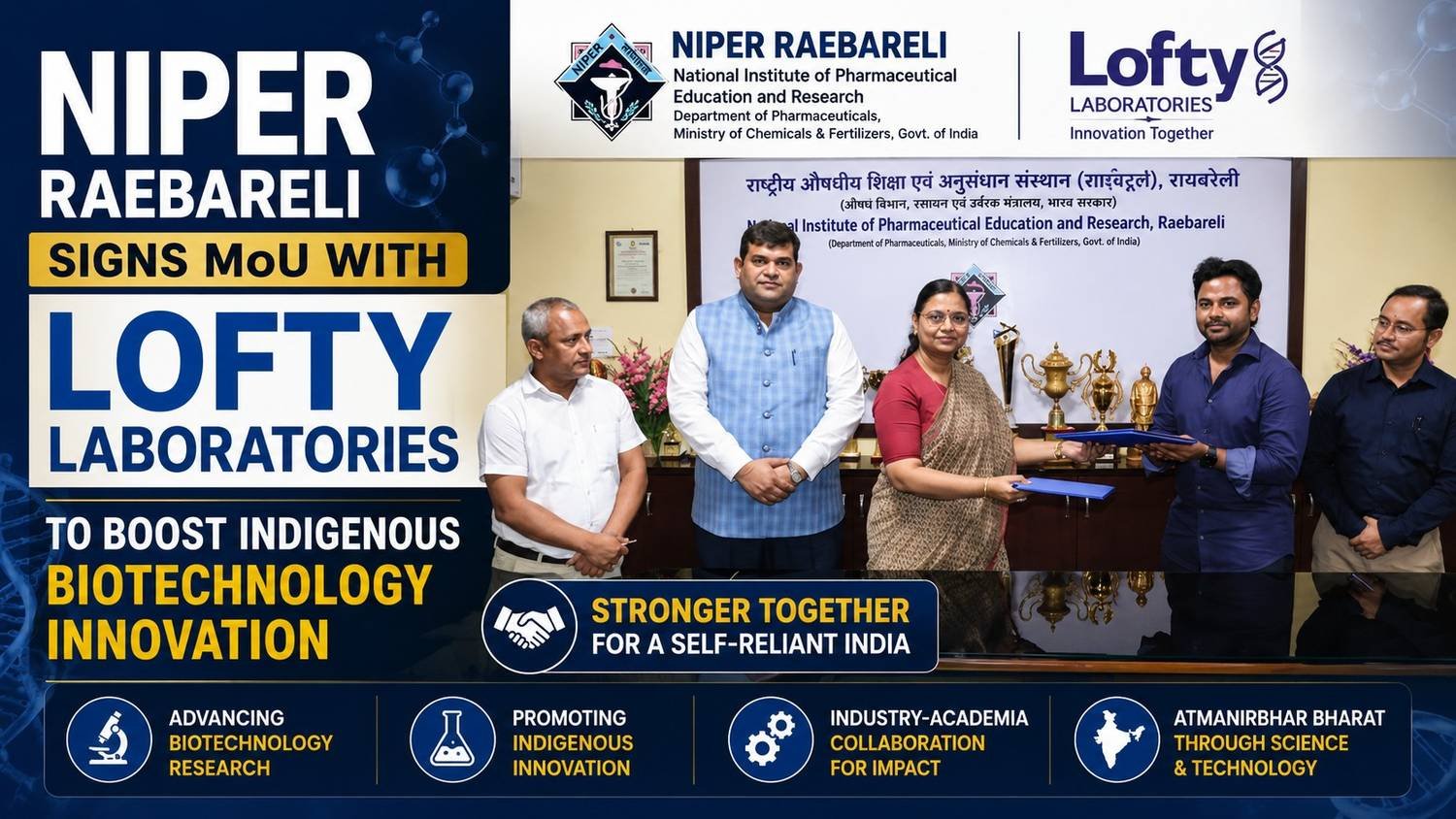
National Institute of Pharmaceutical Education and Research Raebareli (NIPER-Raebareli) has signed a Memorandum of Understanding (MoU), Confidential Disclosure Agreement (CDA), and Technology Transfer Agreement with Lofty Laboratories, Hyderabad.
The agreement aims to strengthen collaboration in pharmaceutical and biotechnology research, innovation, and commercialization of indigenous technologies.
Strengthening Academia-Industry Partnerships
The collaboration represents an important step toward promoting stronger partnerships between academic institutions and industry players in India’s pharmaceutical and biotechnology sectors.
Under the agreement, both organisations will work together on:
- Research and development projects
- Technology commercialization
- Innovation-driven collaborations
- Joint scientific activities in areas of mutual interest
The partnership also aims to accelerate the transfer of laboratory-developed technologies into commercially viable products.
Commercialization of Indigenous Technology
During the signing ceremony, both institutions agreed to adopt an industry-ready technology developed at NIPER-Raebareli for further commercialization and industrial development.
The initiative is expected to support India’s broader goal of strengthening indigenous scientific innovation and reducing dependence on imported biotechnology products.
Focus on Affordable Gel-Staining Technology
Commercialization of the current technology could significantly reduce the cost of gel-staining agents.
These agents are widely used in biological and biomedical research, especially in studies involving:
- Genes
- Cancer research
- Nucleic acid-related diseases
The development of affordable indigenous alternatives is expected to lower research costs and improve accessibility for laboratories and research institutions.
Boost for India’s Biotechnology Sector
According to NIPER officials, indigenous production of advanced gel-staining agents will contribute significantly to strengthening India’s pharmaceutical and biotechnology ecosystem.
The collaboration is expected to support:
- Domestic technology development
- Research commercialization
- Innovation-driven manufacturing
- Growth of India’s biotech industry
Importance of Technology Transfer Agreements
Technology transfer agreements play a crucial role in bridging the gap between academic research and industrial application.
Such collaborations help ensure that innovations developed in research institutions are transformed into practical and commercially scalable solutions that benefit industry, healthcare, and society.
Supporting India’s Innovation and Self-Reliance Goals
The NIPER-Raebareli and Lofty Laboratories partnership aligns with India’s broader focus on:
- Indigenous innovation
- Research commercialization
- Biotechnology advancement
- Self-reliance in scientific technologies
The agreement highlights the growing importance of collaboration between academia and industry in building a globally competitive pharmaceutical and biotechnology ecosystem in India.