

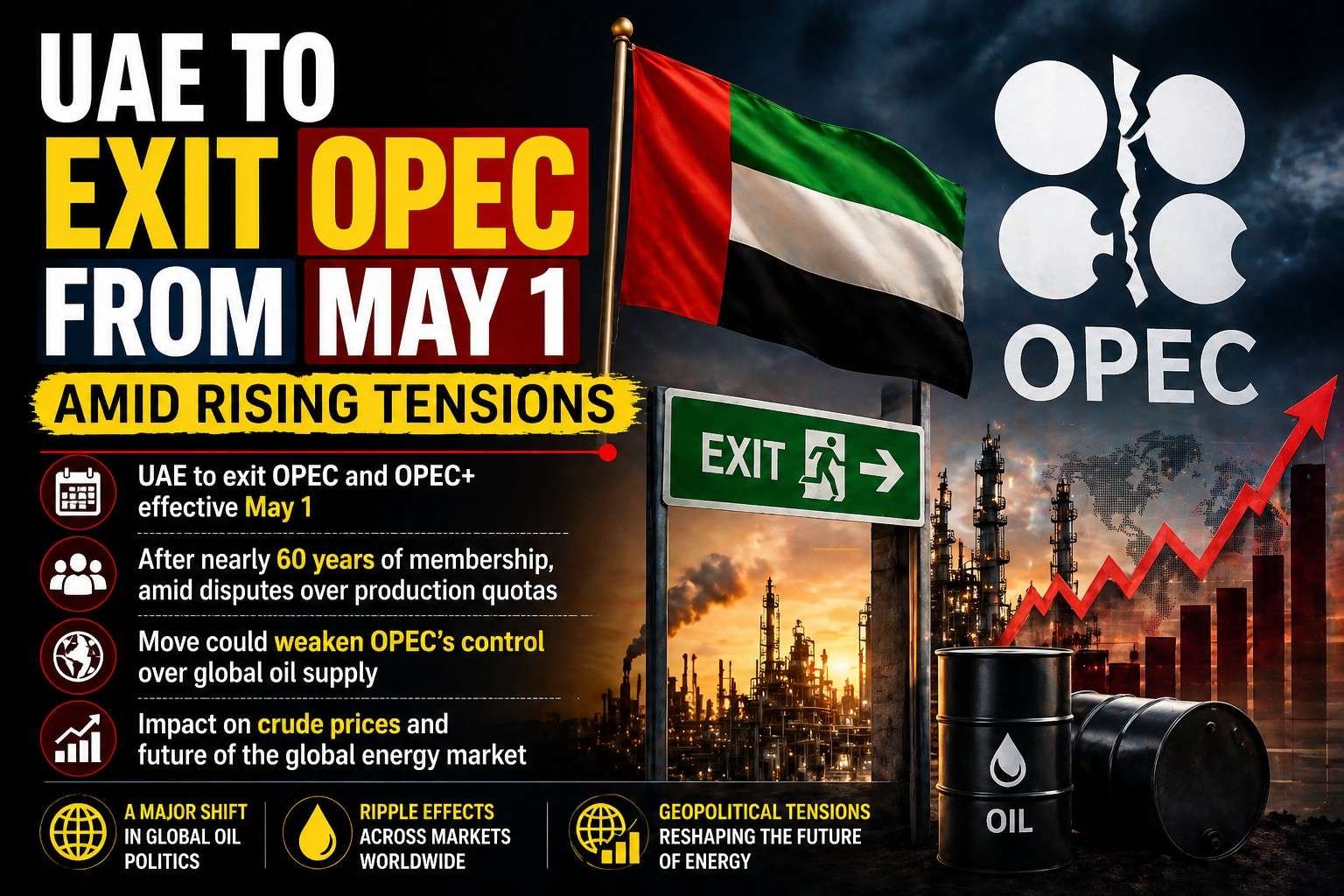
In a historic shift for the global energy landscape, the United Arab Emirates has announced it will exit OPEC and the wider OPEC+ alliance, effective May 1, 2026. This decision ends nearly 60 years of membership for the UAE, which has served as the cartel’s third-largest producer.
The announcement comes amidst a period of extreme volatility in the Middle East, including the ongoing Strait of Hormuz crisis and recent conflict involving Iran, which has seen the UAE targeted by missile and drone attacks.
Why Is UAE Leaving OPEC?
The decision comes after a comprehensive review of its production strategy and future capacity goals. According to UAE’s Energy Ministry, exiting OPEC aligns better with the country’s long-term national interests.
Energy Minister Suhail Al Mazrouei stated that the timing of the exit was carefully chosen to ensure:
- Minimal disruption to global oil prices
- Limited impact on OPEC and allied producers
- Greater flexibility for UAE’s production plans
The UAE aims to expand its oil production capacity to 5 million barrels per day by 2027, which requires more independent decision-making.
Geopolitical Tensions Behind the Move
The announcement comes amid escalating tensions in the region, particularly involving Iran, which is also an OPEC member.
Recent developments include:
- Missile and drone attacks targeting the UAE
- Disruptions to oil shipping routes
- Increased risks in the Strait of Hormuz, a critical global oil transit route
These factors have significantly affected the UAE’s ability to export oil smoothly, adding pressure on its economy.
UAE’s Role in OPEC
The UAE has been a key member of OPEC for nearly six decades:
- Membership dates back to 1967 (via Abu Dhabi)
- One of the most influential voices in production decisions
- Third-largest oil producer in OPEC, after Saudi Arabia and Iraq
Its exit marks a major shift within the organization, potentially impacting how global oil supply is coordinated.
About OPEC and OPEC+
- OPEC is a cartel of major oil-producing nations formed in 1960 to coordinate petroleum policies and stabilize prices, while OPEC+ is a broader alliance created in 2016 that includes non-OPEC producers like Russia.
- Full name: Organisation of the Petroleum Exporting Countries
- Founded: September 1960 in Baghdad by Iran, Iraq, Kuwait, Saudi Arabia, Venezuela
- Headquarters: Vienna, Austria (since 1965)
- Purpose: Coordinate petroleum policies, stabilize oil prices, ensure fair returns for producers, and secure reliable supply for consumers.
- Current members (post-UAE exit): Algeria, Republic of the Congo, Equatorial Guinea, Gabon, Iran, Iraq, Kuwait, Libya, Nigeria, Saudi Arabia, Venezuela.
- OPEC (12 Members): Saudi Arabia (Leader), Iran, Iraq, Kuwait, Venezuela (Founding Members); Algeria, Congo, Equatorial Guinea, Gabon, Libya, Nigeria, and the UAE (leaving May 1).
- OPEC+ (10 Non-OPEC Allies): Russia, Azerbaijan, Bahrain, Brunei, Kazakhstan, Malaysia, Mexico, Oman, South Sudan, and Sudan.
Conclusion:
The UAE’s decision to leave OPEC reflects a strategic shift toward energy independence and long-term capacity expansion. While geopolitical tensions played a role, the move is primarily aimed at giving the country more control over its oil production future.