

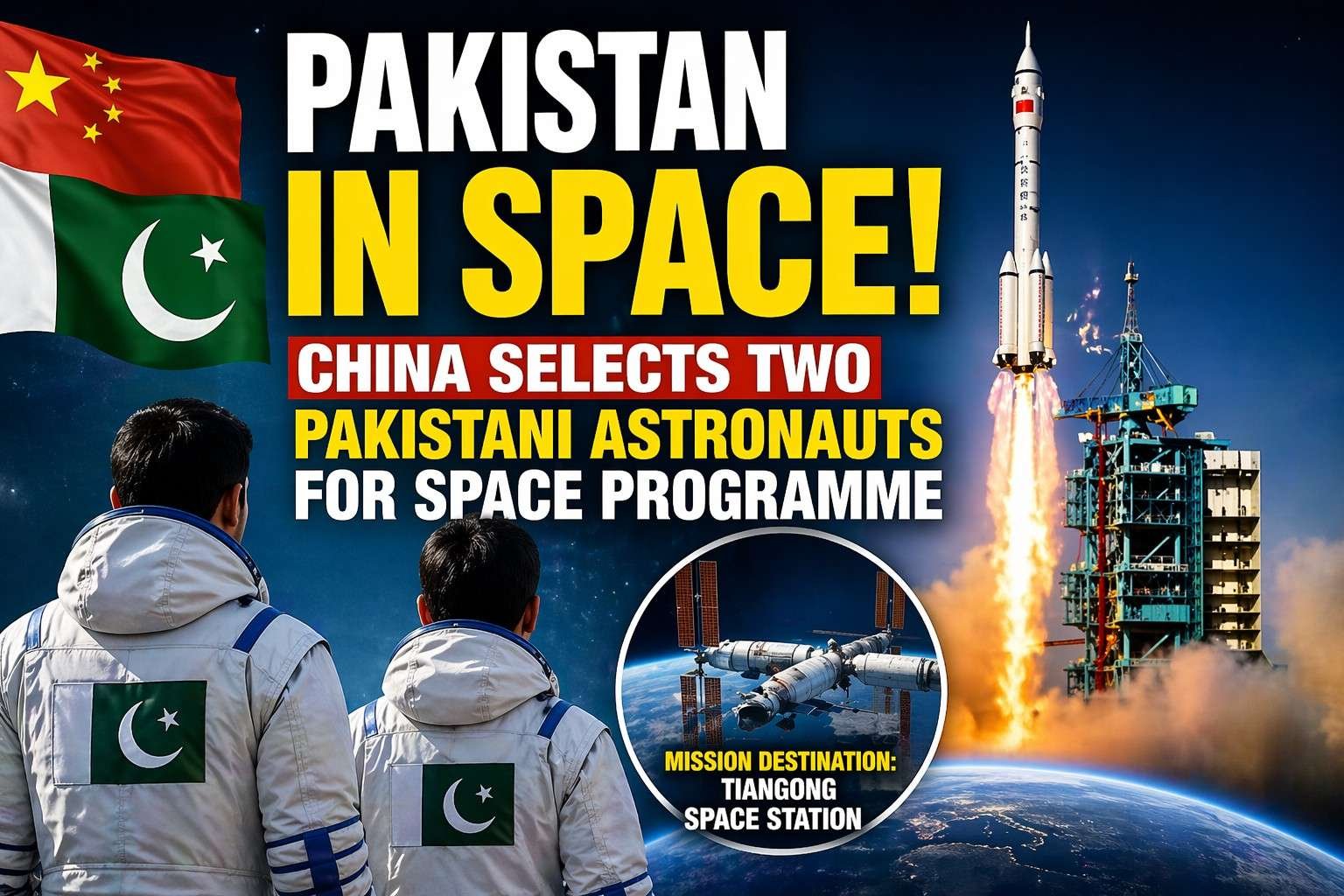
- China has selected two Pakistani astronauts for its human spaceflight programme. This marks the first time foreign astronauts have been chosen for China’s space missions, signaling a major shift in international cooperation.
- The two candidates, Muhammad Zeeshan Ali and Khurram Daud, will undergo rigorous training under the China Manned Space Agency.
- One of them is expected to become the first non-Chinese astronaut to visit the Tiangong Space Station, orbiting Earth at around 400 km altitude.
- The two men were selected after Beijing and Islamabad signed a cooperation agreement in February 2025, allowing Pakistani astronauts to take part in missions to the Chinese space station.
- China is planning to launch a Pakistani lunar rover to the moon as part of the Chang’e-8 mission, scheduled for 2028.
Significance of the Development:
1. Strengthening China–Pakistan Strategic Ties
- This mission deepens the long-standing “all-weather” partnership between China and Pakistan.
- Space collaboration adds a new dimension beyond economic and defense cooperation.
2. China’s Expanding Global Space Role
- China is emerging as a major alternative space power alongside the US and Russia.
- Opening its programme to foreign astronauts signals growing international ambitions.
3. Historic First for Pakistan
- Pakistan is set to send its first astronaut into space.
- A major boost for SUPARCO (Pakistan’s space agency) and STEM development.
4. Scientific & Technological Gains
- The selected astronaut will likely serve as a payload specialist, conducting experiments in space.
Key Facts for Exams:
- Focus Keyword: China selects two Pakistani astronauts for space programme
- Two Pakistani candidates selected:
- Muhammad Zeeshan Ali
- Khurram Daud
- Selected by: China Manned Space Agency (CMSA)
- Mission destination: Tiangong Space Station
- One astronaut will be chosen as a payload specialist
- First foreign astronauts in China’s space programme
- Selection involved multi-stage screening process
- Training to take place in China
- Likely mission timeline: 2026–2027
Conclusion:
The selection of two Pakistani astronauts represents a turning point in global space diplomacy. It highlights China’s intent to transform its space programme into a multinational platform, similar to the International Space Station model.