

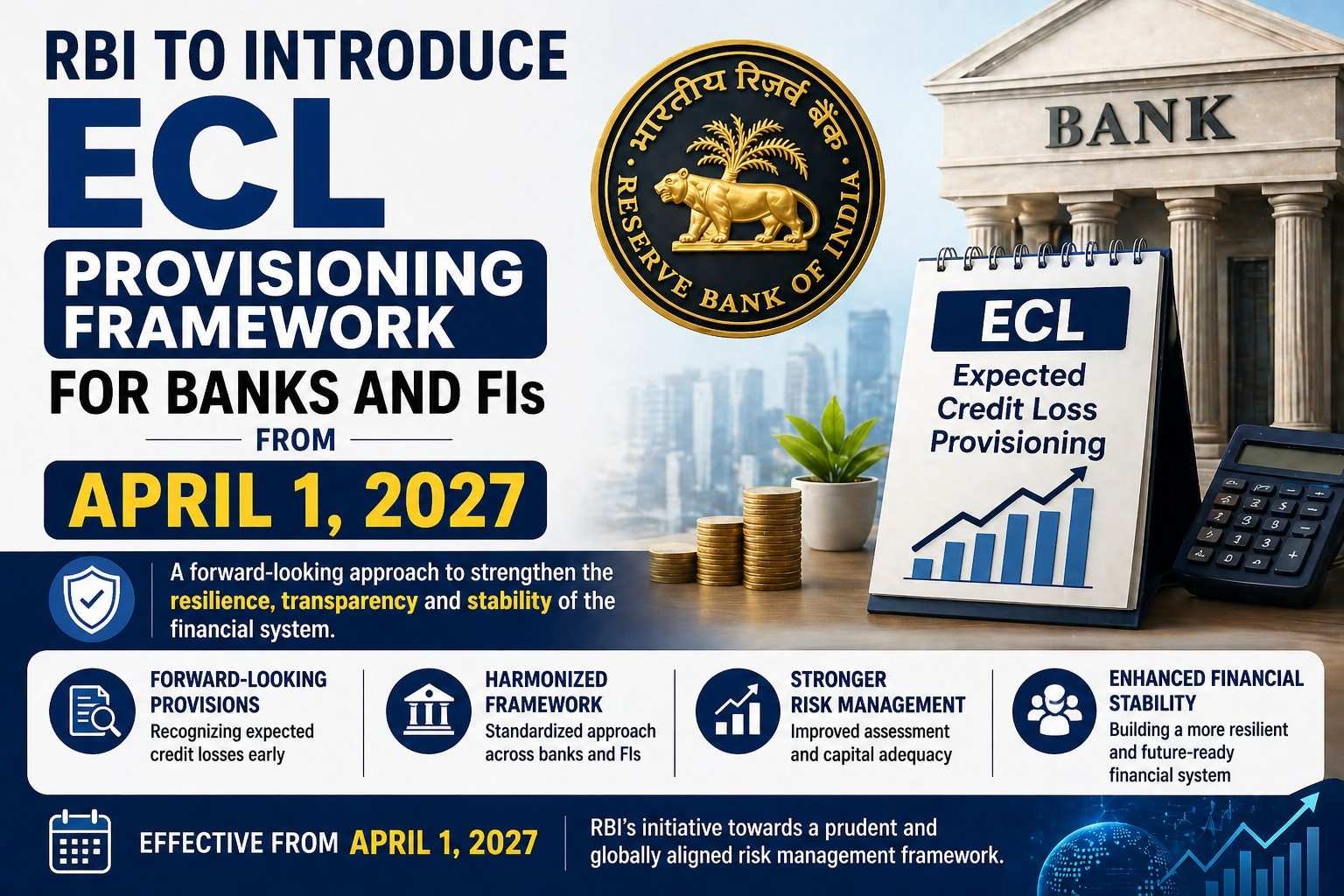
In a landmark move to strengthen India’s banking system, the Reserve Bank of India has announced that banks and financial institutions will adopt the Expected Credit Loss (ECL) provisioning framework from April 1, 2027.
The move replaces the current incurred-loss-based provisioning model with a more proactive and forward-looking system.
What is the ECL Framework?
The Expected Credit Loss (ECL) approach requires banks to make provisions in advance, based on the expected probability of default, instead of waiting for a loan to become a Non-Performing Asset (NPA).
This means banks will identify stress earlier and build financial buffers proactively.
New 3-Stage Asset Classification System
Under the ECL framework, banks will classify loans into three stages:
Stage 1: Low-Risk Loans
Loans with no significant increase in credit risk since initial recognition.
➡ Provisioning based on 12-month expected credit loss.
Stage 2: Increased Risk Loans
Loans where credit risk has increased significantly but are not yet impaired.
➡ Provisioning based on lifetime expected credit loss.
Stage 3: Impaired Loans
Loans that are credit-impaired or stressed.
➡ Provisioning based on lifetime expected credit loss.
This staging model aligns India’s banking system with global best practices.
Existing NPA Norms Will Continue
The RBI clarified that existing NPA classification norms will continue.
For example:
- A term loan overdue for more than 90 days will still be classified as an NPA.
So, ECL classification and NPA classification will run in parallel.
Additional Early Warning Indicators
Banks and FIs will also need to introduce more Early Warning Indicators (EWIs) to detect stressed assets earlier.
These may include:
- Delayed repayments
- Credit rating downgrades
- Sectoral stress signals
- Cash flow deterioration
This will improve credit monitoring.
Why RBI is Introducing ECL
The objective is to:
- Improve transparency
- Strengthen risk management
- Increase comparability of bank financial statements
- Align Indian norms with global standards like IFRS 9
It will make the banking sector more resilient.
Challenges for Banks
Experts believe banks will need to work hard to prepare for the transition.
Banks may need to:
- Build historical credit databases
- Develop risk models
- Upgrade IT systems
- Train staff
The shift may also increase provisioning requirements and impact capital adequacy ratios.
Transition Relief for Banks
To ease the one-time impact, RBI has provided:
- A calibrated transition framework
- A glide path till March 31, 2031 for some impacts
- Transitional arrangements for capital impact
This gives banks time to adjust.
Conclusion
The introduction of the Expected Credit Loss (ECL) framework by the Reserve Bank of India marks one of the biggest banking reforms in recent years. By shifting from a reactive to a proactive provisioning model, RBI aims to strengthen the resilience, transparency, and stability of India’s banking sector.