

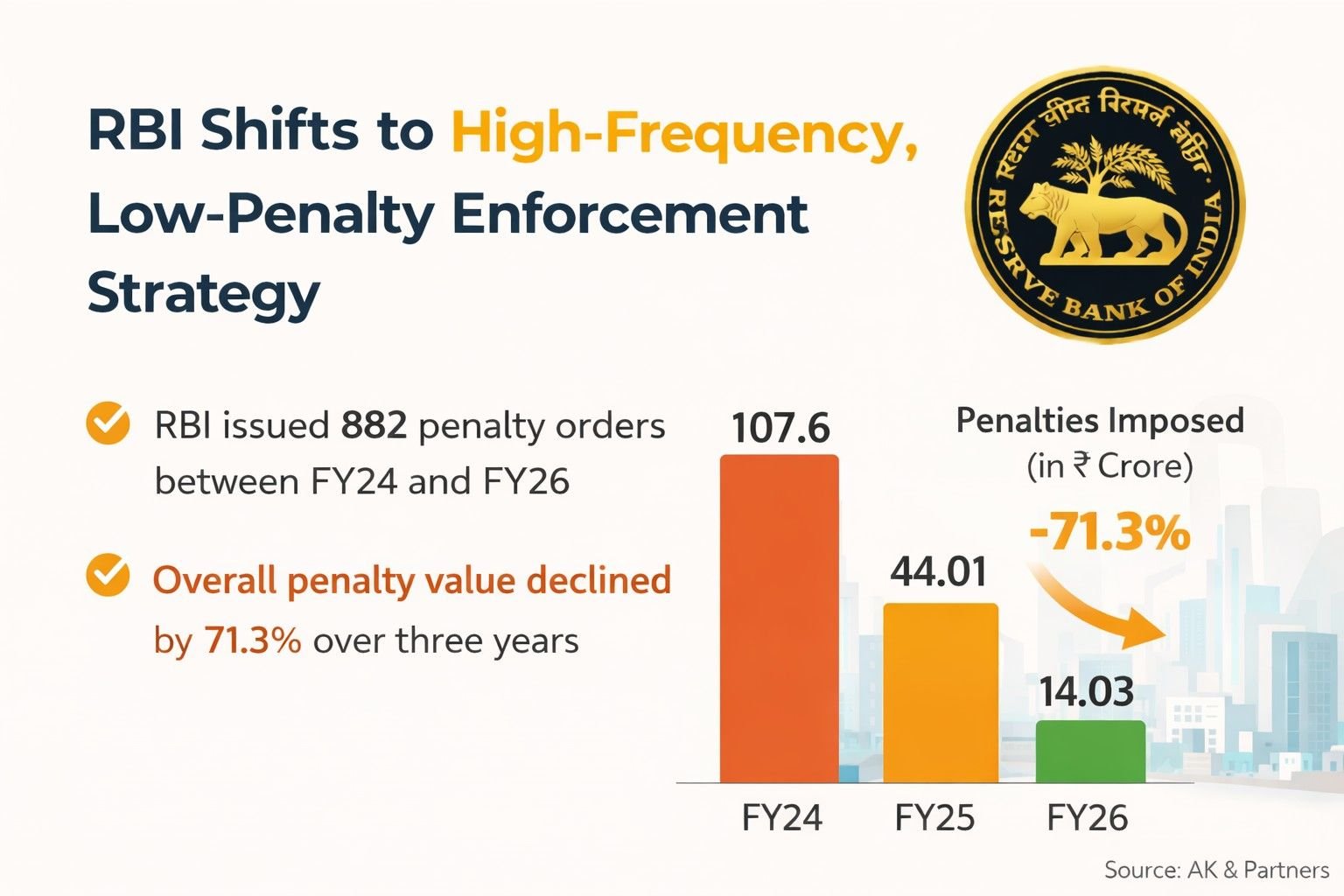
The Reserve Bank of India (RBI) is undergoing a major shift in its regulatory approach, moving towards frequent enforcement actions with smaller penalties instead of imposing large one-time fines.
This trend reflects a structural transformation in supervision, where the focus is on continuous compliance monitoring rather than occasional punitive action.
Decline in Penalty Amount, Not Enforcement
According to a report by AK & Partners:
- RBI issued 882 penalty orders between FY24 and FY26
- Total penalties amounted to around ₹166 crore
- Overall penalty value declined by 71.3% over three years
Year-wise Data:
- FY24: 305 orders → ₹87.40 crore
- FY25: 333 orders → ₹53.92 crore
- FY26: 245 orders → ₹25.07 crore
Despite the fall in penalty amounts, enforcement activity remained high, indicating redistribution—not reduction—of regulatory intensity.
Shift in Enforcement Strategy
A key trend is the move from large penalties to repeated smaller actions:
- Over 90% of penalties now fall below ₹1 crore
- Strong clustering under ₹50 lakh
- High-value penalties (above ₹1 crore) have nearly disappeared
This approach aims to:
- Ensure continuous monitoring
- Drive behavioural correction
- Prevent violations at an early stage
Focus Areas of RBI Supervision
1. Commercial Banks
- FY26 shows increased focus on commercial banks
- Larger institutions face greater regulatory scrutiny due to systemic importance
2. NBFCs
- Enforcement orders:
- FY24: 27 → FY25: 48 → FY26: 31
- Penalties sharply declined:
- ₹12.41 crore → ₹7.48 crore → ₹1.8 crore
- Average penalty reduced to ~₹5.8 lakh per order
This indicates earlier intervention and continuous supervision.
3. Cooperative Banks
- Account for 70–75% of total enforcement cases
- But contribute only 15–26% of total penalty value
4. Banks (Public & Private)
- Private banks: penalties down 67.3%
- Public sector banks: penalties down 58.8%
- Typical penalty range: ₹10 lakh – ₹75 lakh
5. Payment Entities
- Shift from large one-time penalties to multiple smaller penalties
- Example:
- FY24: One penalty above ₹5 crore
- FY26: Five penalties totaling ₹0.89 crore
Rising Use of Stronger Deterrents
- Cancellation of licenses is emerging as a more powerful enforcement tool
- Registration cancellations increased:
- 167 (FY24) → 181 (FY26)
Common Violations
Across all entities, the most frequent violations include:
- KYC non-compliance
- Breach of exposure norms
- Loans to directors/related parties
- Deposit-related violations
- Interest rate irregularities
Geographical Trends
- Maharashtra emerged as the top enforcement hub
- Accounted for:
- 288+ penalties
- ₹73.58 crore in fines
- Increasing cases related to loan and advance irregularities
Future Outlook
RBI’s enforcement focus is expected to shift towards:
- Digital lending risks
- Cybersecurity resilience
- Outsourcing and fintech partnerships
Conclusion
The RBI’s evolving strategy signals a clear shift from “high penalties, low frequency” to “low penalties, high frequency.”
This model emphasizes:
- Continuous compliance
- Early detection of risks
- Sustained regulatory engagement
For financial institutions, this means compliance is no longer occasional—it must be consistent, proactive, and deeply embedded in operations.