

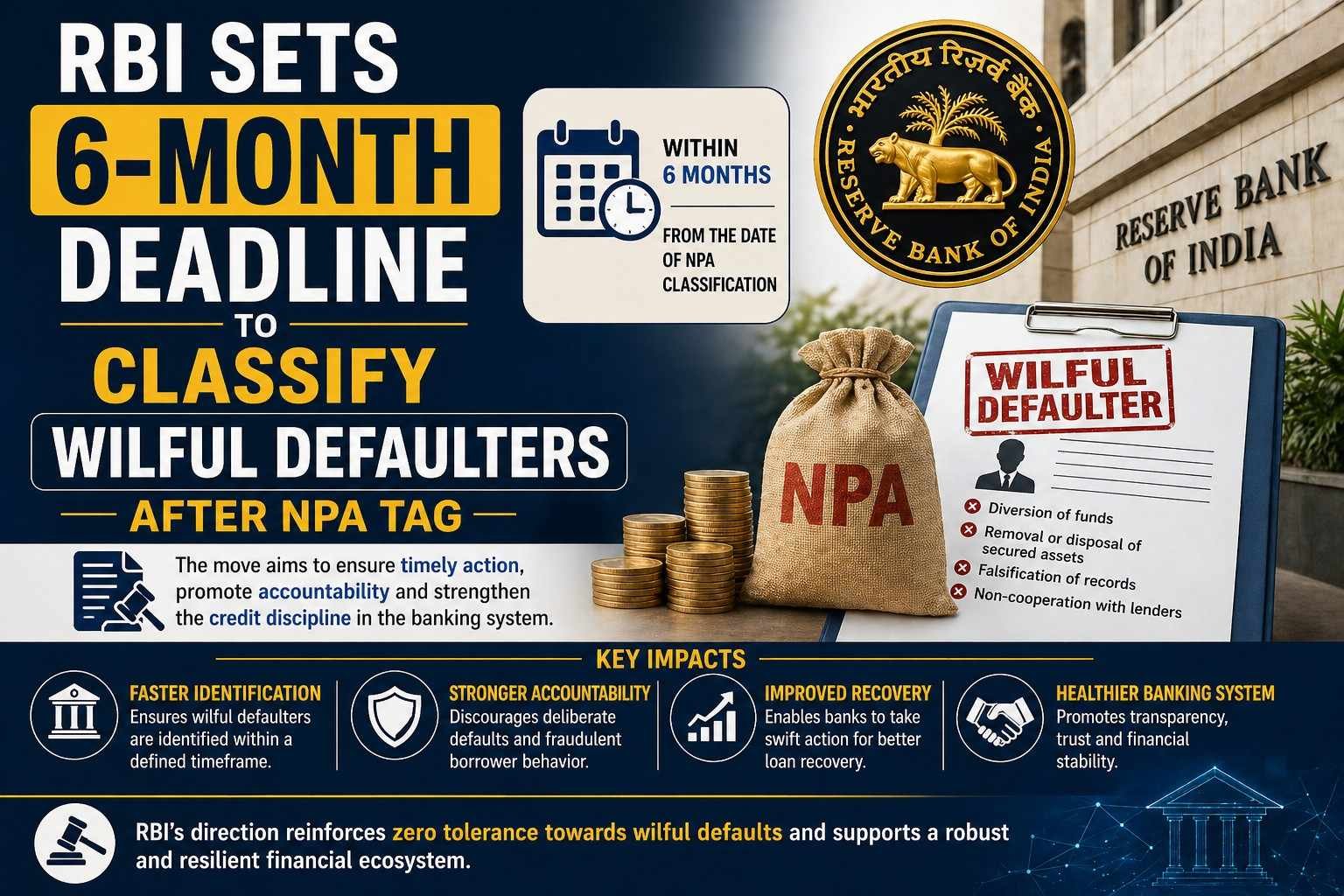
In a major move to strengthen credit discipline and accountability, the Reserve Bank of India has directed banks to complete the process of classifying a borrower as a wilful defaulter within six months of the account being tagged as a Non-Performing Asset (NPA).
The amended guidelines will come into effect from April 1, 2027.
What is a Wilful Defaulter?
A borrower is classified as a wilful defaulter if they fail to repay despite having the capacity or engage in misuse of borrowed funds.
This includes cases where the borrower:
- Fails to repay despite having repayment capacity
- Diverts funds for purposes other than sanctioned use
- Siphons off funds
- Disposes of or removes secured assets without lender approval
These actions indicate deliberate default rather than genuine financial stress.
New RBI Guidelines
Under the new amendment directions on Commercial Banks – Treatment of Wilful Defaulters and Large Defaulters, banks must act quickly.
Internal Preliminary Screening
If wilful default is observed during internal preliminary screening:
➡ The bank must initiate the classification process.
6-Month Deadline
The borrower must be classified or declared a wilful defaulter within 6 months of the account becoming an NPA.
This ensures faster action and improved recovery efforts.
Objective of the New Rules
The RBI aims to:
- Strengthen credit discipline
- Improve accountability of borrowers
- Prevent misuse of borrowed funds
- Improve loan recovery process
- Deter intentional defaults
What is Non-Performing Asset (NPA)?
A Non-Performing Asset (NPA) is a loan or advance given by a bank or financial institution that stops generating income because the borrower fails to repay interest or principal for more than 90 days.
In India, the Reserve Bank of India (RBI) uses this 90-day overdue rule to classify NPAs.
Key Points About NPAs
- Definition: Any loan where repayment of interest or principal is overdue for 90+ days.
- Impact on Banks: NPAs reduce profitability, weaken lending capacity, and increase risk of defaults.
- Reason Loans = Assets: For banks, loans are assets because they generate income through interest. When payments stop, the asset becomes “non-performing.”
Types of NPAs
| Category | Criteria | Meaning |
|---|---|---|
| Sub-Standard Assets | NPA for ≤ 12 months | Early-stage default, still recoverable |
| Doubtful Assets | NPA for > 12 months | High risk of non-recovery |
| Loss Assets | Considered irrecoverable | Minimal or no recovery possible |
Conclusion
The new directive by the Reserve Bank of India to classify wilful defaulters within six months of NPA recognition is a major step toward improving credit discipline and strengthening India’s banking system. It sends a strong message against intentional defaults and financial misconduct.