

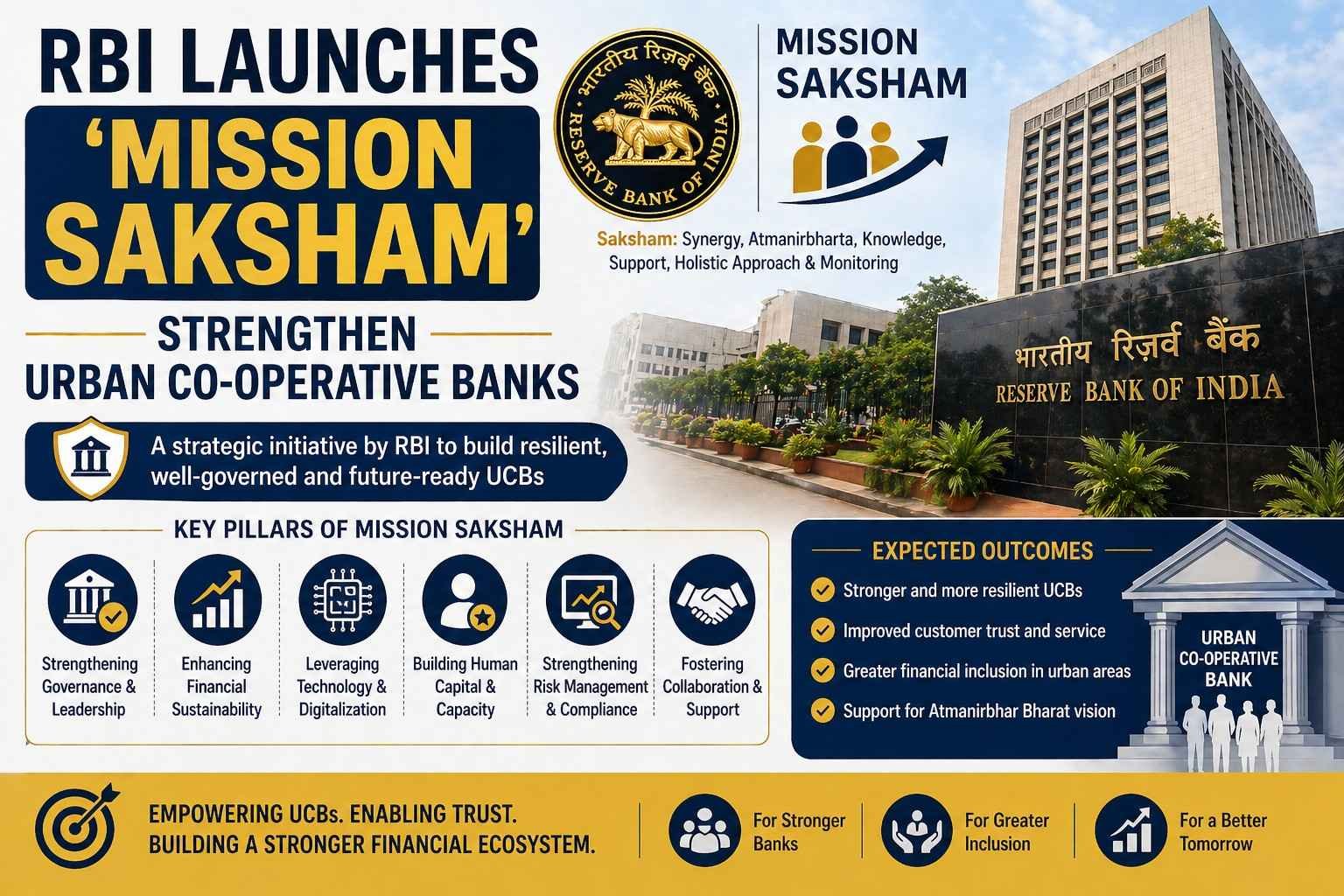
In a significant move to strengthen India’s Urban Co-operative Banking sector, the Reserve Bank of India has launched Mission SAKSHAM (SAhkari Bank KSHamta Nirman), a nationwide capacity-building and training initiative for Urban Co-operative Banks.
The mission was launched in a mission-mode and sector-wide approach, covering UCBs across India.
Key Details of the Initiative:
Core Objective: To develop professionally qualified and competent bankers within the cooperative sector through a structured process of education, training, examination, and consultancy.
Certification Framework: The mission aims to establish a standardized certification process to ensure that staff and management at UCBs possess the necessary skills to handle modern banking challenges.
Regulatory Context: This initiative is part of a broader effort to professionalize the cooperative banking sector. In line with these goals, the RBI has also designated a specific Nodal Officer to facilitate regular interaction and coordination with UCBs.
Timeline: While the framework is being deployed, several related regulatory changes for UCBs are slated for completion or implementation by March 31, 2026, including achieving specific Priority Sector Lending (PSL) targets.
What is Mission SAKSHAM?
Mission SAKSHAM is designed to improve the managerial, operational, and governance capabilities of Urban Co-operative Banks.
The initiative aims to:
- Enhance managerial and operational efficiency
- Improve compliance culture and regulatory adherence
- Strengthen institutional resilience
- Build a culture of continuous learning and development
- Support the healthy growth of the UCB sector
Objective of the Initiative
According to RBI, Mission SAKSHAM seeks to create a self-reinforcing and sustainable learning ecosystem within the co-operative banking sector.
This will contribute to:
- Systemic stability in the banking system
- Long-term institutional development
- A stronger and healthier Urban Co-operative Banking ecosystem
Key Points
- Mission Name: Mission SAKSHAM
- Full Form: SAhkari Bank KSHamta Nirman
- Launched By: Reserve Bank of India
- Target Sector: Urban Co-operative Banks
- Purpose: Training and capacity building
- Focus Areas: Governance, operations, compliance, resilience
Broader Regulatory Reforms for UCBs:
Alongside Mission SAKSHAM, the RBI has implemented several measures to support the growth and stability of UCBs:
Expansion Freedom: UCBs meeting certain criteria can now open new branches (up to 10% of their existing branch network) without seeking prior approval from the RBI.
Increased Lending Limits: The individual housing loan limits for UCBs have been doubled, increasing from ₹30 lakh to ₹60 lakh.
Deposit Insurance Changes: Effective April 1, 2026, the flat-rate premium system for deposit insurance will be replaced by a Risk-based Premium (RBP) framework. This model will use two risk assessment tiers to determine premiums, rewarding banks with a “vintage incentive” for long-term stability without claims.
This initiative reflects RBI’s continued focus on strengthening the co-operative banking sector and improving the overall health of India’s financial system.