

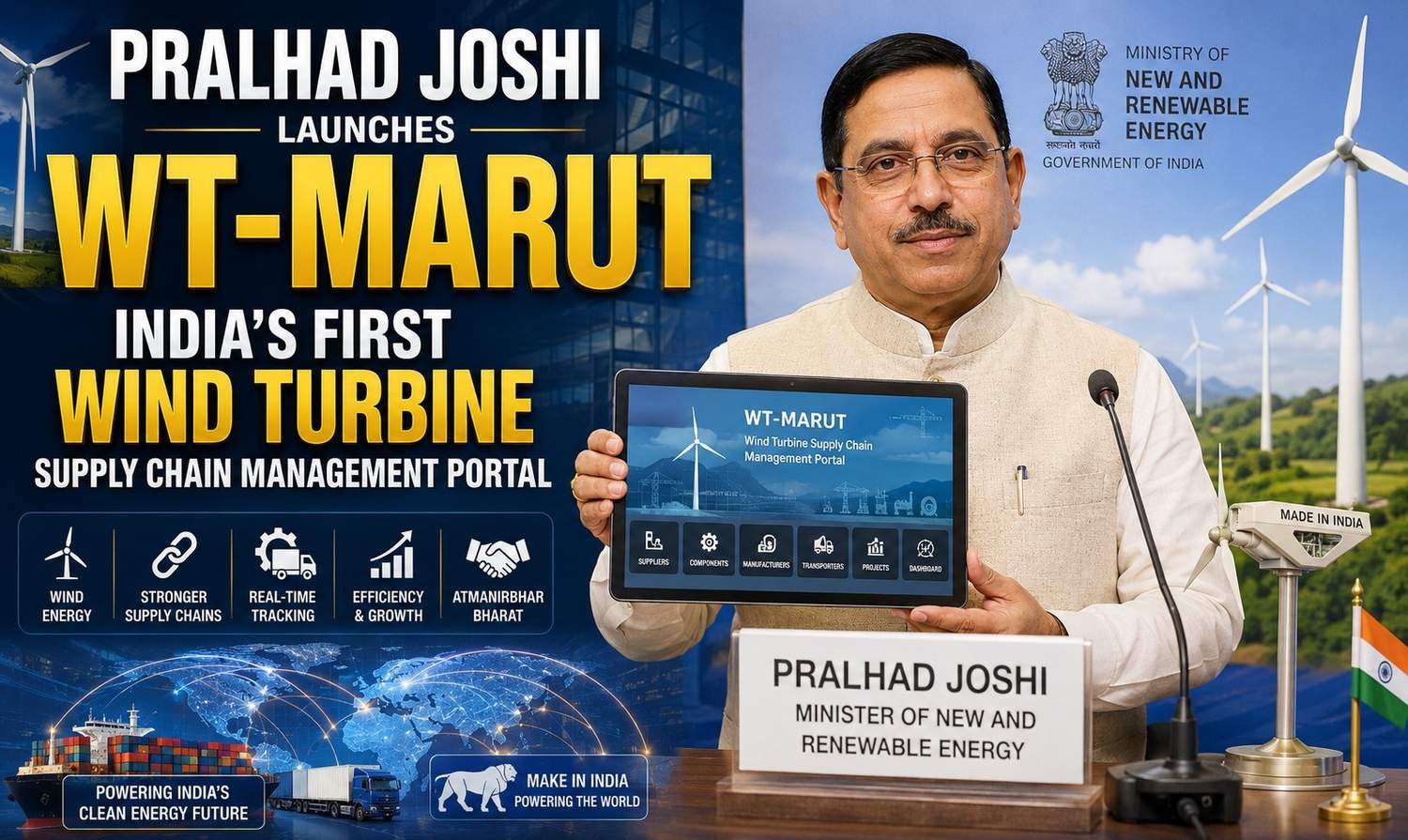
- Union Minister for New and Renewable Energy Pralhad Joshi launched the Wind Turbine Supply Chain Management (WT-MARUT) Portal, the country’s first dedicated digital platform for wind supply chain management.
- The portal was launched at the Global Wind Day Conference in Goa and is expected to improve supplier visibility, promote domestic manufacturing and enhance India’s competitiveness in global wind energy markets.
- Developed under the aegis of the Ministry of New and Renewable Energy (MNRE) with support from the Indian Wind Turbine Manufacturers Association (IWTMA), WT-MARUT aims to create an integrated digital ecosystem for India’s wind industry.
What is WT-MARUT?
WT-MARUT is India’s first dedicated digital platform designed specifically for managing the wind turbine supply chain.
The portal will:
- Provide visibility into component sourcing.
- Enable supplier discovery and qualification.
- Strengthen collaboration among manufacturers and suppliers.
- Support domestic sourcing requirements under the ALMM framework.
- Improve export readiness.
- Ensure secure hosting of industry data within India.
The platform is expected to enhance efficiency, transparency and resilience across the wind energy value chain.
The portal is expected to support the government’s vision of:
- Aatmanirbhar Bharat
- Make in India
- Clean energy transition
- Strengthening renewable energy manufacturing
India’s Wind Energy Sector Gaining Momentum
The launch comes at a time when India’s wind energy sector is witnessing record growth.
According to official figures:
- India added a record 6.1 GW of wind power capacity in FY26.
- The addition marked the highest-ever annual wind installation in the country’s history.
- Wind installations increased by 46% year-on-year.
India currently has:
- 56.1 GW of installed wind energy capacity.
- The status of the world’s fourth-largest wind energy market.
However, despite this progress, less than 5% of India’s estimated wind potential of 1,164 GW has been utilised so far.
India Targets 100 GW Wind Capacity by 2030
Industry experts and government institutions believe that wind energy will play a crucial role in India’s energy transition.
Stakeholders such as:
- Central Electricity Authority (CEA)
- The Energy and Resources Institute (TERI)
- National Institute of Wind Energy (NIWE)
have recommended that India should achieve 100 GW of wind energy capacity by 2030 to ensure a sustainable and affordable energy transition.
Pralhad Joshi expressed confidence that the sector can achieve:
- 100 GW wind capacity by 2030
- 155 GW wind capacity by 2035
These targets are expected to significantly increase the share of renewable energy in India’s power mix.
Wind Turbine Exports Growing Rapidly
India is also emerging as an important exporter of wind turbine components and equipment.
According to a joint report by IWTMA and PwC:
- Wind turbine exports crossed ₹12,000 crore in FY26.
- Exports increased by nearly 50% compared to FY25.
- India’s global export share could rise to:
- 10% by 2030
- 20% by 2040
The WT-MARUT portal is expected to support this growth by making Indian manufacturers more globally competitive and improving supply chain coordination.
Role of ALMM Framework
The WT-MARUT portal will also assist companies in complying with the Approved List of Models and Manufacturers (ALMM) framework.
The ALMM mechanism aims to:
- Promote domestic manufacturing.
- Ensure quality standards.
- Increase supply chain transparency.
- Reduce dependence on imports.
By enabling better supplier identification and sourcing, the portal can help manufacturers meet regulatory requirements more efficiently.
Conclusion
The launch of WT-MARUT marks an important milestone in India’s renewable energy journey.
As the country’s first wind turbine supply chain management platform, it is expected to strengthen domestic manufacturing, enhance exports and support India’s ambitious clean energy targets.
With record installations, rising exports and ambitious capacity goals, India’s wind energy sector is poised for rapid growth, and WT-MARUT could become a key enabler of this transformation.