

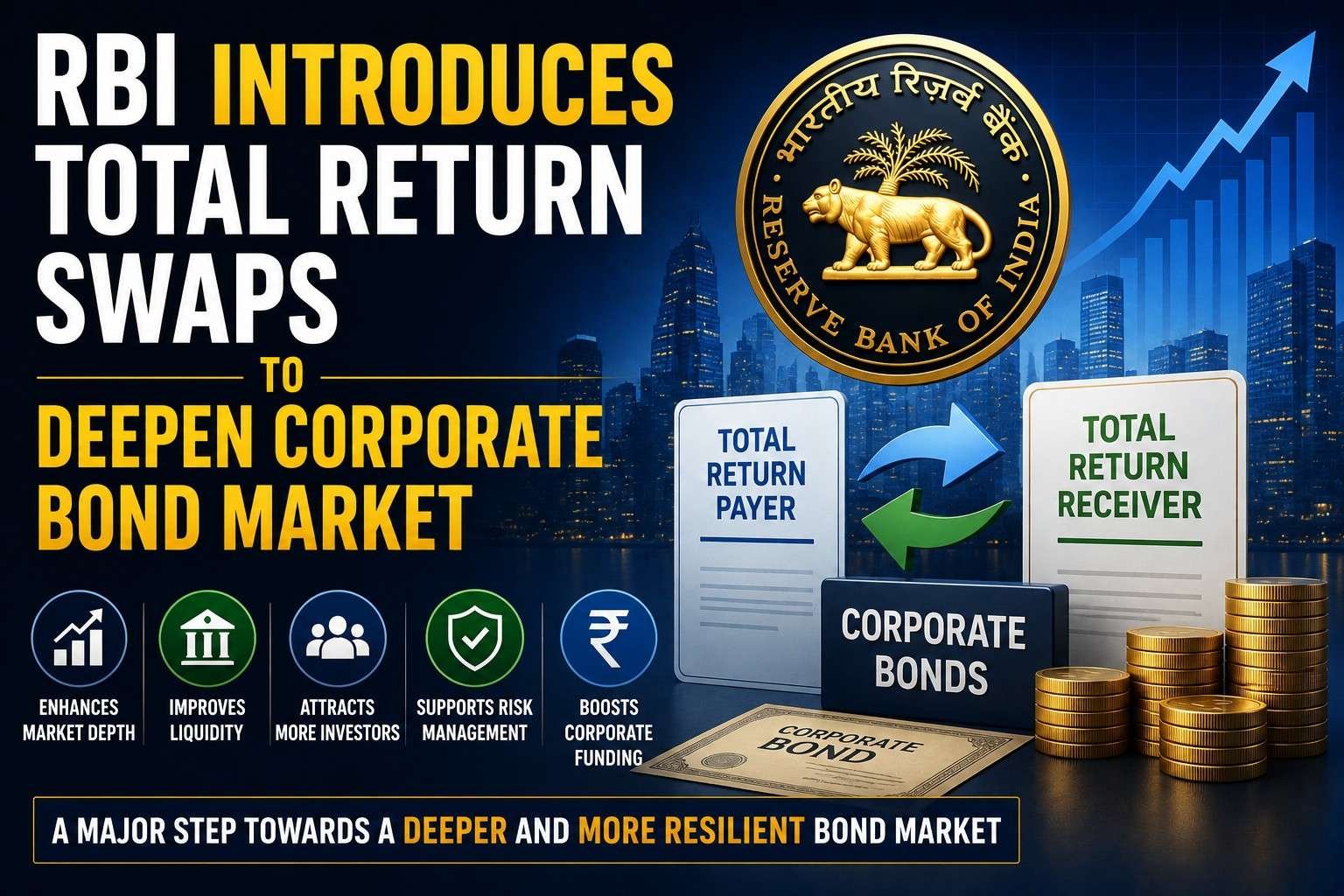
- The Reserve Bank of India (RBI) has introduced Total Return Swaps (TRS) and expanded participation in the credit derivatives market through its revised Credit Derivatives Directions, 2026.
- The move is aimed at improving credit risk management and deepening India’s corporate bond market.
- The new framework came into effect immediately after its notification.
What Has RBI Announced?
The RBI has introduced three major reforms:
- Introduction of Total Return Swaps (TRS).
- Wider participation in credit derivatives.
- Greater flexibility for resident non-retail participants.
These measures seek to improve liquidity, strengthen risk management, and support the development of India’s corporate debt market.
What are Total Return Swaps (TRS)?
A Total Return Swap is a financial derivative contract where one party transfers the total economic return of an asset to another party.
The total return includes interest income.
- Price appreciation.
- Credit gains or losses.
In exchange, the receiving party pays a predetermined financing cost.
TRS enables investors to transfer both:
- Credit risk.
- Market risk.
Until now, India allowed only Credit Default Swaps (CDS) in the over-the-counter market.
Difference Between CDS and TRS
| Feature | Credit Default Swap (CDS) | Total Return Swap (TRS) |
|---|---|---|
| Risk Covered | Credit risk only | Credit and market risk |
| Income Transfer | No | Yes |
| Price Risk | No | Yes |
| Underlying Return | Not transferred | Fully transferred |
| Usage | Default protection | Total risk transfer |
TRS provides greater flexibility compared to traditional CDS contracts.
Wider Participation Allowed
- Under the new framework, resident non-retail participants can Buy credit protection, Sell credit protection use CDS contracts and use TRS contracts.
- Importantly, RBI has removed earlier restrictions that linked participation to existing underlying exposures.
- This gives institutions more freedom in managing risk.
Eligible Market Makers
The RBI has permitted several institutions to act as market makers.
Eligible entities include:
- Scheduled commercial banks.
- Standalone primary dealers.
- Non-banking financial companies (NBFCs).
- Housing finance companies.
These entities can offer both CDS and TRS products in the over-the-counter market.
Objectives of the New Framework
- The RBI said the revised rules aim to deepen the corporate bond market, improve credit risk transfer, increase market participation, enhance liquidity, develop derivative markets and strengthen financial stability.
Impact on Financial Markets
The revised framework could:
- Improve price discovery.
- Enhance market efficiency.
- Expand risk-sharing opportunities.
- Attract institutional investors.
- Boost corporate bond issuances.
The move aligns India’s derivative markets with global practices.
Conclusion
The RBI’s introduction of Total Return Swaps marks a significant reform in India’s financial markets. By broadening participation and allowing new risk management tools, the central bank aims to strengthen the corporate bond market and create a more efficient credit risk transfer ecosystem.