

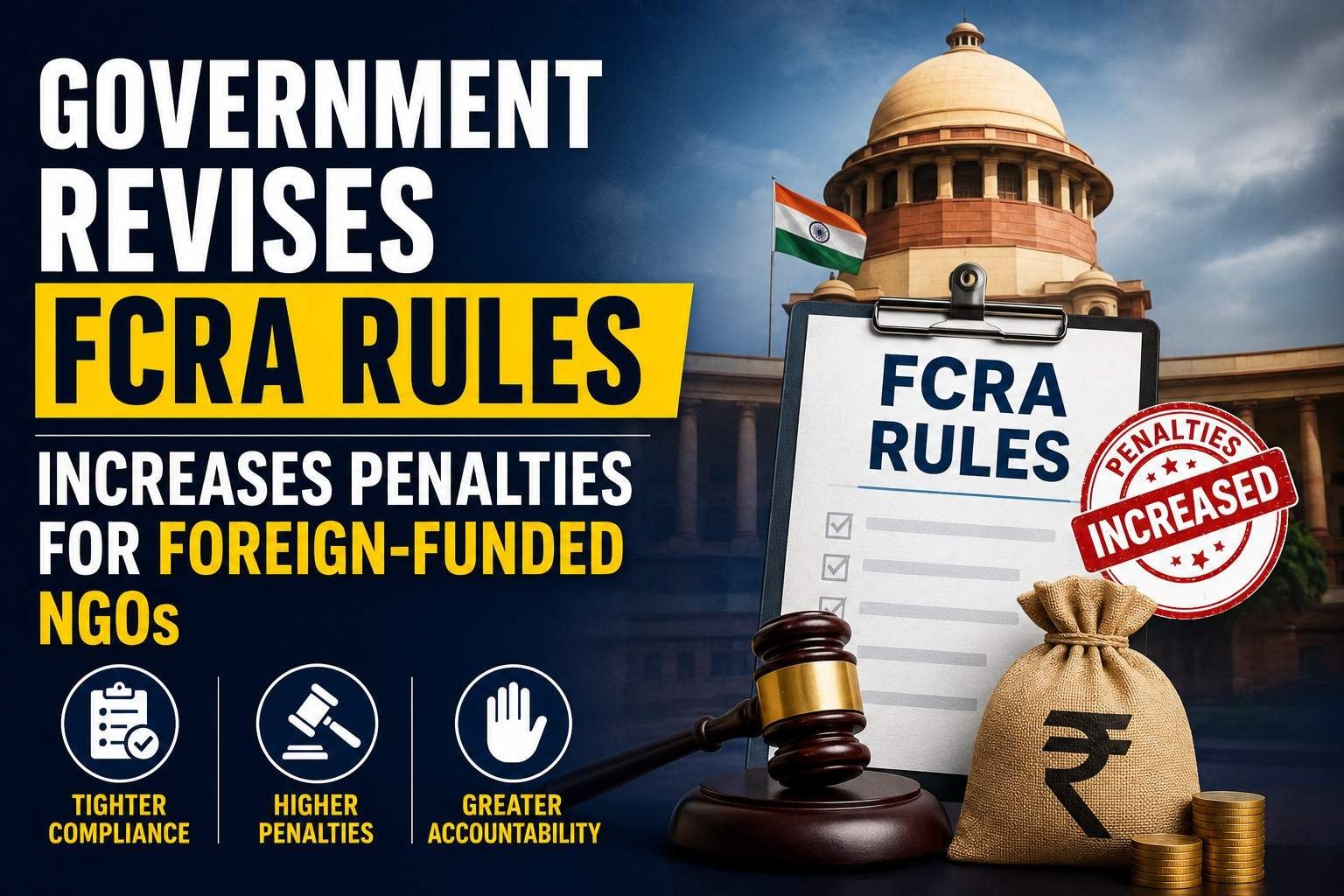
- The Ministry of Home Affairs has introduced major changes to the Foreign Contribution (Regulation) Act (FCRA) rules, significantly increasing penalties for violations and imposing stricter compliance requirements on non-governmental organizations (NGOs) receiving foreign funds.
- The new rules aim to improve transparency, accountability, and monitoring of foreign contributions received by organizations operating in India.
Higher Penalties for Violations
- Under the revised rules, NGOs violating provisions related to foreign contribution utilization will face substantially higher penalties.
- If administrative expenses exceed the permitted limit of 20 percent of foreign contributions, organizations will have to pay a penalty of ₹1 lakh or 5 percent of the excess expenditure, whichever is higher.
- Similarly, speculative investments made using foreign contributions will attract a penalty of ₹1 lakh or 30 percent of the amount invested, whichever is higher.
- Additionally, the government will recover 100 percent of any returns earned from such speculative activities.
Penalty for Misuse of Funds
- Organizations using foreign contributions for purposes other than those for which they were received will face penalties equal to 30 percent of the amount misused or ₹1 lakh, whichever is higher.
- The same penalty applies when foreign contributions are utilized in states or activities for which approval has not been granted.
Mandatory Declaration of Activities
Under the new rules, NGOs applying for registration must clearly specify:
- Purpose of activities.
- States and Union Territories of operation.
- Nature of work.
- Areas of intervention.
These details will become part of the registration certificate.
Organizations must choose their activities from predefined categories mentioned in the Schedule of the FCRA Rules.
Restrictions on Foreign Nationals
- The government has introduced new restrictions regarding foreign nationals serving as key functionaries.
- Associations having foreign nationals, except persons of Indian origin, as key office bearers ordinarily may not receive FCRA registration or prior permission.
- However, the government retains the power to grant exemptions in specific cases.
Social Media Disclosure Made Mandatory
- Organizations seeking registration or renewal must now provide details of their social media accounts.
- This measure aims to improve transparency and facilitate monitoring of organizational activities.
Religious Activities and Restrictions
The revised rules permit various faith-based activities, including:
- Maintenance of religious places.
- Religious education.
- Devotional programs.
- Preservation of traditions.
However, several activities have specifically been allowed only while excluding proselytization.
The restriction applies to:
- Religious education.
- Documentation of faith traditions.
- Preservation of indigenous beliefs.
- Tribal faith practices.
Minimum Spending Requirement
- To prevent inactive organizations from retaining licenses, the government has introduced a minimum expenditure condition.
- Organizations must spend at least ₹10 lakh of foreign contributions during the previous two financial years on approved activities to qualify for renewal.
Additional Fees Introduced
- The amended rules also introduce additional fees.
- Organizations seeking approval for additional states or additional purposes must pay ₹300 for each additional category.
Disclosure of Ultimate Donors
- If foreign funds are received through donor-advised funds or intermediary channels, NGOs must disclose the ultimate source of funding.
- This provision seeks to improve transparency regarding the original source of foreign contributions.
Detailed Annual Reporting
Annual returns must now include:
- Detailed activity reports.
- Financial statements.
- Program implementation reports.
- Utilization details.
Organizations must also declare books, publications, or media content produced by them.
Importance of FCRA
- The Foreign Contribution Regulation Act regulates the acceptance and utilization of foreign contributions by organizations and individuals in India.
- The law aims to ensure that foreign funding does not adversely affect national interests, public policy, or democratic processes.
Conclusion
- The revised FCRA framework represents one of the most significant regulatory changes for NGOs in recent years.
- The government believes the changes will improve accountability, transparency, and proper utilization of foreign funds while strengthening oversight of organizations receiving overseas contributions.