

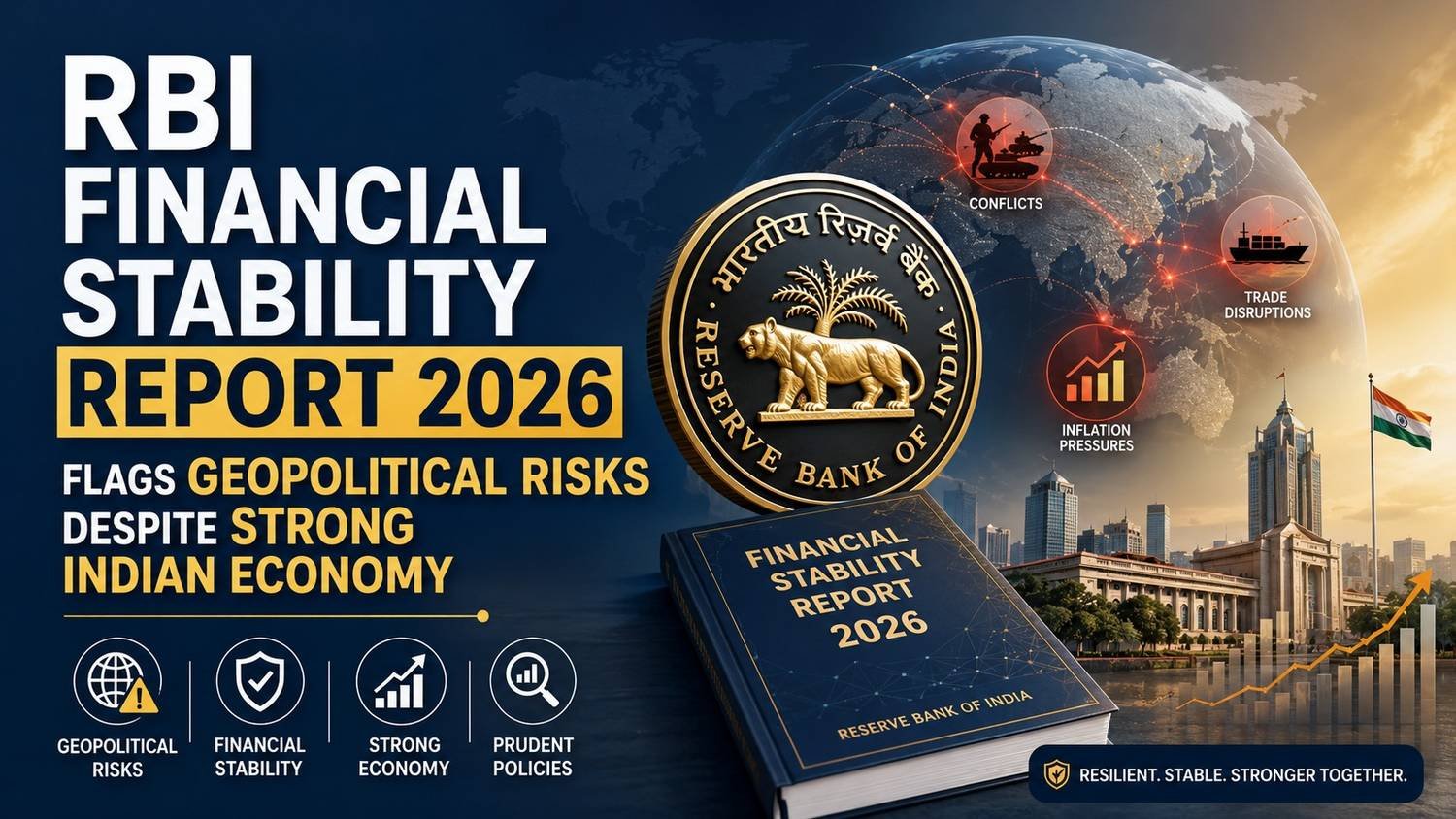
- The Reserve Bank of India (RBI) has cautioned that geopolitical tensions and global economic uncertainties continue to pose significant risks to India’s economy and financial system, even as tensions in West Asia have eased following an interim peace agreement.
- In its latest Financial Stability Report (FSR) 2026, the central bank stated that while India possesses strong macroeconomic fundamentals and a resilient financial sector, the country remains vulnerable to external shocks such as rising crude oil prices, supply-chain disruptions and global geopolitical conflicts.
India’s Economy Remains Resilient
The RBI highlighted that India’s economy has demonstrated remarkable resilience despite multiple external challenges.
According to the report:
- India’s GDP grew 7.7% in FY26.
- Average GDP growth over the last three years stood at 7.3%.
- Strong private consumption and robust fixed investment continued to support economic activity.
- High-frequency indicators for April and May 2026 suggest growth remained healthy despite disruptions caused by the West Asia conflict.
The central bank has projected India’s GDP growth at 6.6% for FY27.
RBI Warns of External Risks
Despite the positive outlook, the Financial Stability Report warned that several global risks continue to threaten India’s economic stability.
Major concerns highlighted include:
- Geopolitical conflicts and global fragmentation.
- Higher crude oil and commodity prices.
- Supply-chain disruptions.
- Slower global economic growth.
- Increased volatility in financial markets.
The RBI noted that India remains particularly exposed because it imports a large share of its crude oil and several essential commodities.
Oil Prices Could Impact the Economy
The RBI warned that a sustained rise in crude oil prices could create several macroeconomic challenges.
These include:
- Widening of the Current Account Deficit (CAD).
- Higher import bills.
- Increased inflationary pressures.
- Greater exchange rate volatility.
- Pressure on economic growth.
The report noted that previous episodes of sharp oil price increases have significantly affected India’s external sector, making energy prices one of the country’s key vulnerabilities.
Fiscal Deficit May Face Pressure
- The Financial Stability Report also cautioned that rising energy and commodity prices could adversely affect the government’s fiscal position.
- Higher subsidy requirements, reduced pass-through of fuel price increases and potential excise duty cuts may increase fiscal pressures.
- However, the RBI observed that higher customs duties on imports of gold and silver could provide some fiscal support.
- The report further stated that any fiscal slippage could push up government bond yields and increase debt servicing costs.
Banking System Remains Strong
One of the most reassuring findings of the report relates to India’s banking sector.
The RBI’s macro stress tests indicate that Scheduled Commercial Banks (SCBs) remain well-capitalised even under adverse economic scenarios.
The report found that:
- Bank capital adequacy ratios remain comfortably above regulatory requirements.
- The banking system is capable of absorbing severe economic shocks.
- Non-Banking Financial Companies (NBFCs) also maintain adequate capital buffers, although a few entities may experience stress under extreme scenarios.
These findings indicate that India’s financial system is better prepared to withstand future uncertainties.
Positive Factors Supporting Stability
Despite the risks, the RBI identified several developments that could support financial stability.
These include:
- Revival of Foreign Portfolio Investment (FPI) debt inflows.
- Declining global energy prices, if sustained.
- Strong domestic demand.
- Healthy corporate and banking sector balance sheets.
- Continued structural reforms.
These factors could help moderate government bond yields and strengthen overall financial resilience.
Conclusion
- The RBI’s Financial Stability Report 2026 presents a balanced assessment of India’s economic outlook.
- While geopolitical tensions, elevated oil prices and global uncertainties continue to pose challenges, India’s strong macroeconomic fundamentals, resilient banking system and prudent policy framework provide significant protection against external shocks.
- Going forward, maintaining financial stability, strengthening institutional resilience and closely monitoring global developments will remain key priorities for policymakers as India navigates an increasingly uncertain global economic environment.