

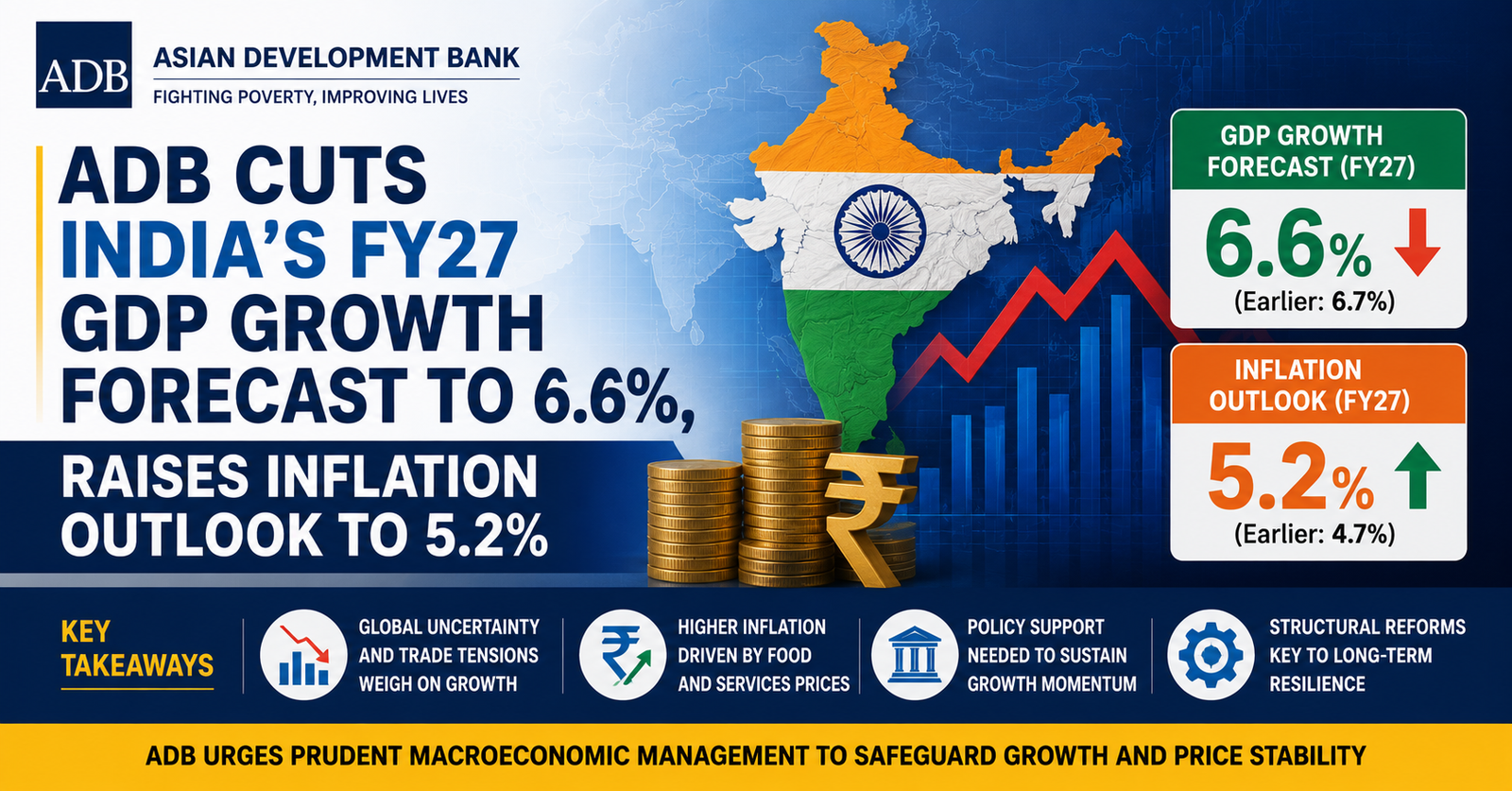
- The Asian Development Bank (ADB) has revised India’s economic growth forecast for FY2026–27 (FY27) downward to 6.6%, citing rising global energy prices triggered by geopolitical tensions in the Middle East.
- Despite the downward revision, ADB has reiterated that India remains the world’s fastest-growing major economy, supported by strong domestic demand, public investment and resilient services exports.
- The revised projections were released in the Asian Development Outlook (ADO) July 2026.
ADB Lowers India’s GDP Growth Forecast
ADB has reduced India’s GDP growth forecast for FY27:
- Previous Forecast (April 2026): 6.9%
- Revised Forecast (July 2026): 6.6%
For FY2027–28 (FY28), the growth forecast remains unchanged at 7.3%.
According to ADB, elevated crude oil prices and higher energy costs are expected to reduce household purchasing power and weigh on overall economic activity.
Why Has the Forecast Been Revised?
ADB attributed the lower growth projection primarily to:
- Rising international crude oil prices.
- Middle East geopolitical tensions.
- Higher energy import costs.
- Pressure on household incomes.
- Increased transportation and production expenses.
These factors are expected to temporarily moderate economic growth during FY27.
What Will Support India’s Growth?
Despite external challenges, ADB expects several domestic factors to support the Indian economy:
- Policy measures to attract foreign investment.
- Continued public capital expenditure.
- Strong services exports.
- Targeted credit support.
- Fuel tax reductions.
- Structural reforms improving competitiveness.
These drivers are expected to help India maintain strong economic momentum relative to other major economies.
Inflation Forecast Raised to 5.2%
Alongside the GDP revision, ADB also increased India’s inflation forecast.
Inflation Projections
| Period | April Forecast | July Forecast |
|---|---|---|
| FY27 | 4.5% | 5.2% |
| FY28 | 4.0% | 4.0% (Unchanged) |
ADB expects higher fuel prices, a weaker rupee and food inflation resulting from heatwaves to keep inflation elevated during FY27.
However, inflation is expected to moderate in FY28 as energy and food prices stabilise.
Risks to India’s Growth
ADB highlighted several downside risks:
- Escalation of geopolitical conflicts.
- Further increases in crude oil prices.
- Supply chain disruptions.
- Adverse weather affecting agriculture.
- Persistent inflationary pressures.
These factors could influence India’s growth trajectory if global conditions deteriorate further.
RBI’s Forecast Mirrors ADB
The ADB’s revised projections closely align with the Reserve Bank of India (RBI).
Recently, the RBI also:
- Reduced FY27 GDP growth forecast to 6.6%.
- Raised inflation projection to 5.1%.
The convergence of projections reflects growing concerns over global energy prices and external uncertainties.
IMF’s Latest Outlook
The International Monetary Fund (IMF) has also updated its projections.
According to the IMF:
- FY27 GDP Growth: 6.4%
- FY28 GDP Growth: 6.7%
The IMF noted that India’s economy continues to benefit from strong private consumption and robust services activity.
Outlook for Developing Asia
ADB also revised its broader regional outlook.
Developing Asia and the Pacific
- 2026 Growth Forecast: 4.9%
- Previous Forecast: 5.1%
- 2027 Forecast: 5.1% (Unchanged)
The region is expected to face slower growth due to prolonged disruptions in energy markets and global supply chains.
Regional inflation has been revised upward to 4.3% for 2026.
Conclusion
While the Asian Development Bank has lowered India’s FY27 growth forecast to 6.6% and raised inflation expectations to 5.2%, the overall outlook remains positive. Strong domestic demand, government investment, services exports and structural reforms continue to provide resilience. However, global energy prices, geopolitical tensions and inflation remain key risks that policymakers and businesses will closely monitor over the coming months.