

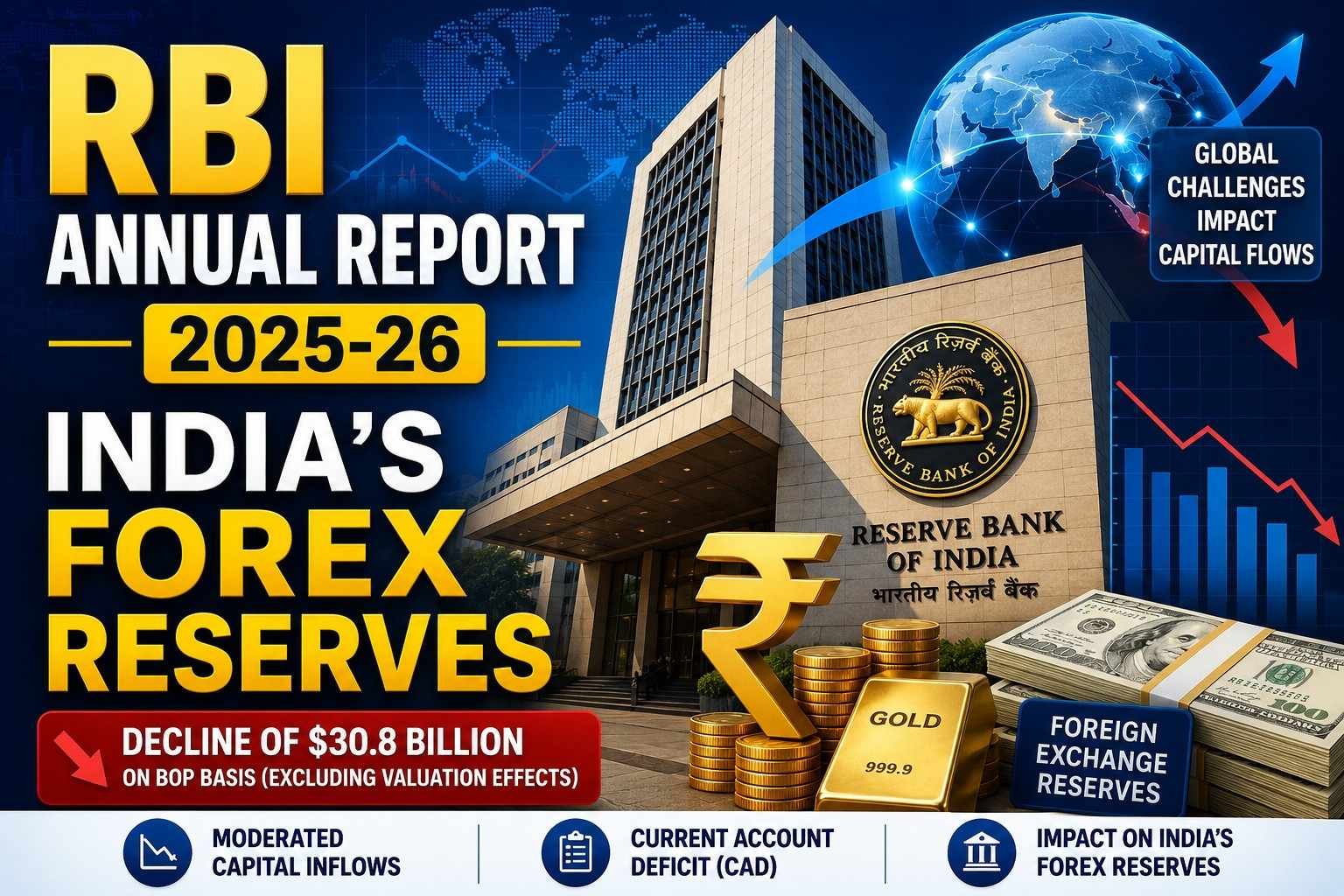
- The Reserve Bank of India (RBI), in its Annual Report 2025-26, highlighted the challenges faced by India’s external sector amid a difficult global financial environment.
- Despite strong foreign exchange reserves, volatile capital flows, geopolitical tensions, and pressure on the Indian rupee prompted the central bank to actively intervene in the foreign exchange market during the year.
Challenging Global Environment and Capital Flows
- According to the report, the global investment environment remained uncertain during FY26.
- Net capital inflows into India moderated during the period from April to December 2025 and were insufficient to fully finance the country’s Current Account Deficit (CAD).
- One of the major concerns during the year was the significant outflow of foreign portfolio investments.
- Foreign Portfolio Investors (FPIs) withdrew a net $16.5 billion from Indian markets during FY26, primarily from the equity segment.
- The situation worsened in March 2026 when geopolitical tensions in the Middle East triggered a massive $13.1 billion outflow in a single month.
RBI’s Intervention to Support the Rupee
- The Indian rupee came under considerable pressure during the year and depreciated by approximately 9.5 percent against the US dollar.
- To prevent excessive volatility and maintain orderly market conditions, the RBI undertook aggressive foreign exchange market interventions.
- The central bank sold a record $53.13 billion from its foreign exchange reserves.
- These interventions helped contain sharp currency fluctuations and ensured stability in the domestic foreign exchange market.
- As a result of these forex operations, the RBI earned ₹1.69 lakh crore from foreign exchange transactions during FY26, registering a remarkable 52 percent increase compared to the previous year.
Decline in Foreign Exchange Reserves
- The RBI report noted that India’s foreign exchange reserves declined by $30.8 billion on a Balance of Payments (BoP) basis during April–December 2025.
- The fall was largely attributed to the central bank’s dollar-selling operations and weaker capital inflows.
- Despite the decline, India’s external position remained comfortable. As of March 31, 2026, the country’s foreign exchange reserves stood at $691 billion, providing a strong buffer against external shocks.
Comfortable Import Cover and Debt Protection
The RBI emphasized that India’s foreign exchange reserves continue to provide substantial protection against external vulnerabilities.
At the end of March 2026:
- Forex reserves stood at $691 billion.
- Reserves were sufficient to finance approximately 11 months of imports.
- The reserve stock covered nearly 90 percent of India’s total external debt.
These indicators highlight the resilience of India’s external sector despite global uncertainties.
RBI’s Income from Foreign Assets Increases
The annual report also showed a significant increase in earnings from foreign assets.
- Total foreign income increased by 27 percent to ₹3.28 lakh crore.
- Higher returns from investments in foreign securities contributed substantially to this growth.
- Domestic income also increased by 26 percent to ₹1 lakh crore, mainly due to higher interest earnings from rupee-denominated securities.
The strong performance of both foreign and domestic investments boosted the RBI’s overall financial position.
Expansion of RBI’s Balance Sheet
- The RBI’s balance sheet witnessed substantial growth during FY26.
- The size of the balance sheet increased by ₹15.72 lakh crore, or 20.6 percent, rising from ₹76.25 lakh crore as on March 31, 2025, to ₹91.97 lakh crore as on March 31, 2026.
Growth on the Asset Side
The increase in assets was driven by:
- Domestic investments rising by 44.9 percent
- Gold holdings increasing by 63.8 percent
- Foreign investments growing by 7.9 percent
Growth on the Liability Side
On the liabilities side:
- Revaluation accounts increased by 63.4 percent
- Currency notes issued rose by 11.8 percent
- Deposits increased by 11.6 percent
- Other liabilities expanded by 21.1 percent
Conclusion
The RBI Annual Report 2025-26 presents a picture of a central bank actively managing external sector challenges amid global uncertainty. While India’s foreign exchange reserves declined due to market interventions and capital outflows, they remained at a comfortable level of $691 billion, providing strong import and debt coverage.