

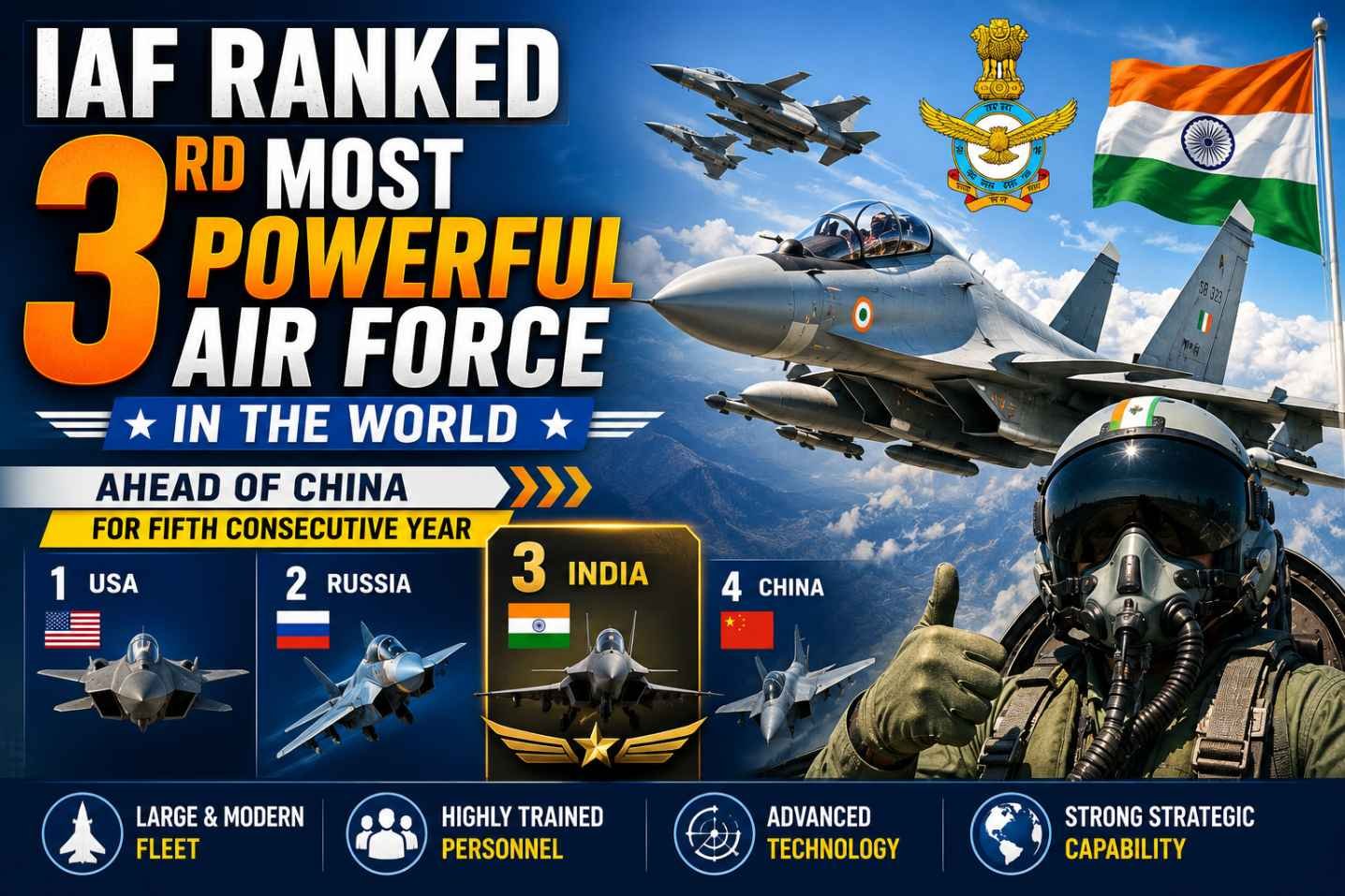
- The Indian Air Force (IAF) has once again been recognised as the third-most powerful air force in the world, according to the World Directory of Modern Military Aircraft (WDMMA) 2026 Global Air Power Rankings.
- For the fifth consecutive year, the IAF has retained its third-place position, ranking ahead of China’s People’s Liberation Army Air Force (PLAAF) despite China’s significantly larger aircraft fleet.
- Only the United States Air Force and the Russian Air Force rank above the IAF in the latest global assessment, highlighting India’s growing air combat capability and operational strength.
WDMMA 2026 Global Air Power Rankings
The World Directory of Modern Military Aircraft (WDMMA) annually evaluates the world’s military aviation capabilities.
The 2026 report covers:
- 129 air services
- 103 countries
- Over 48,000 military aircraft
Instead of ranking nations solely on fleet size, WDMMA uses its proprietary True Value Rating (TVR) system, which assesses:
- Aircraft quality
- Fleet balance
- Combat capability
- Technological sophistication
- Logistics support
- Modernisation
- Operational readiness
This explains why India ranks ahead of China despite having a smaller fleet.
Why India Ranked Above China
Although China’s PLAAF operates 3,733 aircraft, more than double the IAF’s 1,716 aircraft, WDMMA gives greater importance to:
- Fleet composition
- Multi-role capability
- Operational flexibility
- Combat readiness
- Aircraft diversity
- Maintenance infrastructure
- Modernisation
This comprehensive evaluation enabled India to remain ahead of China in the rankings.
Indian Air Force Fleet Strength
The IAF currently operates:
Combat Aircraft
- 542 combat and attack aircraft
- Spread across seven fighter and attack aircraft types
Helicopters
- 498 helicopters
- 222 Mi-17 helicopters
- 111 HAL Dhruv and Rudra helicopters
Transport Fleet
- 282 transport aircraft
Trainer Fleet
- 374 trainer aircraft
Special Mission Aircraft
- 20 aircraft, including:
- Airborne Early Warning & Control Systems (AEW&C)
- Intelligence, Surveillance & Reconnaissance (ISR) platforms
- Aerial refuelling aircraft
These assets significantly enhance India’s operational reach and battlefield awareness.
Fighter Fleet Remains the Core
Combat aircraft account for 31.6% of the IAF’s total fleet.
For comparison:
- Fighter aircraft represent approximately 32% of the US Air Force inventory.
This demonstrates the IAF’s continued emphasis on maintaining a strong combat-oriented force structure.
Future Expansion Plans
The Indian Air Force is expected to become even stronger over the coming decade.
Rafale Fighters
India plans to induct:
- 114 additional Rafale fighter aircraft
These aircraft will substantially improve long-range strike capability and air superiority.
Tejas Mk-1A
The IAF has already ordered:
- 180 Tejas Mk-1A fighters from Hindustan Aeronautics Limited (HAL).
The indigenous fighters will replace ageing aircraft while supporting India’s “Atmanirbhar Bharat” initiative.
Advanced Medium Combat Aircraft (AMCA)
India is also developing its:
- Fifth-generation Advanced Medium Combat Aircraft (AMCA)
The stealth fighter is expected to begin induction after 2029, significantly enhancing India’s future air combat capability.
Why New Aircraft Are Critical
Over 200 legacy fighter aircraft, including:
- Jaguar
- Mirage 2000
- MiG-29
are expected to retire during the 2030s.
Their replacement with:
- Rafale
- Tejas Mk-1A
- AMCA
is essential to maintain the IAF’s combat strength and squadron numbers.
Why This Ranking Matters
The WDMMA ranking reflects more than just military prestige.
A strong air force supports:
- National security
- Border defence
- Strategic deterrence
- Disaster relief
- Humanitarian operations
- Power projection
- Regional stability
Remaining ahead of China for five consecutive years underscores India’s continued investment in modernising its air power.
Key Highlights
- IAF ranked 3rd most powerful air force globally.
- India stays ahead of China’s PLAAF for the fifth consecutive year.
- IAF operates 1,716 military aircraft.
- Fleet includes 542 combat and attack aircraft.
- Operates 498 helicopters.
- Has 282 transport aircraft and 374 trainer aircraft.
- Ranked using WDMMA’s True Value Rating (TVR) system.
- Future expansion includes 114 Rafale fighters, 180 Tejas Mk-1A, and the AMCA programme.
Conclusion
The Indian Air Force’s retention of the third position in the WDMMA 2026 Global Air Power Rankings highlights the growing strength, balance, and operational capability of India’s air combat fleet. While challenges such as declining squadron strength remain, upcoming inductions of Rafale fighters, Tejas Mk-1A aircraft, and the future AMCA programme are expected to further enhance the IAF’s capabilities and maintain its position among the world’s leading air forces.
[…] Click Here To Read: IAF Ranked 3rd Most Powerful Air Force in the World, Ahead of China for Fifth Co… Air Marshal Ashutosh Dixit Appointed as Next Vice Chief of Air Staff DRDO and Indian Air Force Successfully Test Indigenous TARA Glide Weapon System […]