
- The Ministry of Health and Family Welfare (MoHFW) released the sixth round of the National Family Health Survey (NFHS-6), providing updated insights into India’s health and demographic landscape.
- Conducted during 2023-24, the survey covered 679,238 households across 715 districts, making it one of the largest and most comprehensive health surveys in the country.
-
The latest National Family Health Survey (NFHS-6) (2023–24) reveals notable progress in India’s health, nutrition, women’s empowerment, and social development indicators compared to the previous NFHS-5 (2019–21) survey.
-
Covering approximately 6.79 lakh households and assessing 101 indicators, the survey highlights major gains in immunisation, digital inclusion, maternal healthcare, nutrition, and health insurance coverage.
Major Improvement in Child Immunisation
One of the most remarkable achievements recorded in NFHS-6 is the expansion of childhood immunisation coverage.
Rotavirus Vaccine Coverage Surges
The coverage of the Rotavirus Vaccine, which protects children from severe diarrhoea, increased dramatically from 36.4% in NFHS-5 to 85.4% in NFHS-6, representing the largest improvement among all childhood vaccines.
Measles Vaccination Improves
The coverage of the second dose of the Measles Vaccine also witnessed a substantial increase, contributing to improved protection against vaccine-preventable diseases.
Overall Immunisation Coverage
The percentage of fully immunised children aged 12–23 months increased significantly, indicating improved healthcare outreach and vaccination programmes across the country.
Women’s Digital and Financial Empowerment
NFHS-6 highlights remarkable progress in women’s access to digital technologies and financial services.
Internet Usage Nearly Doubles
The proportion of women aged 15–49 years who have ever used the internet rose sharply from:
- 33.3% (NFHS-5)
- 64.3% (NFHS-6)
This reflects India’s rapid digital transformation and increasing digital literacy among women.
Financial Inclusion Expands
More women now:
- Operate their own bank accounts.
- Have access to mobile phones.
- Participate in the digital economy.
These improvements indicate growing financial independence and empowerment.
Decline in Domestic Violence
The survey recorded encouraging progress in women’s safety.
The percentage of ever-married women who reported experiencing physical or sexual violence by their spouse declined from:
- 29.2% (NFHS-5)
- 22.3% (NFHS-6)
This suggests improvements in awareness, legal protection, and social attitudes toward gender-based violence.
Maternal and Child Healthcare Improves
1. Antenatal Care: Nearly 96% of pregnant women received antenatal care services, reflecting improved maternal healthcare coverage.
2. Institutional Deliveries: Institutional deliveries crossed 90%, ensuring safer childbirth conditions.
3. Skilled Birth Attendance: More than 91% of births were attended by skilled healthcare personnel.
4. Postnatal Care: Postnatal care services for newborns also improved considerably, contributing to better maternal and child health outcomes.
Reduction in Child Malnutrition
Stunting Declines
Child stunting, which reflects chronic undernutrition and long-term nutritional deprivation, decreased significantly:
- 35.5% (NFHS-5)
- 29.3% (NFHS-6)
This represents a decline of 6.2 percentage points, indicating improvements in nutrition, healthcare, and child welfare interventions.
Area of Concern: Exclusive Breastfeeding
Despite improvements in maternal healthcare and institutional deliveries, the survey identified a concerning trend.
The proportion of infants below six months receiving exclusive breastfeeding declined from:
- 63.7% (NFHS-5)
- 55.8% (NFHS-6)
This suggests a need for greater awareness and support for breastfeeding practices among mothers.
Health Insurance Coverage Expands
NFHS-6 recorded substantial progress in health insurance coverage.
The percentage of households with at least one member covered under a health insurance scheme increased from:
- 41.0% (NFHS-5)
- 60.2% (NFHS-6)
This increase of 19.2 percentage points means that approximately six out of every ten Indian households now have some form of health insurance coverage.
Significance of NFHS-6 Findings
The survey findings indicate that India has made considerable progress toward:
- Universal immunisation.
- Maternal and child healthcare.
- Women’s empowerment.
- Digital inclusion.
- Financial inclusion.
- Nutritional improvement.
- Healthcare accessibility.
However, challenges remain in areas such as exclusive breastfeeding and ensuring that healthcare and nutrition gains reach all sections of society.
NFHS-6 Shows Significant Improvement in India’s Health and Social Indicators

BySheeba Chaudhary
Jun 1, 2026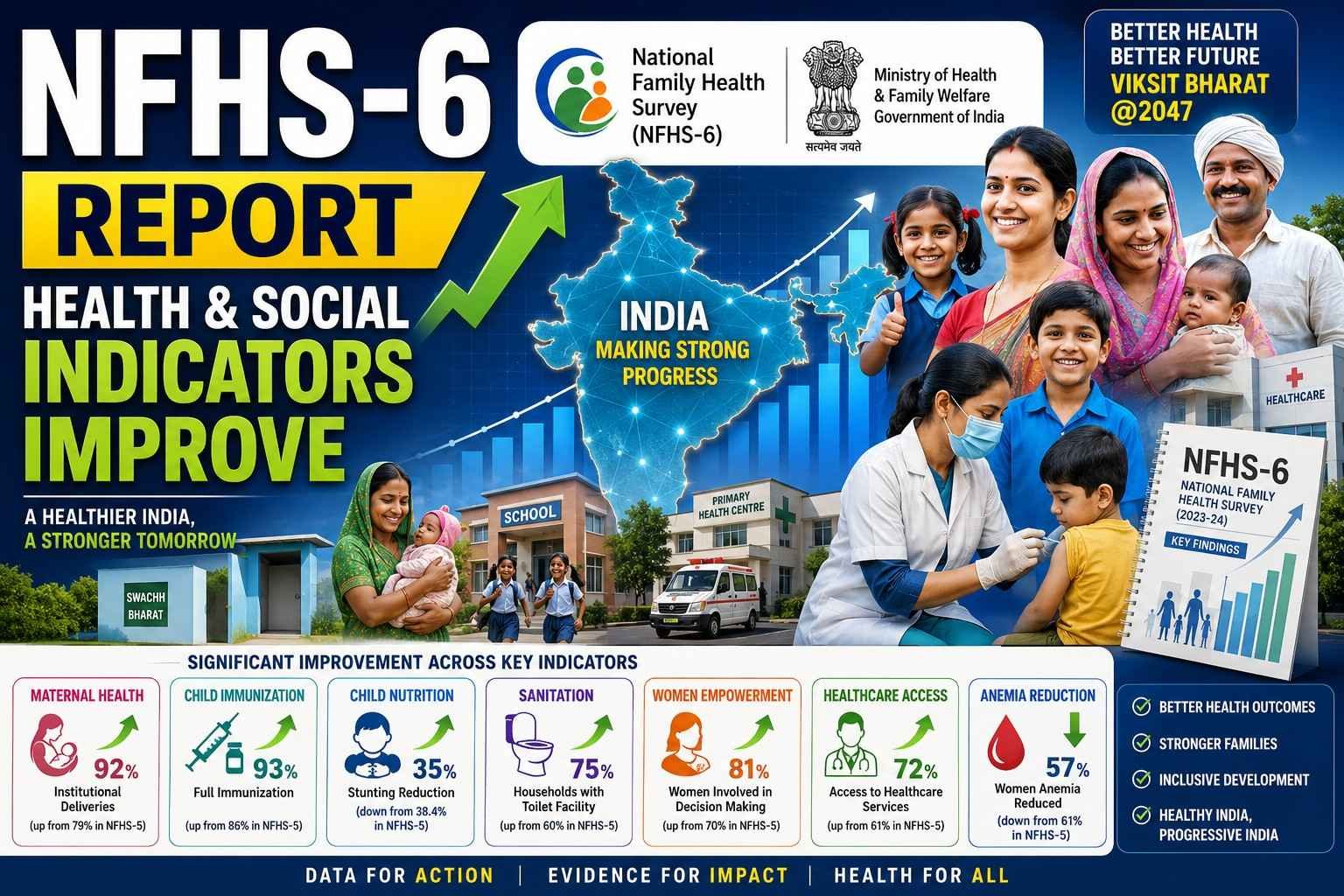 The National Family Health Survey (NFHS-6) highlights notable progress in India's health and social development indicators, reflecting improvements in healthcare access, nutrition, sanitation, and family welfare outcomes.