

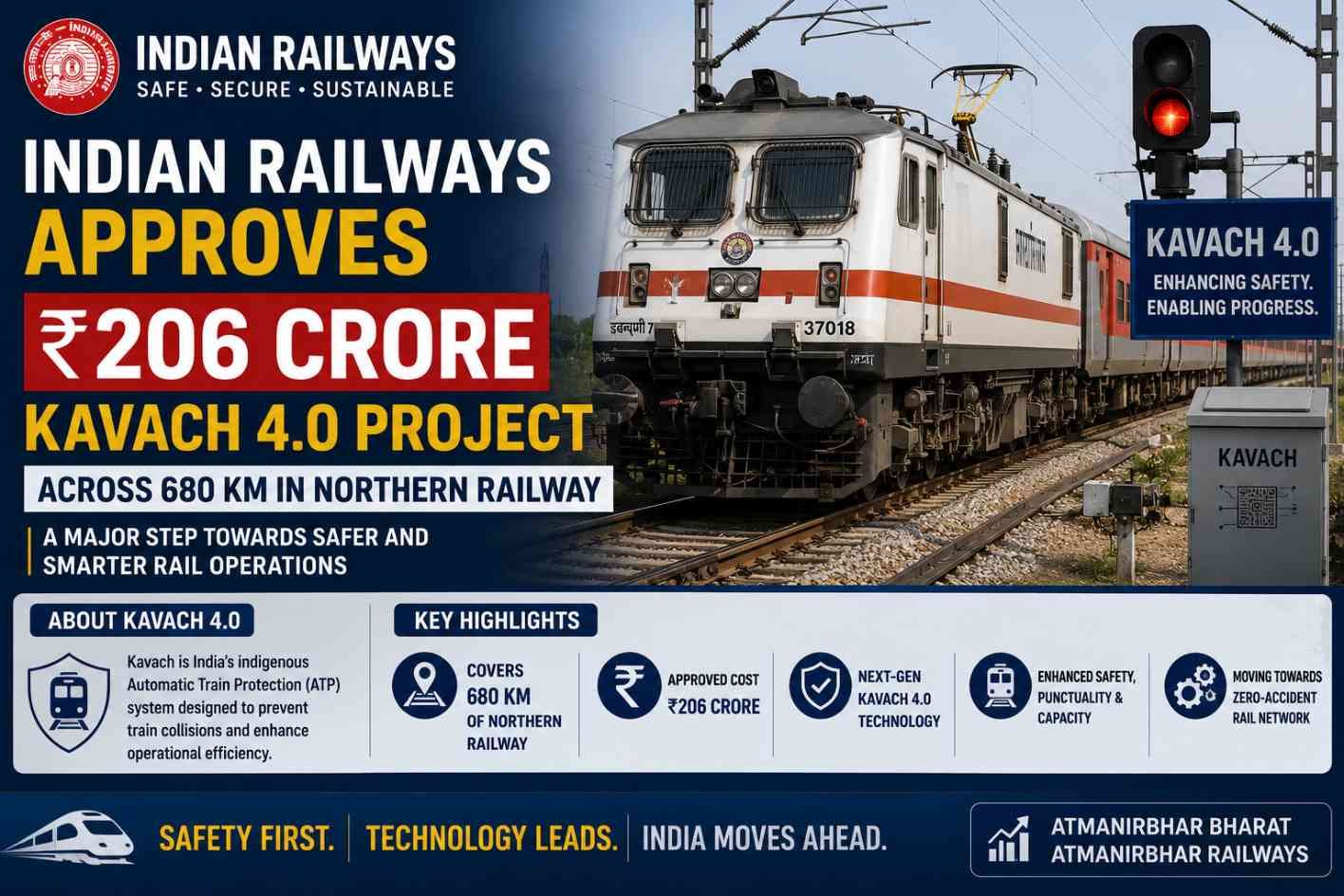
- Indian Railways has approved a ₹206 crore project to deploy its indigenous Kavach 4.0 Automatic Train Protection (ATP) system across 680 route kilometres (RKm) of the Northern Railway network. The initiative is part of the Railways’ nationwide mission to enhance operational safety, prevent train collisions, and move towards its goal of achieving zero accidents.
- The project will cover the Rewari–Delhi and Shakurbasti–Bathinda sections, including important feeder branch lines under the Delhi Division of Northern Railway.
₹206 Crore Approved for Kavach 4.0 Deployment
According to the Ministry of Railways, the approved project aims to install the latest Kavach Version 4.0 on strategically important and high-density railway routes in North India.
The deployment includes:
- Rewari–Delhi section
- Shakurbasti–Bathinda section
- Associated feeder branch lines
- Total coverage of 680 route kilometres
The project forms part of the Railways’ larger strategy to expand the indigenous train protection system across the country’s busiest rail corridors.
What is Kavach?
Kavach is India’s indigenously developed Automatic Train Protection (ATP) system designed to significantly improve railway safety.
Developed to minimise human error, the system automatically intervenes whenever a train risks violating safety protocols.
Key Features of Kavach
- Prevents Signal Passed at Danger (SPAD) incidents.
- Automatically applies emergency brakes if a driver crosses a danger signal.
- Detects trains on the same track and helps prevent collisions.
- Improves operational reliability and passenger safety.
- Supports the Railways’ long-term Zero Accident Mission.
How Kavach 4.0 Improves Safety
The latest Kavach Version 4.0 offers enhanced capabilities for modern railway operations.
It continuously monitors train movement and communication between locomotives, signalling systems, and stations. If the system detects a potential collision or unsafe movement, it automatically activates braking without requiring driver intervention.
This significantly reduces the risk of accidents caused by signalling errors or human mistakes.
Nationwide Expansion Underway
Indian Railways has accelerated the rollout of Kavach across high-density routes.
As of March 2026:
- 3,103 route kilometres have already been commissioned with Kavach.
- Installation work is underway across another 24,427 route kilometres.
- India’s railway network spans nearly 70,000 route kilometres, indicating substantial scope for future expansion.
Currently, Kavach is operational on around 4.4% of the national railway network.
Focus on High-Density Corridors
The Railways is prioritising Kavach deployment on high-utilisation routes, including sections of:
- Delhi–Mumbai corridor
- Delhi–Howrah corridor
- Northern Railway high-density network
The newly approved Northern Railway project will further strengthen safety across some of India’s busiest passenger and freight routes.
Significance of the Project
The ₹206 crore investment reflects the government’s continued focus on modernising railway safety infrastructure through indigenous technology.
The expansion of Kavach is expected to:
- Improve passenger safety.
- Reduce collision risks.
- Enhance operational efficiency.
- Increase reliability of train services.
- Support safer movement of passenger and freight trains.
Although the project has now been approved, installation and commissioning will take place in phases before the system becomes fully operational on these routes.
Moving Towards Zero Accidents
Kavach has become one of the flagship safety initiatives under Indian Railways’ modernisation programme.
By combining indigenous innovation with advanced signalling technology, the system is expected to play a crucial role in making India’s railway network safer, smarter, and more reliable for millions of daily passengers.