

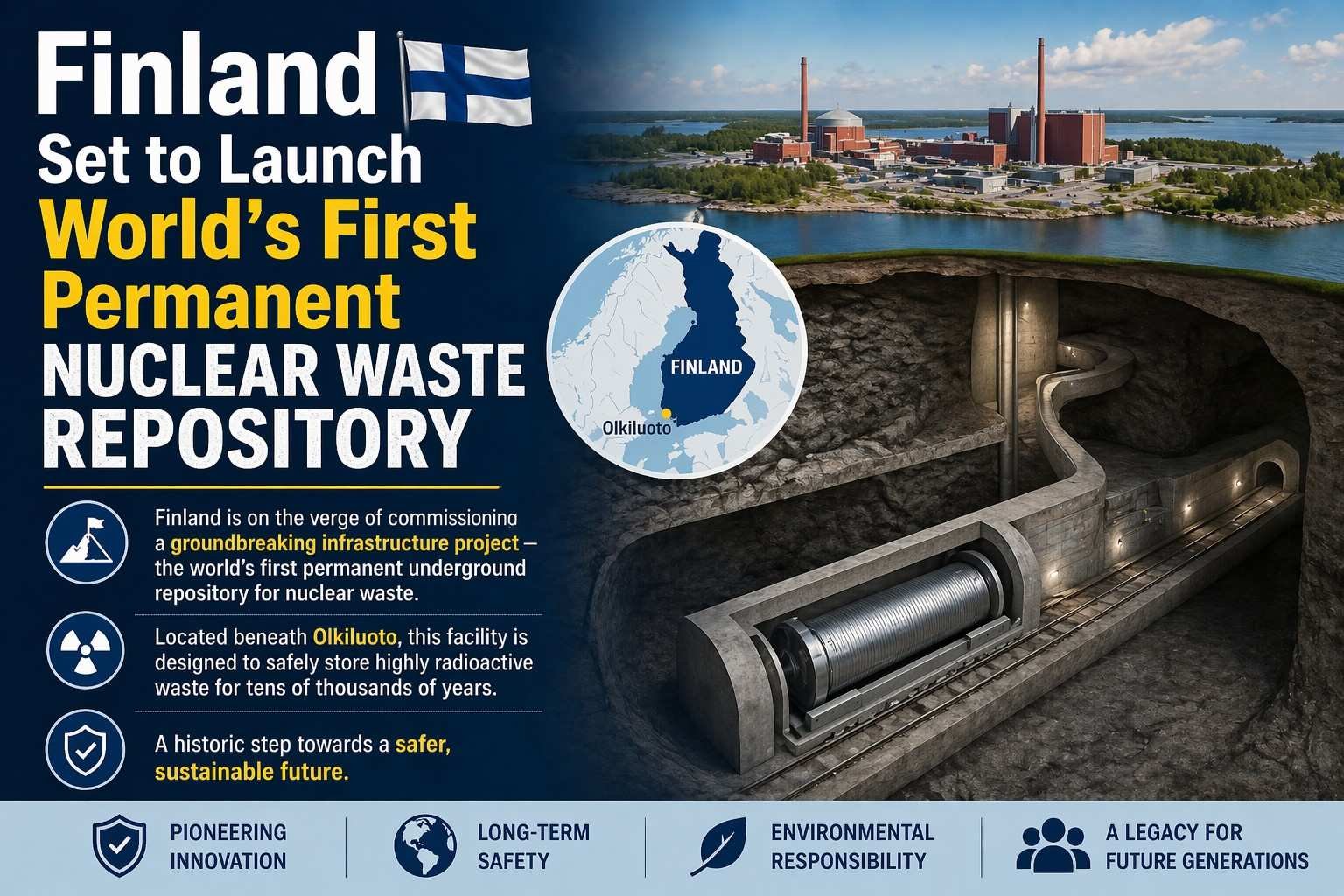
Finland is on the verge of commissioning a groundbreaking infrastructure project — the world’s first permanent underground repository for nuclear waste. Located beneath Olkiluoto, this facility is designed to safely store highly radioactive waste for tens of thousands of years.
The Long-Standing Nuclear Waste Problem
Since the 1950s, nuclear energy has generated large amounts of spent fuel, which remains radioactive for thousands of years.
- Global nuclear waste: Approx 400,000 tonnes
- Currently stored in:
- Cooling pools
- Dry casks (temporary solutions)
These methods ensure short-term safety, but not permanent disposal, making nuclear waste one of the biggest challenges in clean energy.
Finland’s Solution: Deep Geological Repository
Finland’s answer is the Onkalo repository, a deep underground storage system:
- Located 400–450 metres below ground
- Built in 1.9 billion-year-old stable bedrock
- Designed for long-term isolation of radioactive waste
Multi-Layer Safety System
- Spent fuel sealed in metal canisters
- Encased in corrosion-resistant copper capsules
- Surrounded by bentonite clay (blocks water movement)
- Embedded deep in solid rock
This multi-barrier approach ensures safety even if one layer fails.
Why Deep Underground Storage?
Depth plays a crucial role in safety:
- Protects from:
- Natural disasters
- Human interference
- Reduces exposure to:
- Oxygen
- Water (which can cause corrosion)
The stable geological conditions ensure long-term containment over thousands of years.
Science Behind Long-Term Safety
Designing such a facility involves advanced research in:
- Geology and seismic activity
- Groundwater movement
- Climate change and ice-age cycles
- Material durability (e.g., copper corrosion)
The repository follows a passive safety model, meaning:
- No need for human monitoring or maintenance after sealing
- Relies on natural and engineered barriers
Why Finland Succeeded
Many countries have struggled to build permanent repositories, but Finland succeeded due to:
- Clear policy: Manage nuclear waste domestically
- Long-term planning and political consistency
- Strong public trust and transparency
- Early involvement of local communities
Global Significance
As countries return to nuclear energy to meet climate goals, this project is highly significant:
- Provides a working model for safe nuclear waste disposal
- Helps address one of nuclear energy’s biggest concerns
- Supports the expansion of low-carbon energy sources
The facility will store around 6,500 tonnes of Finland’s nuclear waste and may serve as a blueprint for other nations.
Conclusion
Finland’s nuclear waste repository represents a historic step in solving one of the most persistent challenges of nuclear energy. By creating a system designed to safely contain radioactive material for up to 100,000 years, the country has demonstrated that clean energy and long-term environmental safety can coexist.