

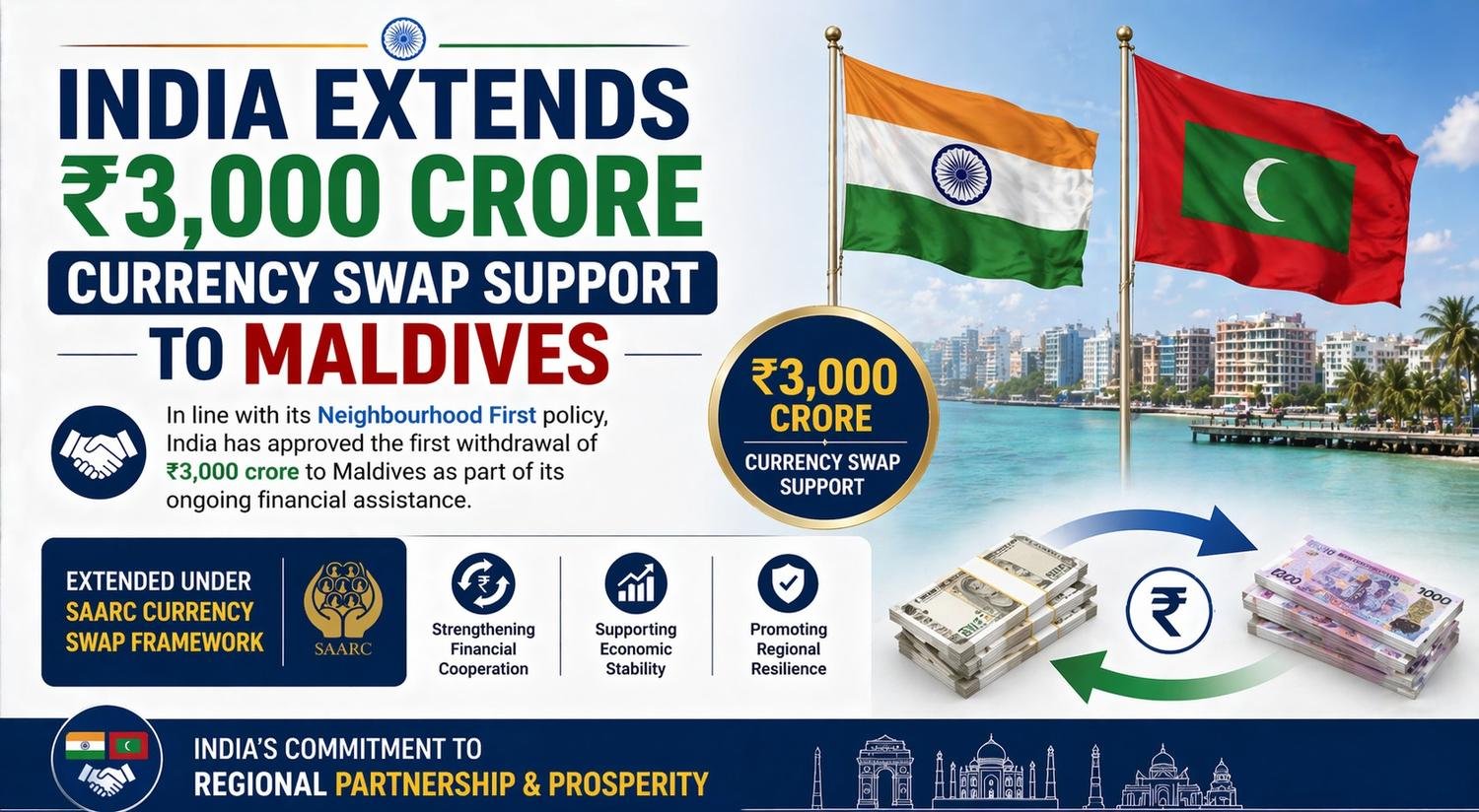
In a significant move under its Neighbourhood First policy, India has approved the first withdrawal of ₹3,000 crore to Maldives as part of its continuing economic and financial assistance.
The assistance is being provided under the Saarc Currency Swap Framework, according to the Indian High Commission in Maldives.
What is the Saarc Currency Swap Framework?
The Framework on Currency Swap Arrangement for SAARC Countries was launched by the Reserve Bank of India in 2012.
It allows SAARC member countries to access foreign exchange support from India to address short-term balance of payment pressures and maintain financial stability.
The current withdrawal was agreed during Maldivian President Mohamed Muizzu’s state visit to New Delhi in October 2024.
Previous $400 Million Facility Matured
Earlier, Maldives had withdrawn $400 million under the same framework in October 2024.
That facility matured on April 24, 2026, and has now been settled.
According to Maldives’ Foreign Ministry, the repayment reflects the government’s commitment to meeting its financial obligations.
India’s Total Support to Maldives
Since the beginning of the SAARC Swap Framework in 2012, RBI has provided an aggregate swap support of around $1.1 billion to Maldives.
Apart from this:
- India rolled over Treasury Bills worth $100 million last year
- The assistance was provided as emergency financial support at Maldives’ request
Why This Matters
The currency swap facility is important because it helps:
- Maintain foreign exchange liquidity
- Support financial stability
- Ease short-term external payment pressures
For a tourism-dependent economy like Maldives, such support is crucial.
Strategic Importance
India described Maldives as an important partner under:
- Neighbourhood First Policy
- Vision MAHASAGAR
India has often acted as the “First Responder” for Maldives during economic and humanitarian crises.
Conclusion
The ₹3,000 crore currency swap assistance reinforces India’s role as a reliable regional partner. By supporting Maldives’ financial stability, India not only strengthens bilateral ties but also promotes broader economic resilience in the South Asian region.