

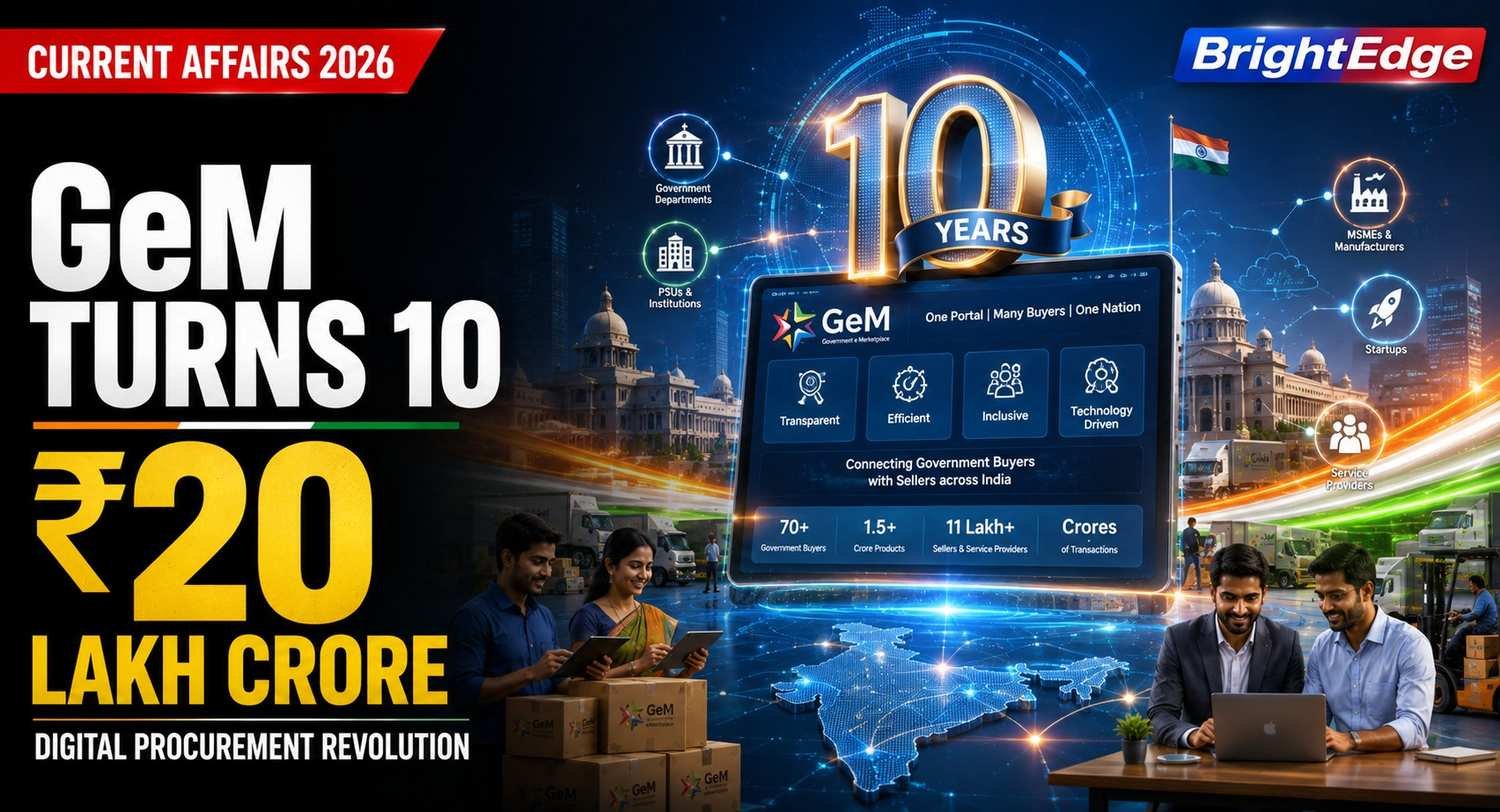
The Government e-Marketplace (GeM) has completed a decade of digital public procurement with a landmark achievement: the platform has facilitated purchases worth more than ₹20 lakh crore since its launch in August 2016. The milestone highlights GeM’s growing role in making government procurement more digital, transparent, efficient and inclusive.
The platform’s growth has been particularly significant for Micro and Small Enterprises (MSEs), startups, women-led businesses and other smaller suppliers, giving them access to government demand through a common digital marketplace.
GeM Completes 10 Years
- The Government e-Marketplace, popularly known as GeM, was launched on 9 August 2016 by the Ministry of Commerce and Industry.
- Its core objective was to create an open, transparent and technology-driven platform through which government organisations could procure goods and services.
- Before GeM, public procurement was spread across multiple systems and processes. GeM sought to bring buyers and sellers onto a unified digital platform.
- The government describes GeM as a national public procurement platform designed to improve transparency, efficiency and inclusivity.
- Ten years later, the platform has crossed the ₹20 lakh crore cumulative procurement mark.
GeM Crosses ₹20 Lakh Crore
- The latest milestone is particularly significant because GeM crossed ₹20 lakh crore in cumulative procurement since its inception.
- According to the latest government-reported figures, GeM recorded approximately ₹1.47 lakh crore in GMV during the first four months of FY 2026–27 alone.
- The figure demonstrates how rapidly digital procurement has expanded in India.
- For comparison, GeM had crossed ₹15 lakh crore in cumulative GMV in August 2025, after nine years of operation.
- By April 2026, cumulative GMV had reached ₹18.4 lakh crore, including more than ₹5 lakh crore during FY 2025–26.
- The subsequent move beyond ₹20 lakh crore underlines the accelerating scale of the platform.
What Is GeM?
- Government e-Marketplace (GeM) is India’s national digital platform for public procurement.
- It allows eligible government buyers to purchase a wide range of goods and services through a technology-enabled marketplace.
- Government buyers can include central and state government departments, public-sector organisations, autonomous institutions and other eligible bodies.
The platform was designed around three broad objectives:
- Transparency
- Efficiency
- Inclusivity
GeM has increasingly used technology, analytics and AI-enabled tools to improve procurement processes and monitoring.
Why the ₹20 Lakh Crore Milestone Matters
- The ₹20 lakh crore figure is more than a large number.
- It reflects the scale at which digital procurement has become integrated into India’s public administration.
- Government procurement involves enormous demand for products and services—from office supplies and electronics to transportation, healthcare products, construction-related requirements and professional services.
- A unified digital platform can make it easier for government buyers to identify suppliers and conduct transactions through standardised digital processes.
- At the same time, sellers gain access to a much larger government market.
GeM and MSMEs: A Major Transformation
- One of GeM’s most important contributions has been expanding opportunities for Micro and Small Enterprises.
- According to government data for FY 2025–26, MSEs executed 68% of total GeM orders and accounted for 47.1% of total GMV. More than 11 lakh MSEs were registered on the platform and received over 51 lakh orders worth approximately ₹2.36 lakh crore during that financial year.
- This is particularly important because smaller businesses have traditionally faced difficulties accessing large institutional markets.
- Digital procurement can reduce geographical barriers and provide smaller enterprises with a structured route to government buyers.
Women Entrepreneurs and Startups Gain Greater Access
- GeM’s ecosystem has also expanded participation by women-led enterprises and startups.
- Government data released in 2026 showed that more than 2.1 lakh women-led MSEs were registered on the platform and had received orders exceeding ₹28,000 crore during FY 2025–26.
- Startups have also emerged as an important category of GeM sellers.
- The platform’s SWAYATT initiative—Startups, Women and Youth Advantage through e-Transactions—was launched to expand opportunities for startups, women entrepreneurs, youth, MSEs and other emerging suppliers.
- This makes GeM more than simply an online purchasing portal. It has increasingly become a channel for connecting government demand with India’s entrepreneurial ecosystem.
GeM at a Glance
| Feature | Key Fact |
|---|---|
| Full form | Government e-Marketplace |
| Launch | 9 August 2016 |
| Ministry | Ministry of Commerce & Industry |
| 2026 milestone | ₹20 lakh crore+ cumulative procurement |
| FY 2026–27 GMV | ₹1.47 lakh crore in first four months |
| Earlier milestone | ₹18.4 lakh crore by April 2026 |
| FY 2025–26 GMV | More than ₹5 lakh crore |
| Major beneficiaries | MSEs, startups, women-led enterprises |
| Core objective | Transparent, efficient and inclusive procurement |
Note: The ₹20 lakh crore milestone and the FY 2026–27 figure are based on the latest reporting available as of August 2026.