

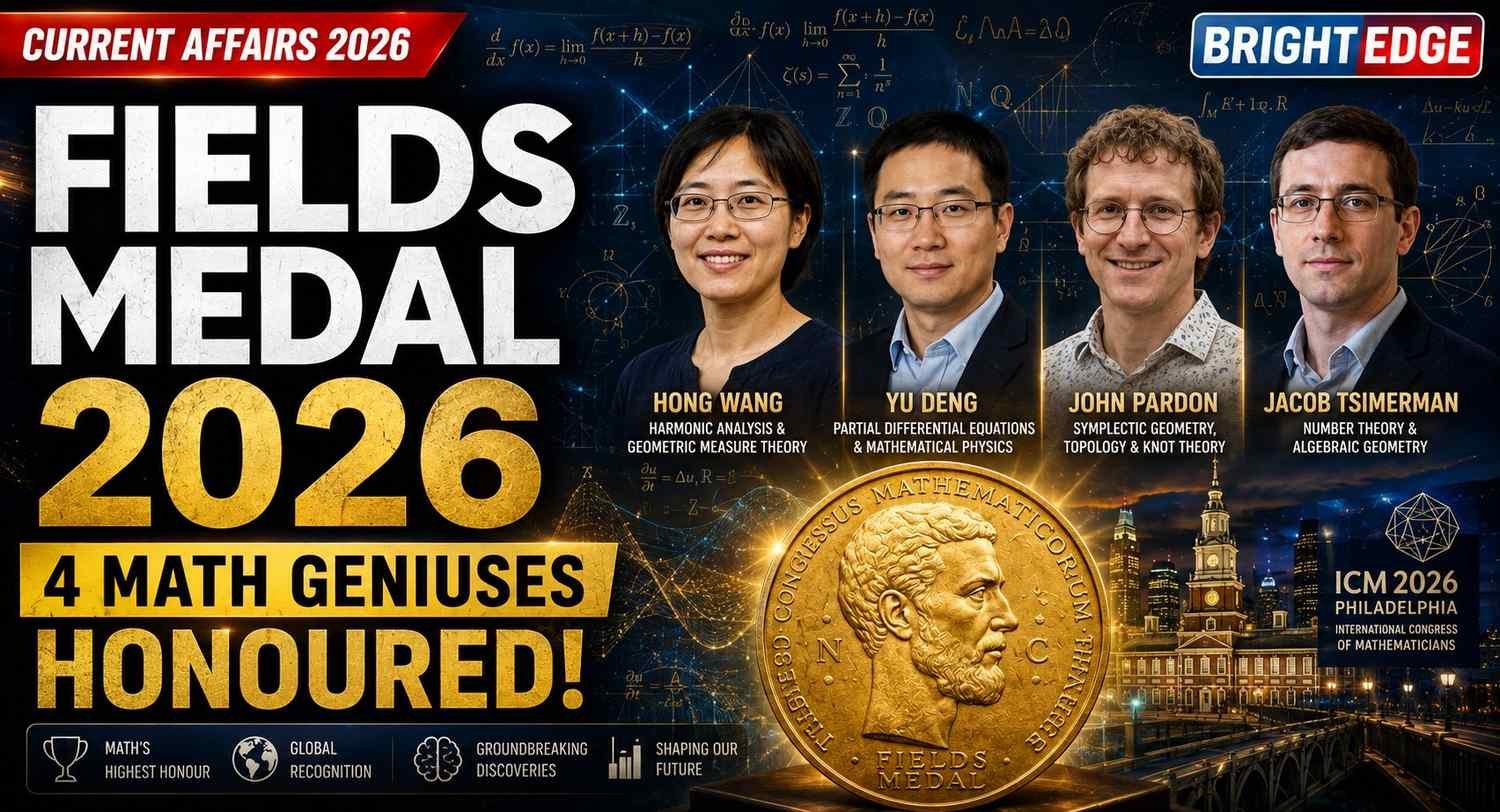
Four Mathematicians Make History
- Hong Wang, Yu Deng, John Pardon and Jacob Tsimerman have been awarded the 2026 Fields Medals, one of the world’s most prestigious honours in mathematics. The International Mathematical Union announced the four recipients at the 2026 International Congress of Mathematicians in Philadelphia on 23 July 2026.
- The 2026 laureates represent several major branches of modern mathematics, including partial differential equations, mathematical physics, harmonic analysis, geometric measure theory, symplectic geometry, topology, number theory and algebraic geometry.
- The four recipients are Yu Deng, John Pardon, Jacob Tsimerman and Hong Wang.
What Is the Fields Medal?
- The Fields Medal is awarded every four years at the International Congress of Mathematicians. The award recognises outstanding mathematical achievement as well as the promise of future achievement.
- Unlike many lifetime-achievement awards, the Fields Medal has an important age criterion: recipients must be under 40 on 1 January of the year of the ICM. Up to four mathematicians can receive the medal at each Congress.
- The medal was established in honour of Canadian mathematician John Charles Fields and has become one of the most coveted distinctions in mathematical research.
2026 Fields Medal Winners at a Glance
| Mathematician | Country/affiliation | Major area | Recognised for |
|---|---|---|---|
| Hong Wang | China/US/France | Harmonic analysis & geometric measure theory | Major advances including the 3D Kakeya problem |
| Yu Deng | China/US | Partial differential equations & mathematical physics | Rigorous work on Boltzmann and wave kinetic equations |
| John Pardon | USA | Symplectic geometry & topology | Breakthroughs involving Fukaya categories, holomorphic curves and topology |
| Jacob Tsimerman | Canada | Number theory & algebraic geometry | Major contributions involving o-minimality and the André-Oort conjecture |
The official International Mathematical Union citations detail the mathematical contributions of each laureate.
1. Hong Wang — A Historic Fields Medal Achievement
- Hong Wang was recognised for her work in harmonic analysis and geometric measure theory.
- Her research includes major advances involving multiscale and decoupling techniques, local smoothing for the planar wave equation, Fourier restriction, Falconer distance sets, Furstenberg sets and the Kakeya problem in three dimensions.
- Her 2026 Fields Medal has additional historical significance.
- Wang became the third woman ever to receive a Fields Medal, according to reporting following the announcement.
- Her recognition also forms part of a landmark achievement for Chinese mathematics. Hong Wang and Yu Deng became the first Chinese nationals to receive Fields Medals, according to reports on the 2026 awards.
Why is Wang’s work important?
- The problems she has worked on concern the relationship between geometry, patterns, dimensions and mathematical structures.
- The three-dimensional Kakeya problem, in particular, has challenged mathematicians for decades. Progress on such problems has implications for harmonic analysis and related areas of mathematics.
2. Yu Deng — Mathematics of Fluids, Waves and Equations
Yu Deng, a mathematician at the University of Chicago, received the Fields Medal for work in partial differential equations (PDEs) and mathematical physics.
The IMU specifically recognised his work on:
- rigorous derivation of the Boltzmann equation from hard-sphere dynamics for rarefied gases;
- derivation of wave kinetic equations from nonlinear dispersive systems;
- probabilistic approaches to nonlinear Schrödinger dynamics.
Why does this matter?
Partial differential equations are fundamental tools for describing changing systems.
They appear in the mathematical modelling of phenomena such as:
- fluid motion;
- waves;
- heat;
- gases;
- quantum systems;
- atmospheric processes.
Deng’s work addresses extremely difficult mathematical questions underlying such physical systems.
3. John Pardon — Geometry, Topology and Knots
John Pardon was honoured for important achievements in symplectic geometry, along with contributions to geometry and topology.
The IMU cited his work involving:
- new approaches to virtual fundamental cycles;
- Fukaya categories of certain manifolds;
- counting holomorphic curves;
- group actions on 3-manifolds;
- knot theory.
Pardon’s work illustrates how seemingly abstract mathematical concepts can connect different areas of geometry and topology.
What is topology?
- Topology studies properties of shapes and spaces that remain meaningful even when objects are stretched or deformed without being torn apart.
- A classic example is the mathematical relationship between a coffee cup and a doughnut: from a topological perspective, both have one hole.
- Knot theory takes these ideas further by studying how closed loops can be embedded and manipulated in space.
4. Jacob Tsimerman — Number Theory and Algebraic Geometry
- Jacob Tsimerman, a Canadian mathematician, received the 2026 Fields Medal for major contributions to number theory and algebraic geometry.
- The IMU highlighted his contribution to the use of o-minimality as a fundamental method in arithmetic and complex algebraic geometry.
It also recognised his role in proving important conjectures, including:
- Griffiths’ conjecture concerning algebraicity of images of period maps;
- the André-Oort conjecture for Siegel modular varieties.
Why is this important?
Number theory investigates the properties and relationships of numbers, while algebraic geometry studies geometric objects defined using algebraic equations.
These areas underpin major parts of modern mathematics and have connections to areas such as:
- cryptography;
- theoretical computer science;
- mathematical physics;
- coding theory.
A Historic Moment for Chinese Mathematics
- The 2026 Fields Medals produced a particularly significant milestone for China.
- Hong Wang and Yu Deng became the first Chinese nationals to win the Fields Medal, according to reports following the announcement.
- The achievement is notable because the Fields Medal has been awarded since 1936 and is presented only once every four years.
- It also highlights the increasing international visibility of Chinese mathematical research.
Hong Wang Makes History for Women in Mathematics
- Another major highlight of the 2026 awards is Hong Wang’s achievement as the third woman to receive the Fields Medal.
- The history of women receiving the Fields Medal has been relatively short.
- The milestone is therefore significant not only for Wang personally but also for representation in advanced mathematical research.
Fields Medal vs Nobel Prize: Is It the “Nobel Prize of Mathematics”?
- The Fields Medal is frequently described in popular media as the “Nobel Prize of mathematics.”
- However, there is an important distinction.
- There is no Nobel Prize specifically for mathematics. The Fields Medal is one of the most prestigious mathematics awards, while the Abel Prize is another major international mathematics honour.
- The Fields Medal is distinctive because it combines recognition of major existing achievements with the expectation of future mathematical contributions.
Why the Fields Medal Is Awarded Every Four Years
- The Fields Medal is linked to the International Congress of Mathematicians (ICM), which takes place every four years.
- The 2026 recipients were announced at the ICM in Philadelphia, Pennsylvania, on 23 July 2026.
- The medal therefore differs from annual awards because mathematicians around the world are assessed within a four-year international cycle.
What Makes the 2026 Fields Medal Special?
The 2026 edition stands out for several reasons:
1. Four exceptional mathematicians honoured
The maximum of four Fields Medals was awarded in 2026.
2. Breakthroughs across multiple disciplines
The recipients work across PDEs, mathematical physics, harmonic analysis, geometry, topology, number theory and algebraic geometry.
3. Historic Chinese achievement
Hong Wang and Yu Deng became the first Chinese nationals to receive the Fields Medal.
4. Landmark achievement for women
Hong Wang became only the third woman to receive the medal.
5. Strong representation of young mathematical talent
The Fields Medal specifically recognises researchers who are below the award’s age threshold and who demonstrate both exceptional achievement and future potential.
Fields Medal 2026 — Exam-Oriented Key Facts
Award: Fields Medal
Year: 2026
Number of recipients: 4
Awarding body: International Mathematical Union (IMU)
Event: International Congress of Mathematicians 2026
Venue: Philadelphia, USA
Recipients: Hong Wang, Yu Deng, John Pardon and Jacob Tsimerman
Frequency: Every four years
Age criterion: Recipients must be under 40 on 1 January of the ICM year
Hong Wang: Third woman Fields Medal recipient
Hong Wang & Yu Deng: First Chinese nationals to receive the Fields Medal
Major fields: PDEs, mathematical physics, harmonic analysis, geometry, topology and number theory.
2026 Fields Medal: Quick Revision Table
| Question | Answer |
|---|---|
| Fields Medal 2026 winners? | Hong Wang, Yu Deng, John Pardon, Jacob Tsimerman |
| Awarded by? | International Mathematical Union |
| Announced at? | International Congress of Mathematicians |
| ICM 2026 location? | Philadelphia, USA |
| How often? | Every four years |
| How many can receive it? | Up to four |
| Hong Wang’s field? | Harmonic analysis & geometric measure theory |
| Yu Deng’s field? | Partial differential equations & mathematical physics |
| John Pardon’s field? | Symplectic geometry & topology |
| Jacob Tsimerman’s field? | Number theory & algebraic geometry |
| Historic achievement? | First Chinese nationals to win Fields Medals |
| Hong Wang’s distinction? | Third woman to receive the Fields Medal |
Why This Matters Beyond Mathematics
- The significance of the Fields Medal extends beyond pure mathematics.
- Mathematical discoveries often become the foundation for developments in physics, computing, cryptography, engineering and data science.
- Research in differential equations can help scientists understand physical systems. Geometry and topology can influence theoretical physics and computational methods. Number theory has long-standing connections with cryptography and secure communications.
- The 2026 Fields Medal therefore celebrates not only four individual mathematicians but also the role of fundamental mathematical research in expanding the boundaries of human knowledge.