

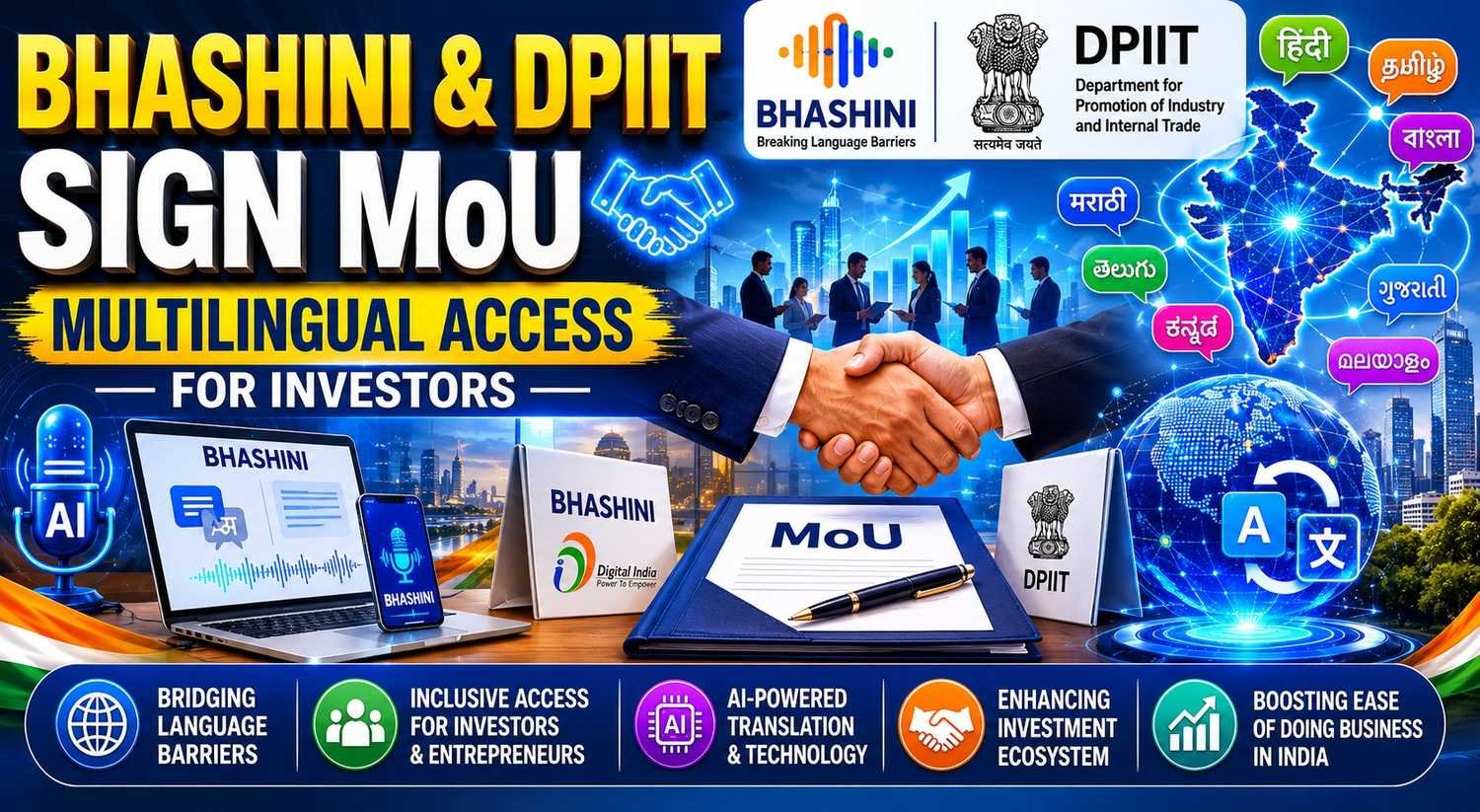
- The Digital India BHASHINI Division (DIBD) and the Department for Promotion of Industry and Internal Trade (DPIIT) have signed a Memorandum of Understanding (MoU) under the “BHASHINI Seva/Sanchalan – A BHASHINI Sahayogi Program.”
- The partnership aims to enhance multilingual digital capabilities across India’s industrial, startup, investment, and business ecosystem by leveraging the BHASHINI Platform, India’s National Language Digital Public Infrastructure.
Objective of the Collaboration
The MoU seeks to enable multilingual access, governance, and service delivery across DPIIT’s digital platforms in all 22 languages recognized under the Eighth Schedule of the Constitution of India.
The initiative will allow:
- Entrepreneurs
- Startups
- Investors
- Businesses
- Citizens
to access government information and services in their preferred language, thereby reducing language barriers and improving accessibility.
Key Areas of Cooperation
Under the agreement, DPIIT and the BHASHINI team will collaborate to implement multilingual capabilities through several BHASHINI initiatives, including:
1. BHASHINI Udyat: Supports multilingual access for entrepreneurs and businesses.
2. BHASHINI Mitra: Provides language assistance and multilingual interaction capabilities.
3. BHASHINI AppMitra: Facilitates multilingual integration into digital applications.
4. BHASHINI Pravakta: Enables advanced speech and voice-based multilingual communication.
Additionally, the collaboration will focus on:
- Translation API integration
- Domain-specific language model development
- Multilingual glossary creation
- Voice-enabled technologies
- Linguistic dataset development
- AI-powered language solutions
Strengthening India’s Investment Ecosystem
The initiative aims to create a more inclusive investment and industrial ecosystem by ensuring that language does not become a barrier to participation in economic growth.
The partnership will facilitate:
- Easier access to government schemes and policies
- Improved startup and industrial services
- Better investor communication
- Enhanced citizen engagement
- Wider participation in entrepreneurship and innovation
Focus on Multilingual AI Development
A key component of the collaboration is the development of multilingual Artificial Intelligence models tailored to sectors such as:
- Investment promotion
- Industrial development
- Innovation
- Entrepreneurship
- Manufacturing
The initiative will support seamless voice-first multilingual experiences across India’s diverse linguistic landscape.
Capacity Building and Language Data Development
The MoU also promotes:
- Language data contribution initiatives
- Capacity-building programs
- Awareness campaigns
- Adoption of multilingual AI tools
- Collaboration among institutions and stakeholders connected with DPIIT
These efforts are expected to strengthen India’s indigenous language technology ecosystem.
Role of BHASHINI in Digital Governance
The collaboration further reinforces the importance of the BHASHINI platform in India’s digital transformation journey.
BHASHINI is emerging as a population-scale language infrastructure that supports:
- Inclusive governance
- AI-driven public services
- Multilingual communication
- Digital accessibility
About BHASHINI
- The Digital India BHASHINI Division (DIBD) functions under the Digital India Corporation and the Ministry of Electronics and Information Technology (MeitY).
- Through the National Hub for Language Technology (NHLT), BHASHINI provides AI-driven speech and text services in multiple Indian languages.
Key Achievements of BHASHINI
- Powers over 800 government websites
- Processes more than 15 million AI inferences daily
- Supports 36 Indian text languages
- Supports 23 Indian voice languages
- Supports 35 international languages
- Promotes open-source innovation and multilingual AI research
- Supports startups and academic collaborations
Significance of the MoU
The DPIIT–BHASHINI partnership aligns with the Government of India’s vision of ensuring that every citizen can participate in economic opportunities regardless of language barriers.
By integrating multilingual AI and language technologies into the investment ecosystem, the initiative is expected to:
- Improve ease of doing business
- Enhance digital inclusion
- Expand access to government services
- Strengthen India’s startup ecosystem
- Promote broader participation in economic growth