

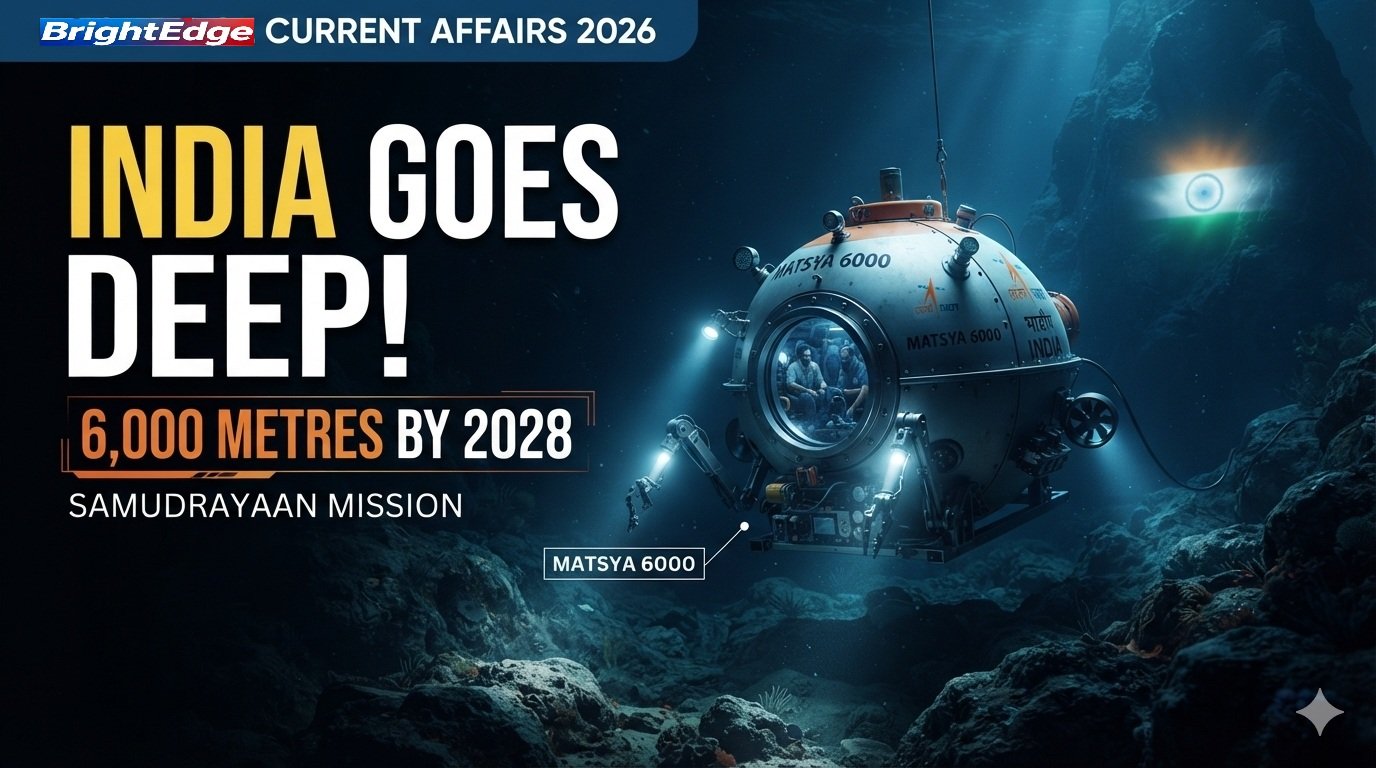
India is preparing to achieve a historic milestone in deep-ocean exploration, with the country targeting its first human deep-sea mission to a depth of 6,000 metres by 2028. Union Minister of State for Science and Technology Dr Jitendra Singh announced the development on November 4, 2026, during the Indo-Pacific Regional Dialogue 2026.
The ambitious initiative will be undertaken under India’s flagship Deep Ocean Mission (DOM) through the Samudrayaan Project, featuring the indigenous human-occupied submersible MATSYA 6000.
The mission aims to strengthen India’s capabilities in deep-sea exploration, marine research, underwater technology and the sustainable utilisation of ocean resources.
India Targets First Human Deep-Sea Mission by 2028
- Speaking at the Indo-Pacific Regional Dialogue 2026, Union Minister Dr Jitendra Singh stated that India is progressing towards sending its first human deep-sea mission to a depth of up to 6,000 metres by 2028.
- He highlighted the growing integration of ocean sciences, space technology, nuclear science, geology, electronics and robotics in advancing India’s deep-ocean capabilities.
- The announcement represents an important step in India’s ambition to become a leading nation in deep-sea exploration and strengthen its strategic position in the Indian Ocean region.
- According to the minister, India’s indigenous capabilities are being strengthened through institutions such as the National Institute of Ocean Technology (NIOT), Chennai.
What is the Samudrayaan Mission?
Samudrayaan is India’s first manned deep-ocean exploration initiative launched under the Deep Ocean Mission in 2021.
The project aims to develop an indigenous human-occupied submersible capable of carrying three scientists to a depth of 6,000 metres beneath the ocean surface.
The mission is being implemented by the National Institute of Ocean Technology (NIOT), Chennai, under the Ministry of Earth Sciences.
Its primary objectives include:
- Exploring unexplored regions of the deep ocean.
- Studying marine biodiversity and deep-sea ecosystems.
- Investigating valuable mineral resources.
- Collecting deep-sea samples for scientific research.
- Developing indigenous underwater technologies.
- Strengthening India’s Blue Economy.
MATSYA 6000: India’s Indigenous Deep-Sea Submersible
The most important component of the Samudrayaan Mission is MATSYA 6000, an advanced human-occupied underwater vehicle designed to carry three aquanauts to a depth of 6,000 metres.
The submersible is being developed using indigenous technologies to withstand the extreme pressure and low temperatures found in the deep ocean.
Key Features of MATSYA 6000
- Maximum Operating Depth: 6,000 metres below sea level.
- Crew Capacity: Three human occupants.
- Personnel Sphere: Approximately 2.26 metres in diameter.
- Material: Titanium alloy (Ti-6Al-4V ELI grade).
- Hull Thickness: Approximately 80 mm.
- Pressure Resistance: Designed to withstand external pressure of approximately 600 bar.
- Operational Endurance: Designed for 12 hours of normal operation and up to 96 hours in emergency conditions.
The personnel sphere is being developed through collaboration between the National Institute of Ocean Technology (NIOT) and the Vikram Sarabhai Space Centre (VSSC) of ISRO.
The titanium personnel sphere is one of the mission’s most critical technological achievements because it must protect the crew against enormous underwater pressure.
Major Progress in the Samudrayaan Mission
India has already achieved several important milestones in developing MATSYA 6000.
- 2021: Deep Ocean Mission launched by the Government of India.
- 2022: Samudrayaan’s objectives and development plans were outlined by the Ministry of Earth Sciences.
- January–February 2025: Wet harbour trials of MATSYA 6000 were conducted at L&T Harbour, Katupalli, near Chennai.
- July 2025: ISRO’s Vikram Sarabhai Space Centre announced its collaboration with NIOT for developing the titanium personnel sphere.
- February 2026: The Government reported the completion of the design and system engineering of MATSYA 6000.
- November 2026: Union Minister Jitendra Singh outlined India’s target of conducting its first human deep-sea mission by 2028.
The latest announcement provides an updated target for India’s ambitious underwater exploration programme.
What is India’s Deep Ocean Mission?
- The Deep Ocean Mission was approved by the Union Cabinet in June 2021 with an initial financial outlay of approximately ₹4,077 crore over five years.
- It is a multidisciplinary initiative led by the Ministry of Earth Sciences to develop technologies for exploring the largely unexplored deep ocean.
The mission has six major components:
- Development of technologies for deep-sea mining, human submersibles and underwater robotics.
- Development of ocean climate change advisory services.
- Technological innovations for deep-sea biodiversity exploration and conservation.
- Deep-ocean survey and exploration.
- Development of technologies for energy and freshwater from the ocean.
- Establishment of an Advanced Marine Station for Ocean Biology.
The mission is expected to contribute significantly to India’s scientific research, technological development and Blue Economy.
Why is the 6,000-Metre Deep-Sea Mission Important for India?
The Samudrayaan Mission is strategically important because the deep ocean contains valuable mineral resources and unexplored marine ecosystems.
1. Exploration of Critical Minerals
- Deep-sea exploration can help India investigate mineral resources such as nickel, cobalt, manganese and other strategically important materials.
- These minerals are essential for several industries, including electric vehicles, renewable energy technologies, electronics and advanced manufacturing.
2. Strengthening the Blue Economy
- The mission will support India’s vision of developing a sustainable Blue Economy through the responsible utilisation of ocean resources.
3. Advancement in Indigenous Technology
- Developing MATSYA 6000 will strengthen India’s capabilities in underwater robotics, pressure-resistant materials, navigation, communication and life-support systems.
4. Marine Biodiversity Research
- The mission will enable scientists to study unexplored marine ecosystems, discover new species and improve understanding of deep-sea biodiversity.
5. Strategic Importance
- Advanced deep-ocean exploration capabilities can strengthen India’s maritime research infrastructure and strategic presence in the Indian Ocean region.
India Joins an Elite Group of Deep-Sea Exploration Nations
- Human exploration at depths of 6,000 metres requires highly sophisticated engineering and life-support technology.
- The development of MATSYA 6000 represents India’s ambition to establish indigenous capabilities in this specialised field.
- The initiative will also strengthen international scientific cooperation and India’s position in global ocean research.
Click here to read: ISRO Launches NVS-03 Satellite
Click here to read: Vikram-1 Launch Successful
Click here to read: India’s GalaxEye Launches World’s First OptoSAR Satellite ‘Drishti’