

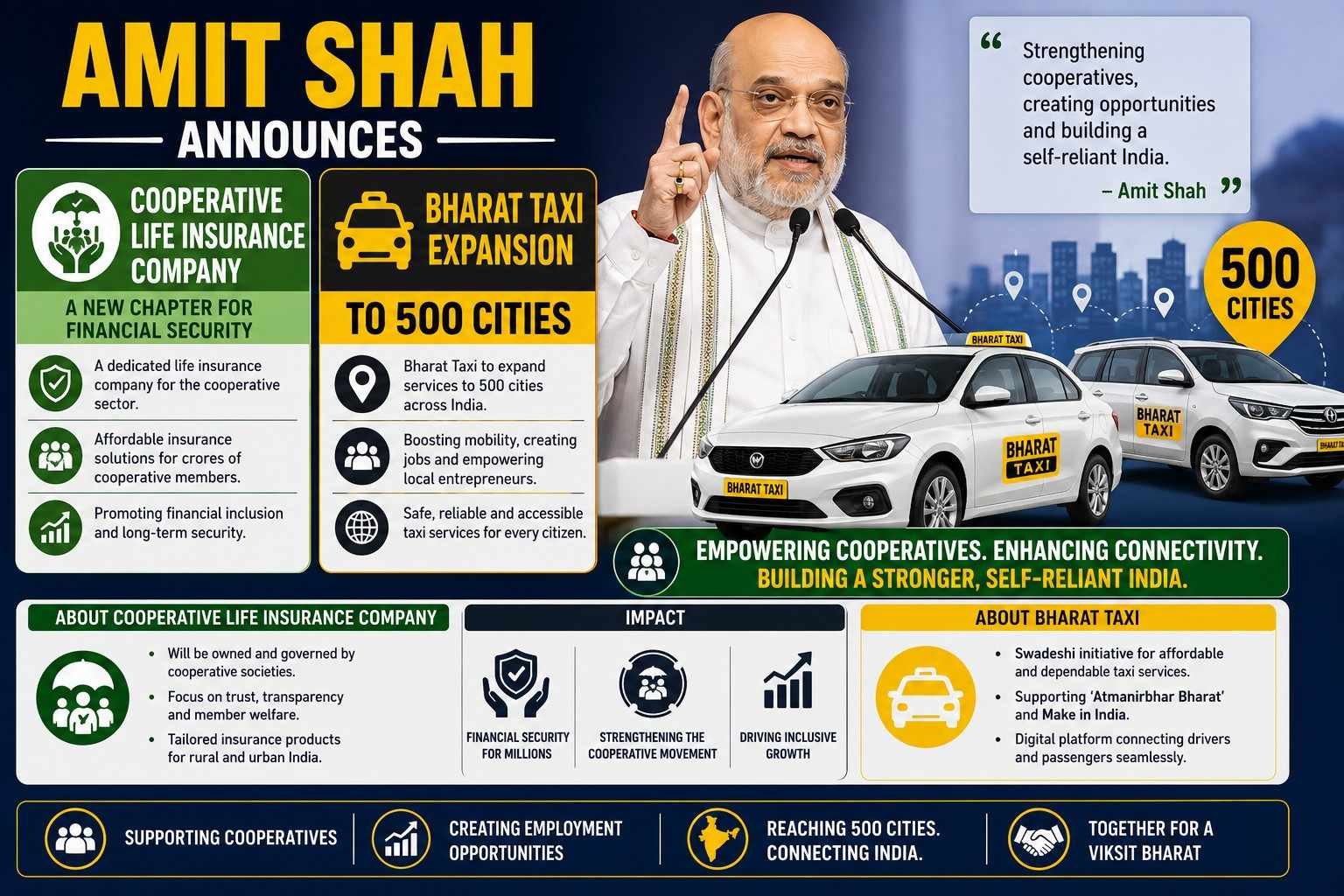
- India’s cooperative sector is set for a major transformation as Union Home and Cooperation Minister Amit Shah announced the establishment of a cooperative life insurance company and an ambitious plan to expand the Bharat Taxi platform to 500 cities within the next two years.
- The announcements were made during the 5th Foundation Day celebrations of the Ministry of Cooperation in New Delhi, where the minister also unveiled a series of reforms aimed at modernising the cooperative ecosystem through technology, infrastructure development, professional management and greater transparency.
Cooperative Life Insurance Company to Be Launched
- One of the biggest announcements was the government’s decision to establish a cooperative life insurance company.
- According to Amit Shah, the new insurer will enable cooperatives to expand beyond their traditional sectors and strengthen their presence in India’s insurance industry.
- Currently, India has 26 life insurance companies, and the proposed cooperative insurer is expected to provide an additional platform for cooperative institutions and their members.
- The minister noted that IFFCO-TOKIO General Insurance, promoted by the Indian Farmers Fertiliser Cooperative (IFFCO), has already demonstrated the success of cooperative participation in the insurance sector.
- The proposed life insurance company is expected to:
- Expand cooperative business opportunities.
- Increase insurance penetration.
- Strengthen financial inclusion.
- Generate new revenue streams for cooperative institutions.
Bharat Taxi to Expand to 500 Cities
Amit Shah also announced a significant expansion of Bharat Taxi, India’s cooperative-based ride-hailing platform.
Expansion Plan
The service will be extended to 500 cities over the next two years, making it one of the country’s largest cooperative mobility platforms.
Current Scale
- 6.37 lakh registered drivers
- 35.77 lakh registered customers
Present Operations
Bharat Taxi currently operates in:
- Delhi-NCR
- Gujarat
- Lucknow
- Chandigarh
- Mumbai
- Jaipur
- Kanpur
Upcoming Cities
The platform will soon expand to:
- Ranchi
- Patna
- Guwahati
- Bhopal
- Kolkata
- Indore
- Nagpur
The initiative is managed by Sahakar Taxi Cooperative Limited, which follows a driver-centric cooperative business model.
Cooperatives Expanding Beyond Traditional Sectors
Amit Shah highlighted that India’s cooperative movement is no longer limited to dairy, sugar, banking and fertilisers.
The sector is now expanding into:
- Insurance
- Mobility services
- Seed production
- Healthcare
- Retail
- Digital services
- Fuel distribution
- Warehousing
A newly established national cooperative for seed production is expected to become India’s largest non-government seed producer within three years.
PACS Becoming Multi-Service Centres
The government has significantly expanded the role of Primary Agricultural Credit Societies (PACS).
Model bye-laws now allow PACS to undertake more than 25 business activities, including:
- Retail stores
- Warehousing
- Healthcare services
- Fuel outlets
- Digital services
Progress So Far
- 394 PACS have applied for fuel retail outlets.
- 3 fuel outlets have already become operational.
- 54,000+ PACS now function as Common Service Centres (CSCs).
- 4,248 PACS have been approved as Jan Aushadhi Kendras.
50,000 PACS to Become e-PACS
Another major milestone announced was the digital transformation of 50,000 PACS into e-PACS.
The initiative aims to improve:
- Transparency
- Digital record-keeping
- Governance
- Service delivery
- Financial inclusion
The government believes digitisation will strengthen grassroots cooperative institutions and improve access to government services.
Tribhuvan Sahkari University to Build Skilled Workforce
To improve professional management within the cooperative sector, Amit Shah announced the establishment of Tribhuvan Sahkari University at Anand, Gujarat.
The university will train professionals in:
- Cooperative Banking
- Dairy Management
- Agriculture
- Fertiliser Management
- Marketing
- Cooperative Administration
Appointments in cooperative institutions will increasingly be made on the basis of merit, helping improve transparency and reduce corruption.
Major Infrastructure Projects Launched
During the event, Amit Shah also inaugurated and laid the foundation stone for several cooperative infrastructure projects.
These include:
- Transfer of 135 grain storage godowns (75,000-tonne capacity).
- Inauguration of 85 grain storage godowns.
- Foundation stone for 47 additional grain storage facilities.
- Launch of Sahakar Van by Amul and NCCF.
- Tissue culture facilities by Bharatiya Beej Sahakari Samiti Ltd. (BBSSL) in Uttar Pradesh and Maharashtra.
- MoU between BBSSL and ICAR to strengthen India’s seed ecosystem.
Vision for Viksit Bharat 2047
- The cooperative movement will play a crucial role in achieving the goal of Viksit Bharat 2047.
- According to him, strengthening cooperatives through technology, infrastructure, professional management and new business opportunities will improve rural livelihoods, promote inclusive growth and increase public trust in cooperative institutions.
Conclusion
The announcements made on the 5th Foundation Day of the Ministry of Cooperation mark one of the most comprehensive reform packages for India’s cooperative sector in recent years. From launching a cooperative life insurance company and expanding Bharat Taxi to modernising PACS and investing in infrastructure, the government aims to transform cooperatives into dynamic engines of economic growth and rural development.
With over 8.5 lakh cooperative societies and 30 crore members, these initiatives could significantly reshape India’s cooperative ecosystem while supporting the broader vision of Viksit Bharat 2047.