

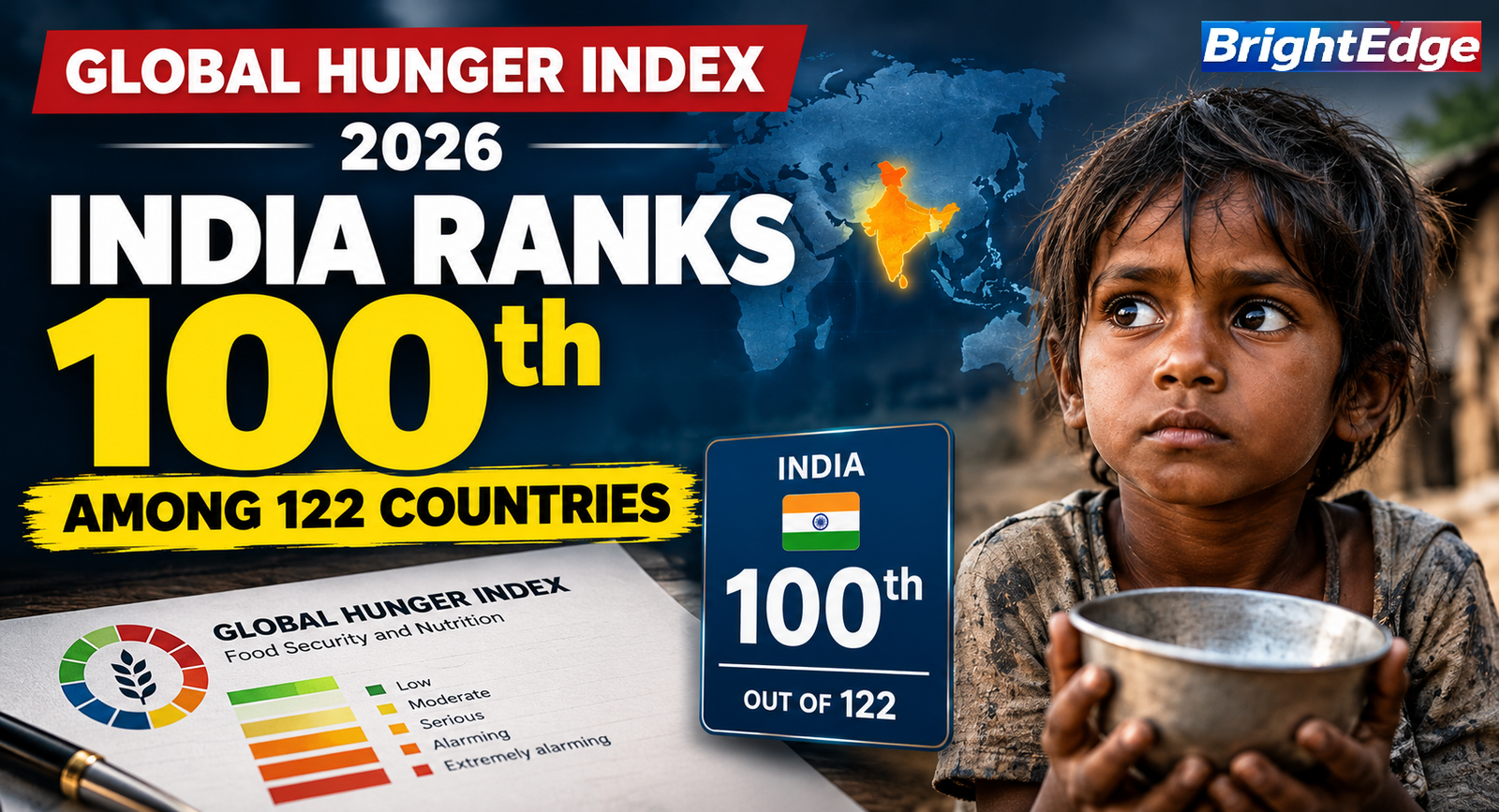
The Global Hunger Index 2026 has placed India at 100th position among 122 countries for which sufficient data were available to calculate scores. India’s score stands at 24.1 on a 100-point scale, corresponding to the serious hunger category.
The findings highlight a complex picture of India’s food and nutrition situation. Several indicators have improved over the long term, but persistent malnutrition among children remains a major challenge.
According to the official country profile published by the Global Hunger Index, 9.8% of India’s population is undernourished, 29.3% of children under five are affected by stunting, and 19.0% experience wasting. The under-five mortality rate used in the index is 2.7%.
The report is relevant to discussions about food security, public health, poverty reduction and progress towards the United Nations Sustainable Development Goals.
Global Hunger Index 2026: Key Highlights
Here are the most important facts from the latest edition:
- India’s rank: 100th.
- Countries ranked: 122.
- India’s GHI score: 24.1 out of 100.
- Hunger severity category: Serious.
- Undernourishment: 9.8% of the population.
- Child stunting: 29.3% of children under five.
- Child wasting: 19.0% of children under five.
- Under-five mortality: 2.7%.
- South Asia’s GHI score: 23.5.
- Global GHI score: 18.2.
- Report theme: No Security Without Food Security.
Source: Official Global Hunger Index 2026 report and India country profile.
What Is the Global Hunger Index?
The Global Hunger Index (GHI) is an annual assessment designed to measure and track hunger at global, regional and national levels.
It is jointly published by Concern Worldwide, Welthungerhilfe, and the Institute for International Law of Peace and Armed Conflict (IFHV), with Helvetas also involved in the 2026 report.
The index combines multiple indicators rather than relying exclusively on food availability or the number of people experiencing undernourishment.
Its methodology considers four dimensions:
- Undernourishment among the population.
- Child stunting.
- Child wasting.
- Mortality among children under five.
These indicators capture different aspects of hunger and undernutrition, including inadequate dietary energy, chronic nutritional deficiencies, acute malnutrition and associated health risks.
The GHI score ranges from 0 to 100. A lower score indicates a less severe hunger situation, while a higher score indicates more severe hunger.
The index is intended to help policymakers, researchers and development organisations understand hunger trends and identify areas requiring further attention.
Top 30 Countries in the Global Hunger Index 2026
| Rank | Country |
| 1-24 | Armenia |
| 1-24 | Belarus |
| 1-24 | Bosnia & Herzegovina |
| 1-24 | Bulgaria |
| 1-24 | Chile |
| 1-24 | China |
| 1-24 | Costa Rica |
| 1-24 | Croatia |
| 1-24 | Estonia |
| 1-24 | Georgia |
| 1-24 | Hungary |
| 1-24 | Kuwait |
| 1-24 | Latvia |
| 1-24 | Lithuania |
| 1-24 | Montenegro |
| 1-24 | North Macedonia |
| 1-24 | Paraguay |
| 1-24 | Romania |
| 1-24 | Russian Federation |
| 1-24 | Serbia |
| 1-24 | Türkiye |
| 1-24 | United Arab Emirates |
| 1-24 | Uruguay |
| 1-24 | Uzbekistan |
| 25 | Moldova |
| 26 | Mongolia |
| 27 | Argentina |
| 27 | Azerbaijan |
| 27 | Brazil |
| 30 | Dominican Republic |
Worst Performing Countries in the Global Hunger Index 2026
| Rank | Country |
| 122 | Somalia |
| 121 | Dem. Rep. of the Congo |
| 120 | Chad |
| 119 | Madagascar |
| 118 | Haiti |
Why Has India Ranked 100th in the Global Hunger Index 2026?
- India’s 100th-place ranking reflects its combined performance across the four indicators used to calculate the Global Hunger Index.
- The country’s score of 24.1 places it in the serious category.
- However, the ranking should not be interpreted as a complete assessment of India’s agricultural production, food distribution system, economic growth or overall development.
- The GHI measures specific dimensions of hunger and nutrition. Its results must therefore be understood within the scope of its methodology.
- India has experienced long-term improvements in several nutrition indicators. Nevertheless, the persistence of undernourishment, child stunting and child wasting indicates that improvements have not eliminated nutritional challenges.
- The latest report reinforces the importance of looking beyond headline rankings to examine the individual indicators that contribute to a country’s score.
Child Stunting in India: Why the Indicator Matters
- Child stunting is one of the most important indicators in the Global Hunger Index.
- Stunting refers to low height for age and is generally associated with chronic undernutrition, recurrent illness and other factors that affect a child’s growth and development.
- According to the official 2026 India profile, 29.3% of children under five are affected by stunting.
- The corresponding figure for 2000 was 50.0%, indicating a decline of 20.7 percentage points over the period.
- This long-term improvement is significant, but the current level means that nearly three in every ten children under five are still affected.
- Addressing stunting requires attention to maternal nutrition, adequate diets, access to healthcare, sanitation, safe drinking water and appropriate infant and young-child feeding practices.
- Nutrition interventions are most effective when these factors are addressed together rather than in isolation.
Child Wasting Remains a Major Concern
- Child wasting refers to low weight for height. It is associated with acute undernutrition and can increase a child’s vulnerability to illness and other adverse health outcomes.
- The Global Hunger Index 2026 reports that 19.0% of children under five in India are affected by wasting.
- This is an important concern because wasting can indicate recent or ongoing nutritional deprivation, illness or other conditions that affect a child’s weight relative to height.
- The 2026 findings also highlight the uneven nature of progress across India’s nutrition indicators. Improvements in stunting and undernourishment do not necessarily mean that every dimension of child nutrition is improving at the same rate.
- Preventing and treating wasting requires timely identification, access to appropriate healthcare and nutrition services, and attention to the conditions that contribute to acute malnutrition.
India’s Four Global Hunger Index Indicators
The 2026 India country profile reports the following figures:
| Indicator | India’s 2026 figure | What it measures |
|---|---|---|
| Undernourishment | 9.8% | Share of the population with insufficient dietary energy intake |
| Child stunting | 29.3% | Share of children under five with low height for their age |
| Child wasting | 19.0% | Share of children under five with low weight for their height |
| Under-five mortality | 2.7% | Share of children who die before reaching age five |
These figures describe different aspects of hunger and nutrition. They should not be added together or interpreted as four estimates of the same population.
The GHI combines the indicators using its established methodology to calculate an overall score.
India vs South Asia and the Global Average
The Global Hunger Index 2026 reports a score of 23.5 for South Asia and 18.2 for the world.
India’s score of 24.1 is higher than both figures, indicating greater hunger severity under the index’s scoring framework.
| Region or country | GHI score in 2026 |
|---|---|
| India | 24.1 |
| South Asia | 23.5 |
| World | 18.2 |
These figures provide context for India’s position within the wider regional and global nutrition landscape.
Regional averages, however, can conceal substantial differences between countries and communities. They should not be used as substitutes for country-specific data or detailed assessments of local food insecurity.
India vs Pakistan and Bangladesh: What Does the Ranking Show?
- The 2026 ranking also provides a basis for examining India’s position relative to neighbouring countries.
- India ranks 100th with a score of 24.1. Pakistan ranks 106th with a score of 25.5, according to the official ranking database.
- The ranking table places countries with identical scores at the same rank. It also groups 24 countries with scores below 5 into positions 1–24 because the differences between their scores are minimal.
- For comparisons involving Bangladesh, readers should consult the official 2026 country-level ranking and data rather than relying on historical rankings or figures from earlier editions.
- More broadly, comparisons between countries should account for the four indicators, the data years used and the methodology of the index.
- A country’s rank alone does not explain the underlying causes of its hunger or nutrition outcomes.
Why Food Security Matters for India’s Development
- Food security involves more than producing sufficient quantities of food. People must also be able to access adequate, safe and nutritious diets consistently.
- Several factors can influence nutrition outcomes, including household income, food prices, agricultural productivity, public distribution systems, maternal health, sanitation, access to healthcare and dietary diversity.
- Children are particularly vulnerable because nutritional deficiencies during early life can affect physical growth and development.
- Improving nutrition therefore requires coordinated action across healthcare, agriculture, education, sanitation and social protection.
- The Global Hunger Index offers one framework for assessing progress, while national surveys and administrative data provide additional information about local conditions and the effectiveness of specific programmes.
What Does the Global Hunger Index 2026 Mean for India?
- The latest findings present two important messages.
- First, India’s long-term GHI score has improved substantially compared with its 2006 reference-year score.
- Second, the country remains in the serious hunger category, and child malnutrition continues to affect a considerable proportion of young children.
- The decline in child stunting demonstrates progress in one important area. At the same time, the reported level of wasting highlights the need for sustained attention to acute malnutrition and child health.
- For policymakers, the challenge is to maintain improvements in food access while ensuring that nutritional support reaches vulnerable households and children.
- For researchers and citizens, the key lesson is to examine the underlying indicators instead of relying on the headline ranking alone.
Click Here To Read: India’s Passport Rank Rises to 84th in 2026