

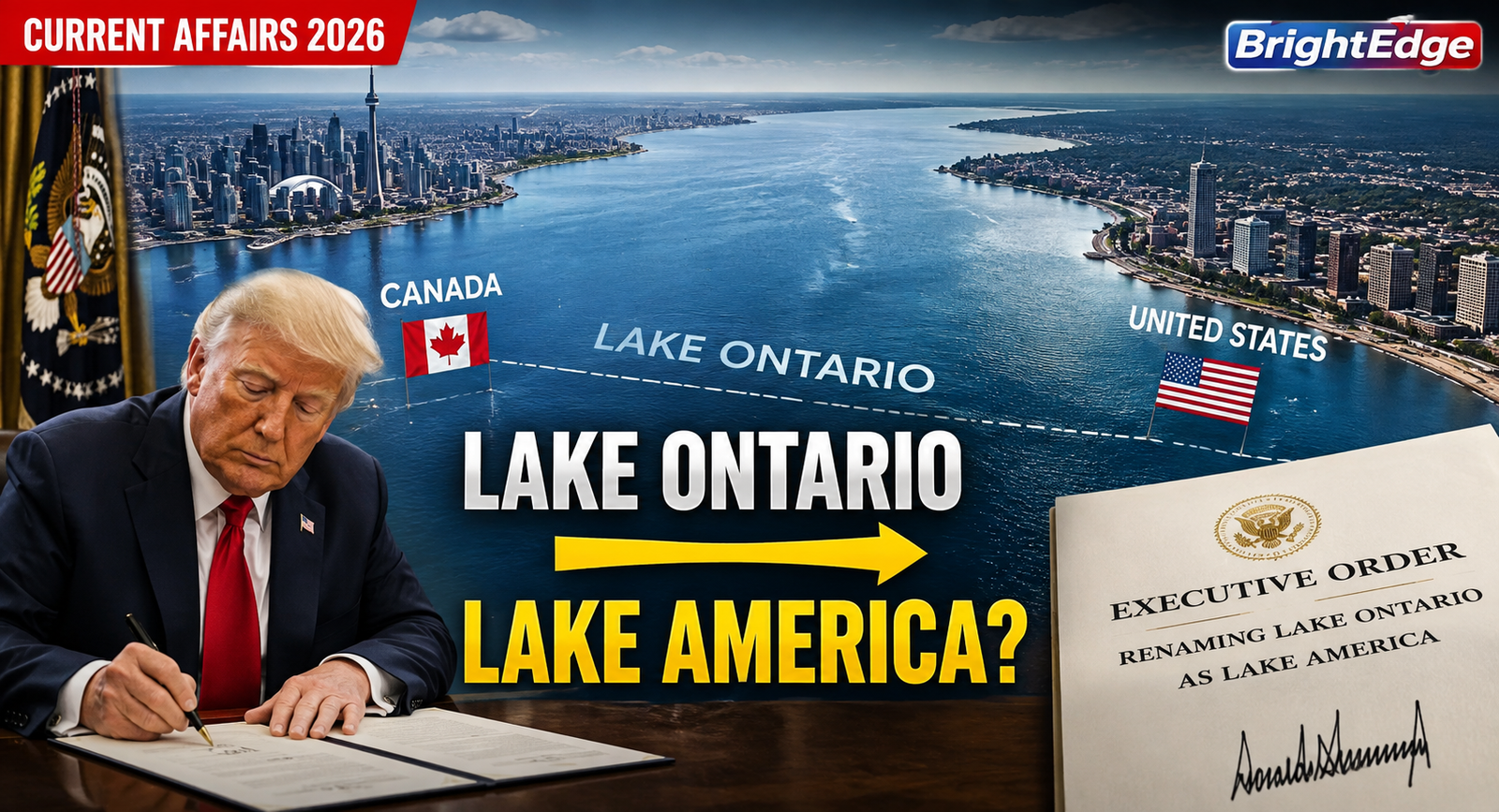
President Donald Trump has ordered Lake Ontario to be renamed “Lake America” for U.S. federal government use, triggering a fresh diplomatic controversy with Canada. The move comes amid already strained U.S.-Canada trade relations.
President Donald Trump has signed an executive order directing the U.S. federal government to rename Lake Ontario as “Lake America” in official American geographic records.
The order, signed on August 27, 2026, directs the U.S. government to implement the new name through federal geographic naming systems. However, the decision does not give the United States authority to force Canada, international organizations or private mapping companies to adopt the new name.
The announcement has quickly become a major international talking point because Lake Ontario is a shared body of water between the United States and Canada.
What Did Trump Order?
- Trump’s executive order is titled “Honoring the American History of the Great Lakes and Renaming Lake Ontario as Lake America.”
- Under the order, U.S. federal agencies are directed to use “Lake America” when referring to the lake in federal documents, maps and geographic databases.
- The White House has described the action as part of its effort to recognize what it calls the American history and significance of the Great Lakes.
- Trump announced the change in the Oval Office while displaying a map showing the proposed name “Lake America.”
- The president had previously pursued a similar geographical renaming initiative by directing U.S. federal agencies to use “Gulf of America” instead of “Gulf of Mexico” for U.S. federal purposes.
Why Is Lake Ontario Being Called Lake America?
- The renaming comes at a particularly sensitive moment in U.S.-Canada relations.
- Trump has been engaged in a prolonged trade dispute with Canada, with disagreements over tariffs and bilateral trade policies adding to tensions between Washington and Ottawa.
- The Lake Ontario announcement came shortly after trade negotiations between the two countries broke down, making the symbolic name change even more politically significant.
- Trump said he had been considering the lake’s renaming for some time, while also criticizing Canada’s treatment of the United States.
Canada Rejects the New Name
- Canada has rejected the U.S. renaming.
- Canadian Prime Minister Mark Carney has said Canadians will continue to call the body of water Lake Ontario.
- Carney also highlighted the historical origins of the name, pointing out that the name predates both the modern Canadian and American states.
- This means the lake could effectively have different official names depending on which country’s government is referring to it.
U.S. position:
Lake America
Canadian position:
Lake Ontario
The disagreement illustrates an important limitation of unilateral geographical renaming: a country can control the terminology used by its own government, but it cannot automatically impose that terminology on another sovereign country.
Can Trump Actually Rename Lake Ontario?
Yes—but only within the scope of U.S. federal authority.
- The executive order directs U.S. federal agencies to adopt the name Lake America. However, the United States cannot legally compel Canada to change its own official geographical terminology.
- Likewise, international organizations, foreign governments, private companies and mapmakers are not automatically required to recognize the new U.S. federal name.
- The distinction is important because Lake Ontario is a shared U.S.-Canada Great Lake, meaning that a unilateral U.S. naming decision does not automatically create a universally recognized international name.
Why Lake Ontario Is Historically Important
- Lake Ontario is one of North America’s five Great Lakes and forms part of the international boundary between the United States and Canada.
- The lake is connected to the other Great Lakes through the Great Lakes–St. Lawrence water system and has enormous importance for transportation, commerce, tourism, fisheries and regional ecosystems.
- Its name also has Indigenous historical roots.
- Canadian officials and Indigenous representatives have emphasized that the name Ontario has a history that goes back centuries and predates the creation of both modern countries.
- This historical dimension has made the proposed renaming particularly controversial.
U.S.-Canada Dispute Goes Beyond a Name
- The Lake America controversy is taking place against the backdrop of broader tensions between Washington and Ottawa.
- Trade disagreements, tariffs and failed negotiations have already strained relations between the two neighboring countries.
- Reuters reported that the renaming was accompanied by criticism from Canadian leaders, Indigenous groups and some U.S. officials.
- For critics, the name change is therefore not simply a geographical decision. They see it as another symbolic flashpoint in an increasingly contentious U.S.-Canada relationship.
What Will Maps Call the Lake?
- This is one of the biggest questions following Trump’s order.
- U.S. federal government maps and geographic databases are expected to begin using Lake America.
- However, different mapmakers and governments may continue using Lake Ontario.
- The earlier controversy over the U.S. government’s use of “Gulf of America” demonstrated that geographical names can differ between U.S. government usage and international or private usage.
- Therefore, people may encounter both names depending on the map, website, country or organization they are using.
Will Canada Change Its Maps?
- Canada has indicated that it will continue using Lake Ontario.
- Canadian Prime Minister Mark Carney has rejected the U.S. naming change and emphasized the lake’s historical name.
- As a result, Canadian government documents and maps are expected to continue referring to the body of water as Lake Ontario.
What Does the Lake America Dispute Mean?
- The immediate practical effect on ordinary people is likely to be limited.
- The lake itself has obviously not changed. Its geographic location, borders, waterways and physical characteristics remain exactly the same.
- The major impact is political, diplomatic and symbolic.
- The dispute highlights how geographical names can become instruments of national identity and political messaging.
- It also raises questions about who has the authority to rename geographical features that are shared between two countries.
Key Facts at a Glance
| Point | Details |
|---|---|
| Existing name | Lake Ontario |
| New U.S. federal name | Lake America |
| Ordered by | U.S. President Donald Trump |
| Executive order | Signed August 27, 2026 |
| Applies to | U.S. federal government usage |
| Canada’s position | Continues to use Lake Ontario |
| Location | U.S.-Canada Great Lakes region |
| Main issue | Diplomatic and political dispute over geographical naming |
Lake Ontario vs Lake America: What Happens Next?
- The controversy is likely to continue as U.S. agencies implement the executive order and Canada maintains its existing terminology.
- The disagreement could also affect international maps, educational materials, digital mapping platforms and media organizations, although each organization will ultimately determine how it handles the competing names.
- For now, the clearest description is that Lake Ontario has been ordered to be called “Lake America” in U.S. federal usage, while Canada continues to recognize it as Lake Ontario.
- That distinction is crucial.
- The executive order changes the terminology used by the U.S. federal government; it does not erase the historical name internationally or force Canada to adopt the new designation.
Conclusion
- President Donald Trump’s decision to rename Lake Ontario as “Lake America” has opened another unusual chapter in U.S.-Canada relations.
- While the United States can direct its federal agencies to use the new name, Canada has rejected the change and continues to call the lake Lake Ontario.
- The controversy is therefore about much more than a name. It touches on national sovereignty, Indigenous history, diplomacy and the limits of unilateral geographical renaming.
- For the foreseeable future, the lake is likely to remain Lake Ontario in Canada and Lake America in U.S. federal usage—making this one of the most unusual geographical disputes between the two neighboring countries.
Click Here to Read: TIME 100 Most Influential People 2026