

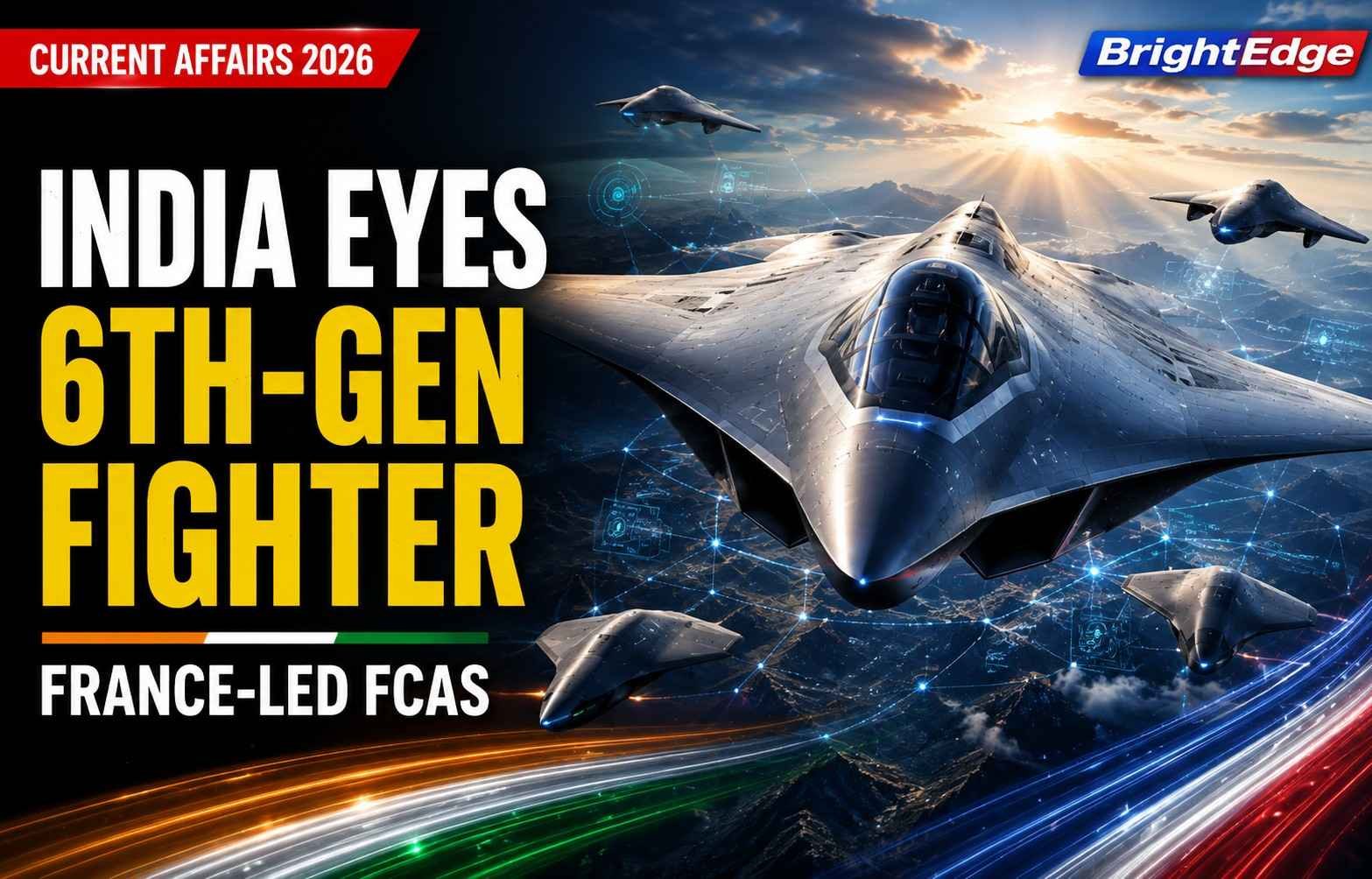
India is stepping up its plans for a sixth-generation fighter jet, with the Ministry of Defence initiating efforts to co-join the French-led Future Combat Air System (FCAS) programme. The move could give India a potential pathway into next-generation combat aviation while complementing its indigenous AMCA programme.
India’s 6th-Gen Fighter Push Gains Momentum
- India has taken a significant step towards its future air-power ambitions.
- According to the latest information presented to Parliament, the Ministry of Defence has initiated efforts to co-join the Future Combat Air System (FCAS), a French-led sixth-generation fighter aircraft development programme. The Parliamentary Standing Committee on Defence has also asked for a clear roadmap and tentative timeline for the development and acquisition of sixth-generation aircraft.
- The development is important because India is already pursuing the Advanced Medium Combat Aircraft (AMCA) as its indigenous next-generation fighter programme. A potential FCAS partnership would give India another route to access and participate in technologies that are expected to define future air combat.
What Is the FCAS Programme?
- The Future Combat Air System, or FCAS, is designed around the idea of a networked combat system rather than simply a conventional fighter aircraft.
- The concept involves a highly capable crewed fighter working alongside unmanned systems, sensors, weapons and a connected combat network.
Future sixth-generation combat aircraft are expected to place greater emphasis on:
- Advanced stealth
- Artificial intelligence
- Manned-unmanned teaming
- Autonomous or semi-autonomous drones
- Advanced electronic warfare
- Network-centric operations
- Long-range sensing and targeting
- Advanced weapons
- High-speed data sharing
- Optional manning and autonomous operations
The broader FCAS concept has been described as a system combining a core combat aircraft with uncrewed systems and other networked capabilities.
Why France Matters to India
- India already has a deepening strategic and defence relationship with France.
- The Indian Air Force operates French-origin Rafale fighters, while India and France have also been pursuing wider cooperation in areas including aerospace and propulsion.
- This existing relationship could potentially provide a foundation for deeper cooperation in future combat-aircraft technologies.
- However, India has not yet formally become a full FCAS development partner. The latest development should therefore be understood as an effort by New Delhi to explore and pursue participation rather than a completed acquisition or signed sixth-generation fighter contract.
What Does This Mean for the Indian Air Force?
- For the Indian Air Force, the sixth-generation fighter question is becoming increasingly important.
- India faces a long-term requirement to modernise its combat fleet while simultaneously developing indigenous aerospace capabilities.
- The Parliamentary Standing Committee on Defence has called for a trajectory and planning process for the development and acquisition of sixth-generation aircraft so that India does not fall behind in advanced combat aviation.
- A future sixth-generation capability could potentially provide the IAF with a combination of:
- Stealth + AI + drones + electronic warfare + networked combat
- That would represent a major evolution from the traditional fighter-aircraft model.
FCAS and AMCA: Competition or Complementary Programmes?
- One of the biggest questions is whether an international sixth-generation programme could affect India’s indigenous AMCA project.
- At present, the two can be viewed as potentially complementary rather than necessarily competing programmes.
- AMCA is intended to strengthen India’s domestic capability to design, develop and manufacture advanced combat aircraft.
- Participation in an international programme such as FCAS, meanwhile, could potentially expose Indian industry and engineers to technologies, manufacturing practices and systems-development expertise associated with future combat aviation.
- The parliamentary committee has also sought updates on the status of AMCA alongside the sixth-generation fighter roadmap.
Why India Is Looking Beyond Fifth-Generation Fighters
- The global air-power environment is changing rapidly.
- Modern combat aviation is moving beyond the idea of a fighter operating independently. Future warfare is increasingly expected to involve interconnected aircraft, drones, satellites, sensors, electronic-warfare systems and artificial intelligence.
- Sixth-generation aircraft are therefore generally described as part of a broader “system of systems” rather than simply a more advanced fighter jet.
- This is one reason India’s interest in sixth-generation technology has emerged even while AMCA remains a major national aerospace project.
Could India Co-Develop and Manufacture the Fighter?
Earlier reporting had indicated that India was exploring the possibility of working with France on co-development and co-manufacturing of a future sixth-generation fighter under FCAS.
If such cooperation eventually moves forward, the crucial issues for India would include:
- Workshare for Indian companies
- Technology transfer
- Indigenous manufacturing
- Intellectual-property rights
- Access to critical technologies
- Engine technology
- Radar and sensor technology
- Electronic warfare systems
- AI and autonomous systems
- Domestic maintenance and upgrades
For New Delhi, the value of participation would depend heavily on how much technological and industrial capability India could develop domestically rather than simply becoming an aircraft buyer.
What About the European FCAS Situation?
- The FCAS programme has also faced major political and industrial complications in Europe.
- Earlier in 2026, reporting indicated serious disagreements between France and Germany over the future of the programme and the division of work between major industrial players.
- The latest Indian parliamentary reporting, however, refers to the programme as being spearheaded by France and says the Ministry of Defence has initiated efforts to co-join it.
- This makes the exact future structure of FCAS particularly important for India.
- Before committing to a major partnership, New Delhi would need clarity on the programme’s industrial structure, development roadmap, technology-sharing arrangements and India’s potential role.
India Has Another Option: GCAP
- India’s sixth-generation fighter ambitions have previously been discussed in the context of two major international programmes.
- One is FCAS, associated with France and European partners.
- The other is the Global Combat Air Programme (GCAP) involving the United Kingdom, Italy and Japan.
- Earlier reports said India was evaluating possibilities involving both programmes.
- The latest parliamentary information, however, specifically points to India’s efforts to co-join the French-led FCAS programme.
What Could a Sixth-Generation Fighter Give India?
A successful Indian role in a sixth-generation programme could potentially provide long-term benefits beyond simply acquiring another fighter aircraft.
1. Advanced Aerospace Technology
India could gain exposure to technologies that are expected to dominate future combat aviation.
2. Stronger Defence Industry
Indian aerospace companies could potentially participate in the development and manufacturing ecosystem.
3. Greater Strategic Autonomy
Domestic participation could reduce long-term dependence on foreign suppliers for upgrades and critical capabilities.
4. Manned-Unmanned Teaming
A future fighter could operate alongside autonomous or remotely controlled combat drones.
5. AI-Enabled Warfare
Artificial intelligence could assist with sensor fusion, threat assessment, mission planning and decision support.
6. Network-Centric Combat
Future aircraft are expected to operate as nodes within a much larger battlefield network rather than as isolated platforms.
India’s Air-Power Strategy Is Entering a New Phase
India’s interest in FCAS represents a broader shift in its approach to combat aviation.
The country is simultaneously pursuing indigenous fighter development through AMCA while exploring international cooperation for technologies beyond today’s fifth-generation aircraft.
For the Indian Air Force, the objective is not simply to acquire a faster or stealthier fighter. The larger goal is to prepare for an era in which AI, autonomous drones, electronic warfare, sensors, data networks and manned aircraft operate as one integrated combat system.
India’s move toward the French-led FCAS programme is therefore significant—but it is still an early-stage strategic and developmental step, not a finalized sixth-generation fighter deal.
The coming years will reveal whether India can turn this interest into a meaningful co-development partnership and, ultimately, a sixth-generation combat-air capability.
Key Takeaways
- India has initiated efforts to co-join the French-led FCAS sixth-generation fighter programme.
- The development was highlighted in information provided to the Parliamentary Standing Committee on Defence.
- The committee has sought a roadmap and timeline for India’s sixth-generation fighter plans.
- India is simultaneously pursuing the indigenous AMCA programme.
- India’s indigenous AMCA (Advanced Medium Combat Aircraft) is generally associated with the fifth-generation category, although future iterations could incorporate more advanced capabilities.
- FCAS focuses on a broader networked combat system involving advanced aircraft and unmanned systems.
- India’s eventual participation would depend heavily on workshare, technology transfer and industrial participation.
- India has not yet finalized a sixth-generation fighter acquisition or full FCAS partnership.
- The development could become an important milestone in India’s long-term air-power modernisation strategy.
As of 2026, no country has an operational sixth-generation fighter jet in frontline service. Several countries, however, are developing or participating in sixth-generation combat-air programmes.
Countries involved in sixth-generation fighter programmes
| Country | Programme | Status |
|---|---|---|
| United States | NGAD (Next Generation Air Dominance) | Development/testing |
| China | Chinese next-generation fighter programme | Development/testing; details largely classified |
| France | FCAS / SCAF | Development |
| Germany | FCAS / SCAF | Development |
| Spain | FCAS / SCAF | Development |
| United Kingdom | GCAP | Development |
| Italy | GCAP | Development |
| Japan | GCAP | Development |
| India | Sixth-generation ambitions; exploring FCAS participation while developing AMCA | Early/planning stage |
| Sweden | Future combat-air studies / possible international cooperation | Research/planning |
Click Here to Read:Defence Council Clears Procurement of 114 Rafale Fighter Jets