

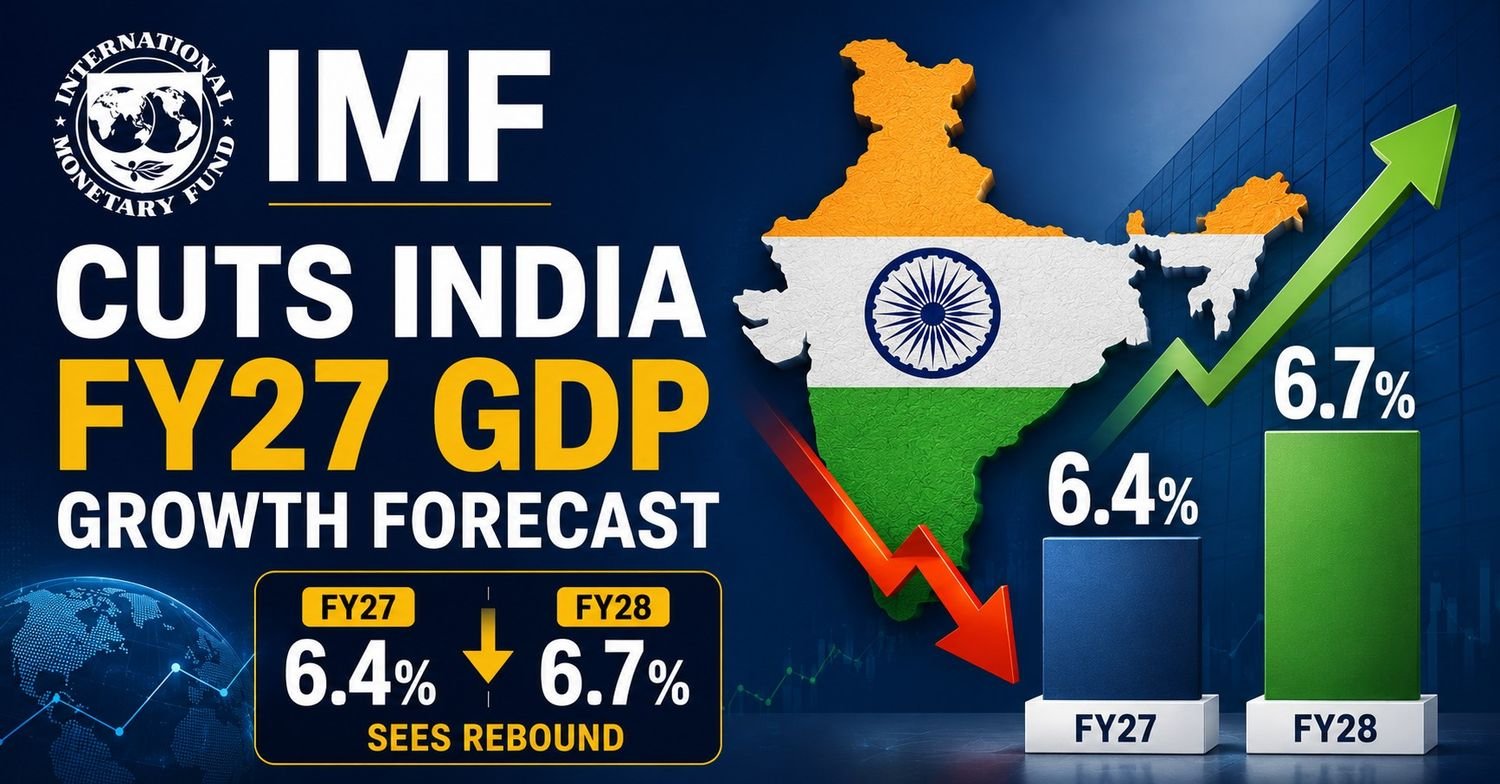
- The International Monetary Fund (IMF) has slightly lowered India’s GDP growth forecast for FY2026–27 to 6.4%, citing higher global energy prices and geopolitical tensions stemming from the West Asia conflict.
- Despite the downgrade, the IMF continues to project India as one of the fastest-growing major economies in the world, supported by resilient domestic demand, private consumption and a robust services sector.
- At the same time, the global lender has raised India’s FY2027–28 growth projection to 6.7%, reflecting expectations of easing global headwinds and sustained domestic economic momentum.
IMF Lowers FY27 Growth Forecast to 6.4%
- In its July 2026 World Economic Outlook (WEO) Update, the IMF revised India’s FY2026–27 GDP growth estimate to 6.4%, down from the 6.5% projected in April.
- Although the revision is modest, it reflects growing concerns over Rising crude oil prices, Geopolitical tensions in West Asia, Higher energy import costs and Global economic uncertainty
- The IMF noted that these factors could temporarily weigh on India’s economic expansion.
FY28 Outlook Improves to 6.7%
Despite trimming the near-term outlook, the IMF has upgraded India’s FY2027–28 growth forecast to 6.7%, up from its earlier estimate of 6.5%.
The improved outlook reflects expectations that:
- Energy prices will gradually stabilize.
- Global trade conditions will improve.
- Domestic demand will remain resilient.
- Policy reforms will continue to support investment and productivity.
India Remains the Fastest-Growing Major Economy
The IMF reiterated that India continues to outperform most major economies.
According to the Fund, India’s growth will be supported by:
- Strong private consumption
- Robust services sector activity
- Healthy domestic demand
- Resilient economic fundamentals
These factors continue to offset weakness arising from external global shocks.
Why Did IMF Cut the Forecast?
The IMF attributed the downward revision primarily to external risks rather than domestic weaknesses.
1. Higher Energy Prices
The conflict in West Asia has pushed global crude oil prices higher.
As India imports nearly 85% of its crude oil requirements, sustained high prices increase:
- Import bills
- Inflationary pressures
- Fiscal challenges
- Current account deficit risks
2. Geopolitical Uncertainty
Persistent geopolitical tensions have disrupted global trade and supply chains, creating uncertainty for investment and exports.
3. Global Economic Slowdown
Slower growth across advanced economies is expected to moderate external demand for Indian exports, affecting manufacturing and trade.
Domestic Economy Continues to Show Strength
Despite external challenges, the IMF highlighted several strengths of the Indian economy.
These include:
- Healthy household consumption
- Expanding services sector
- Continued economic resilience
- Strong domestic demand
The Fund believes these factors will continue to support India’s long-term growth trajectory.
Global Growth Also Revised Lower
The IMF also reduced its global growth outlook for 2026 to 3.0%, reflecting:
- Elevated geopolitical tensions
- Higher energy prices
- Inflationary pressures
- Trade fragmentation
However, it expects global growth to improve in 2027 as these pressures gradually ease.
What This Means for India
- Although the GDP forecast has been revised downward, the IMF’s assessment suggests that India’s growth story remains fundamentally strong.
- The slight downgrade mainly reflects external shocks rather than structural domestic weaknesses.
- A rebound to 6.7% in FY2027–28 indicates continued confidence in India’s long-term economic prospects, supported by consumption, services, policy reforms and resilient macroeconomic fundamentals.
Conclusion
The IMF’s latest World Economic Outlook underscores India’s resilience in an increasingly uncertain global environment. While higher energy prices and geopolitical tensions have prompted a modest reduction in the FY2027 growth forecast to 6.4%, India remains among the world’s fastest-growing major economies. With strong domestic demand and an improving outlook for FY2028, the country’s long-term growth prospects continue to remain positive despite global headwinds.