

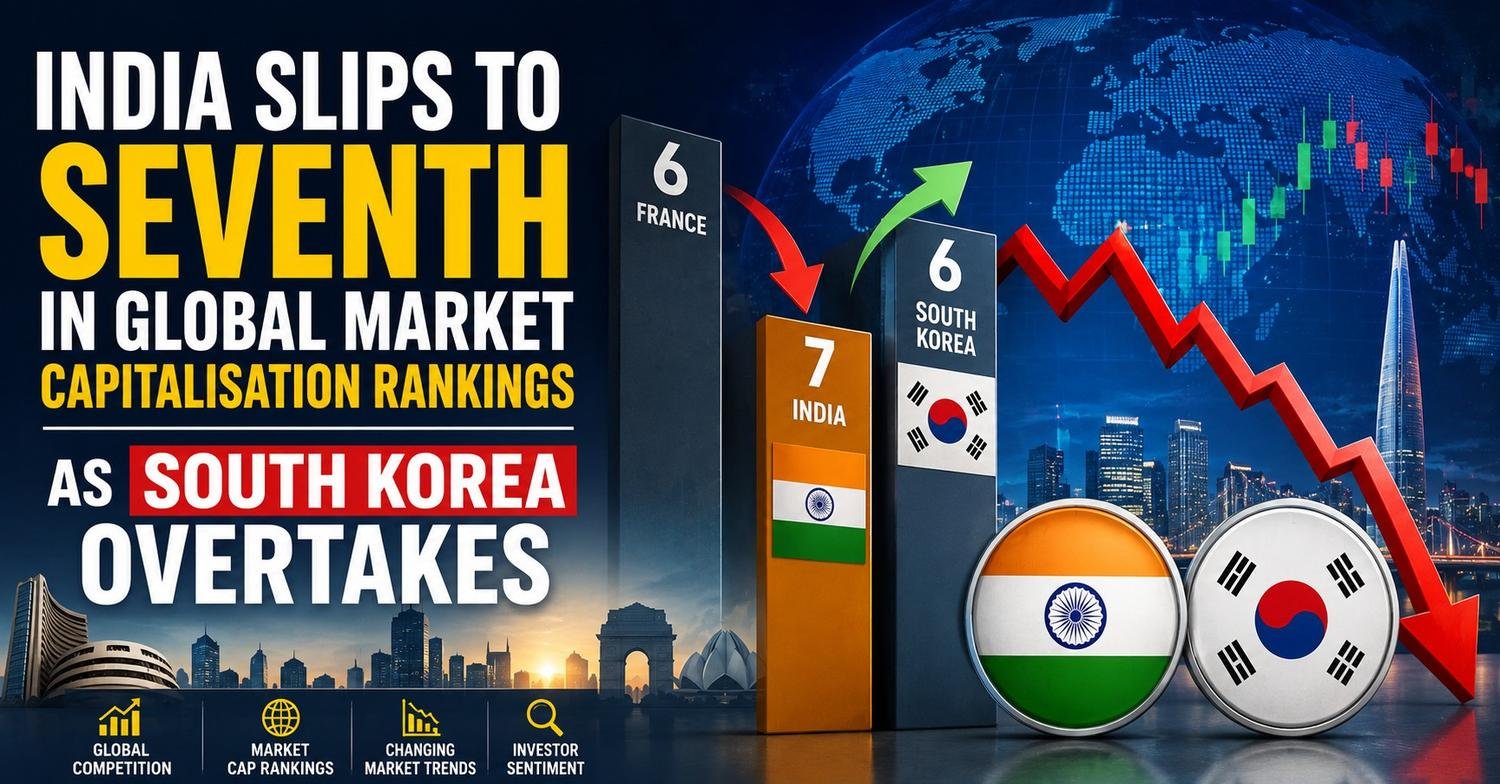
India’s equity market has slipped to seventh position globally by market capitalisation, as a strong rally in South Korean technology stocks propelled South Korea ahead of India in global market value rankings.
The development reflects shifting investor preferences toward economies benefiting directly from the global Artificial Intelligence (AI) and semiconductor boom.
South Korea Surpasses India
According to exchange data, the combined market capitalization of companies listed on South Korea’s stock exchanges:
- KOSPI
- KOSDAQ
- KONEX
reached approximately USD 5.01 trillion.
In comparison, the total market value of companies listed on India’s:
- National Stock Exchange (NSE)
stood at about USD 4.85 trillion.
As a result, India slipped from sixth to seventh place globally.
Second Decline in Two Weeks
India had already fallen behind Taiwan in global market capitalization rankings last month.
Within a fortnight, India has now dropped two positions:
- Earlier position: 5th
- After Taiwan overtook: 6th
- After South Korea overtook: 7th
AI Boom Driving Asian Markets
The primary reason behind South Korea’s rise has been the exceptional performance of semiconductor and AI-related companies.
South Korean Technology Giants
Major gains were led by:
- Samsung Electronics
- SK Hynix
The surge in demand for AI chips and advanced semiconductors has significantly boosted investor confidence.
Stock Market Performance
- KOSPI Index: +107% in 2026
- Taiwan SE Weighted Index: +59% in 2026
Both markets have benefited from the global AI investment wave.
India Faces Multiple Challenges
Unlike South Korea and Taiwan, India has not been a major beneficiary of the semiconductor-led AI rally.
Several factors have weighed on Indian equities:
Weak Market Performance
- NIFTY 50: down 10.1%
- BSE Sensex: down 12.5%
- IT Index: down 19% in 2026
Foreign Investor Outflows
Foreign Portfolio Investors (FPIs) have withdrawn:
- USD 26.4 billion from Indian equities in 2026 so far.
This exceeds the previous annual record outflow of:
- USD 18.91 billion in 2025.
Persistent foreign selling has placed significant pressure on Indian stock markets.
Declining Weight in Global Indices
India’s representation in the:
- MSCI Global Standard Index
has declined substantially.
India’s MSCI Weight
- September 2024 peak: 21%
- Current share: 12.3%
This decline reflects reduced relative attractiveness compared with other emerging markets.
Why Investors Prefer Korea and Taiwan
Market analysts argue that the global investment narrative is currently dominated by:
Artificial Intelligence
AI has become the defining global investment theme.
Semiconductor Manufacturing
Advanced chips are at the center of AI development.
Within emerging markets, the biggest beneficiaries are:
- Taiwan
- South Korea
Both countries host globally dominant semiconductor manufacturers, giving them direct exposure to AI-related growth.
India’s AI Opportunity Remains Strong
Despite lagging in AI-driven stock market gains, experts believe India remains well-positioned to benefit from the broader AI ecosystem.
Rather than manufacturing AI chips, India offers opportunities in:
- Data centres
- Electricity infrastructure
- Cooling systems
- Digital infrastructure
- Cloud services
- AI-enabled services
These sectors form the essential infrastructure supporting AI deployment worldwide.
Significance for India
The ranking decline does not necessarily indicate weakness in India’s long-term economic prospects.
India continues to remain:
- One of the world’s fastest-growing major economies.
- A major destination for manufacturing and services investment.
- A key player in digital transformation and AI adoption.
However, the latest rankings highlight the growing importance of semiconductor manufacturing and AI infrastructure in attracting global capital.
Conclusion
India’s fall to seventh place in global market capitalization rankings reflects the extraordinary momentum enjoyed by South Korea and Taiwan due to the AI and semiconductor boom. While foreign outflows, weak earnings growth, and limited semiconductor exposure have weighed on Indian equities, the country continues to possess significant long-term opportunities through investments in digital infrastructure, data centers, and AI-enabled services. The challenge for India will be to translate its growing digital economy into stronger participation in the global AI value chain.