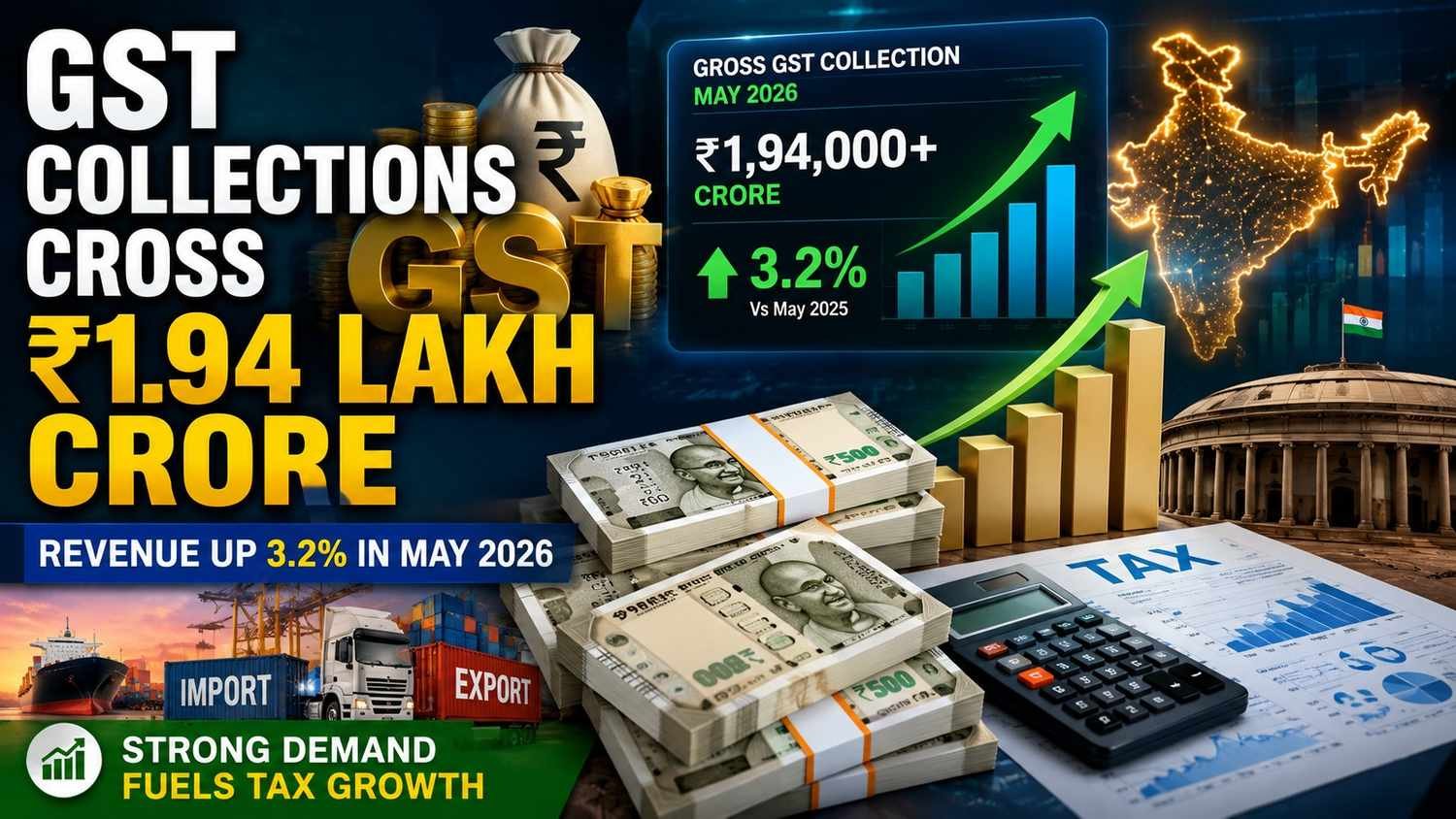
Financial news graphic showing India's GST collections crossing ₹1.94 lakh crore in May 2026, featuring tax revenue charts, rising graphs, Indian currency, and economic growth indicators.India's GST collections rose 3.2% to over ₹1.94 lakh crore in May 2026, driven by strong domestic demand, growth in goods and services supplies, and expanding tax collections from imports.
  • India’s gross Goods and Services Tax (GST) collections increased by 3.2 per cent year-on-year to more than ₹1.94 lakh crore in May 2026, reflecting strong domestic demand, improved supplies of goods and services, and continued growth in tax collections from imports.
  • According to official figures, gross GST collections stood at over ₹1.94 lakh crore in May 2026, compared to ₹1.88 lakh crore collected during the same month last year.
  • The latest numbers highlight the resilience of India’s economy despite global uncertainties and evolving market conditions.

Strong Performance Across GST Components

  • The gross Central GST (CGST) collection from domestic transactions stood at ₹37,397 crore during May 2026.
  • State GST (SGST) collections reached ₹45,143 crore, while Integrated GST (IGST) collections amounted to ₹51,990 crore.
  • The steady rise in collections demonstrates healthy economic activity across sectors and continued improvements in tax compliance across the country.

Goods and Services Show Robust Growth

  • Taxable supplies of goods registered a strong growth of 26.9 per cent during the reporting period, reflecting robust domestic demand and increased economic activity.
  • Meanwhile, taxable supplies in the services sector grew by 22.2 per cent, indicating sustained momentum in consumption and business operations.
  • Economic experts view these figures as a sign of structural resilience in India’s domestic economy, driven by rising consumer spending and expanding business transactions.

GST Refunds Also Increase

  • GST refunds grew by 2.6 per cent during May 2026 to ₹27,281 crore.
  • The increase in refunds reflects efficient processing mechanisms and continued support for businesses and exporters operating within the GST framework.

What the Numbers Mean for the Economy

  • GST collections are widely considered one of the most important indicators of economic activity.
  • Higher collections typically indicate stronger consumption, increased production, and improved compliance within the tax system.
  • The latest figures suggest that India’s domestic economy continues to maintain growth momentum, supported by healthy demand for goods and services.
  • Rising imports have also contributed to higher tax collections, further strengthening government revenues.

Outlook

  • The continued growth in GST collections is expected to support government expenditure on infrastructure, welfare schemes, and development projects.
  • Strong tax revenues also provide policymakers with greater fiscal flexibility while reinforcing confidence in India’s economic growth trajectory.
  • As domestic demand remains resilient and compliance levels continue to improve, GST collections are likely to remain a key barometer of India’s economic performance in the coming months.

By Vijay Kumar

Vijay Kumar is an experienced educator and content professional known for his clear explanations, structured teaching style, and strong command over competitive exam–oriented content. He has worked extensively in the online education ecosystem, contributing to learning platforms and digital education initiatives inspired by leading edtech brands such as Gradeup, BYJU’S, and Adda247. With a focus on current affairs, general studies, and exam-relevant concepts, specializes in simplifying complex topics into easy-to-understand lessons for aspirants preparing for banking, SSC, and other competitive examinations.

Leave a Reply