

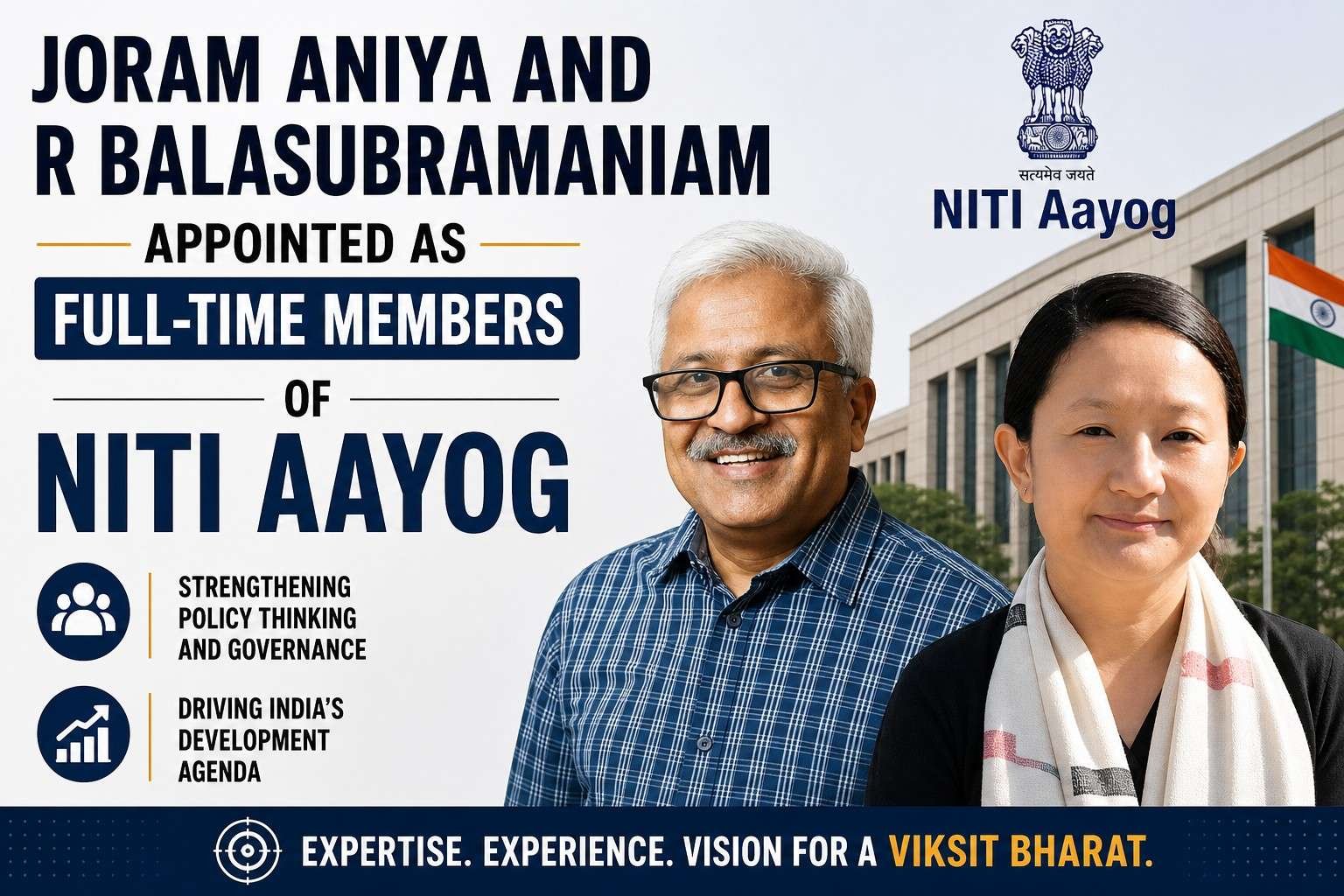
The central government has appointed Joram Aniya and R Balasubramaniam as full-time members of NITI Aayog. With these appointments, the total number of full-time members has increased to seven, in addition to the Vice-Chairman, Ashok Kumar Lahiri.
The decision, approved by Narendra Modi, reflects the government’s continued effort to strengthen institutional capacity and diversify expertise in national policymaking.
Recent Reconstitution of NITI Aayog
These appointments come shortly after a major restructuring of NITI Aayog on April 24, 2026. As part of the reconstitution:
- Ashok Kumar Lahiri was appointed as Vice-Chairman
- New full-time members included:
- K V Raju
- M Srinivas
- Abhay Karandikar
- Gobardhan Das
- Rajiv Gauba
This restructuring aims to bring a mix of administrative, academic, and scientific expertise into the institution.
Joram Aniya: A Historic Representation (First from Arunachal Pradesh)
The appointment of Joram Aniya is being seen as a landmark moment in India’s policymaking landscape. Hailing from Arunachal Pradesh, she brings both academic depth and cultural perspective.
- Associate Professor with over 18 years of experience
- Member of Arunachal Pradesh Private Educational Regulatory Commission
- First woman from the Nyishi community to earn a PhD
- First in the state to complete a PhD in Hindi
- Contributor to indigenous knowledge systems and literature
Her inclusion enhances regional representation and gives a stronger voice to the Northeast in national policy discourse.
R Balasubramaniam: Bridging Policy and Grassroots
R Balasubramaniam adds a unique blend of policy expertise and grassroots experience.
- Founder of Swami Vivekananda Youth Movement (SVYM)
- Founder of Grassroots Research and Advocacy Movement (GRAAM)
- Trained physician turned development activist
- Holds a Master’s degree in Public Administration from Harvard Kennedy School
About NITI Aayog
To replace the Planning Commission, the Government of India established NITI Aayog on 1 January 2015 through a cabinet resolution.
- Established: 1 January 2015
- Replaced: Planning Commission (1950)
- Nature: Policy think tank (non-financial)
- Aim: Transform India through cooperative & competitive federalism
- Chairperson: Prime Minister of India
- “NITI” stands for National Institution for Transforming India.
Comparison between Panning Commission and NITI Aayog
| Feature | Planning Commission (Old) | NITI Aayog (New) |
| Approach | Top-down (Center to States) | Bottom-up (States to Center) |
| Mandate | Formulated Five-Year Plans | Focuses on National Development Agenda |
| Power | Had power to allocate funds | No power to allocate funds; only a think tank |
| State Role | States attended meetings as spectators | States are key stakeholders via the Governing Council |
| Nature | Centralized | Cooperative Federalism |
Conclusion
The induction of Joram Aniya and R Balasubramaniam marks a thoughtful step toward strengthening India’s premier policy think tank. By combining academic excellence, grassroots experience, and regional diversity, the revamped NITI Aayog is better positioned to address the evolving needs of the nation.