

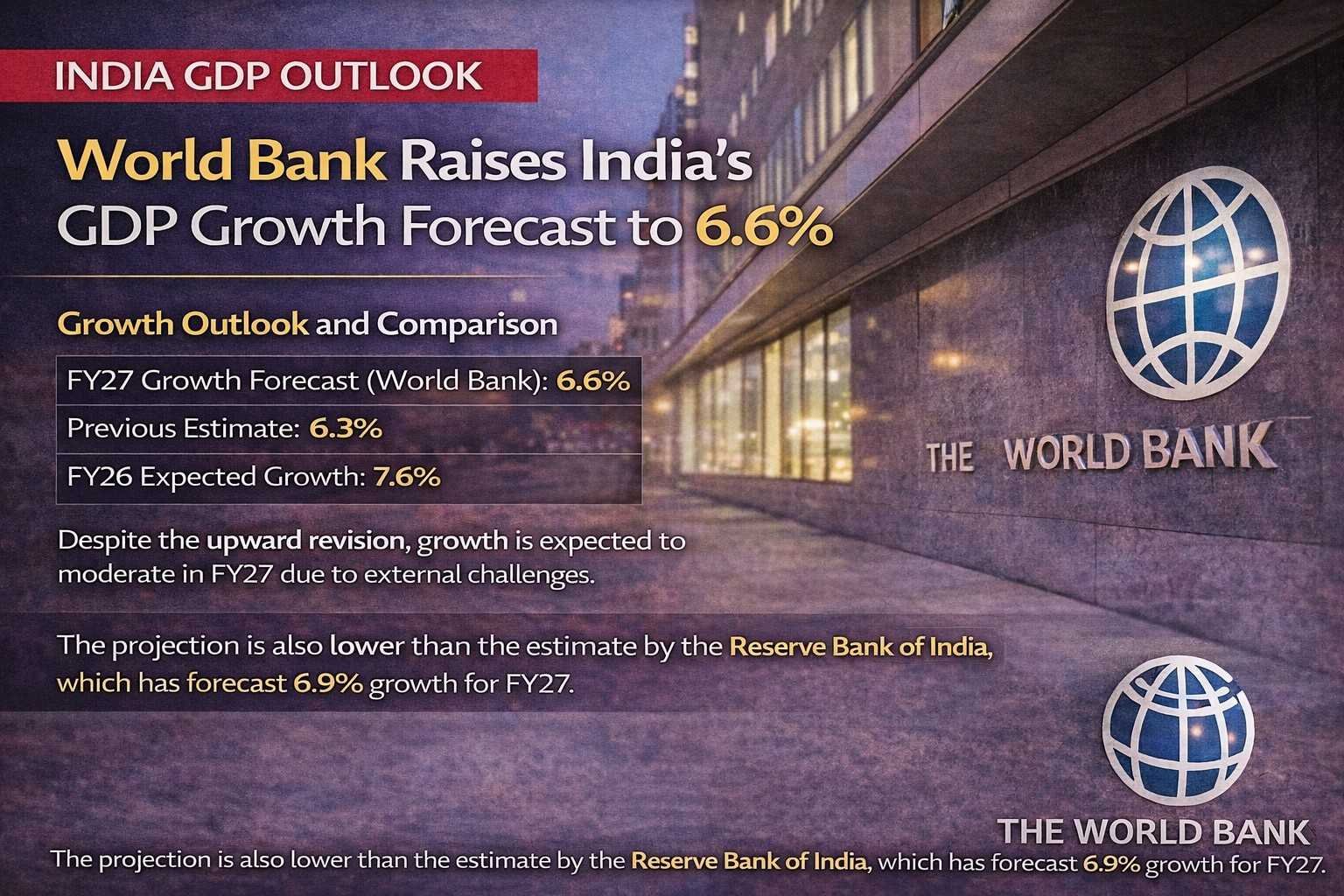
The World Bank has upgraded India’s GDP growth forecast for FY 2026–27 (FY27) to 6.6%, an increase of 30 basis points from its earlier estimate of 6.3% made in October 2025.
The revision reflects strong domestic economic activity, even as global uncertainties persist.
Growth Outlook and Comparison
- FY27 Growth Forecast (World Bank): 6.6%
- Previous Estimate: 6.3%
- FY26 Expected Growth: 7.6%
Despite the upward revision, growth is expected to moderate in FY27 due to external challenges.
The projection is also lower than the estimate by the Reserve Bank of India, which has forecast 6.9% growth for FY27.
Key Factors Behind Growth Revision
According to the World Bank’s South Asia Economic Update (Spring 2026):
Positive Drivers
- Strong domestic demand
- Supportive GST rate cuts (boosting consumption)
- Normalising food prices
Downside Risks
- Ongoing West Asia conflict
- Rising global energy prices
- Slower growth in major trading partners
Inflation Outlook
The report highlights that:
- Inflation is expected to increase in FY27
- Driven mainly by higher energy prices
Although GST reductions may support consumption in the first half of FY27, rising fuel costs could:
- Increase household expenses
- Reduce disposable income
Fiscal Position
The World Bank noted that:
- India’s fiscal deficit had been declining, but
- This trend may stall or reverse due to:
- Increased subsidy expenditure
- Government efforts to control inflation impact
Recent government measures include:
- ₹10/litre excise duty cut on petrol and diesel
- Customs duty exemption on key petrochemical products
Investment and Consumption Trends
- Government consumption likely to moderate
- Investment growth may slow due to:
- Rising input costs
- Global uncertainty
Trade and External Sector
The report notes:
- India’s exports may face pressure due to slower global demand
- However, Free Trade Agreements (FTAs) with regions like:
- European Union
- United Kingdom
are expected to:
- Expand India’s global market access
- Increase coverage from one-sixth to one-third of global GDP
South Asia Growth Outlook
- South Asia’s growth projected at 6.3% in 2026
- Region remains the fastest-growing among emerging markets
The World Bank emphasised that:
India continues to be the key driver of growth in South Asia
Long-Term Outlook
The report suggests that India can achieve its goal of becoming a developed nation by 2047 if it:
- Implements structural reforms
- Enhances productivity and efficiency
Impact of AI on Economy
The World Bank also highlighted that:
- Firms adopting Artificial Intelligence (AI)
- Especially those linked to global supply chains
are witnessing:
- Increased employment opportunities
- Greater technology adoption
Conclusion
The World Bank’s upward revision of India’s growth forecast underscores the country’s economic resilience amid global uncertainties. However, challenges such as rising energy prices, geopolitical tensions, and fiscal pressures may moderate growth in the coming year.