

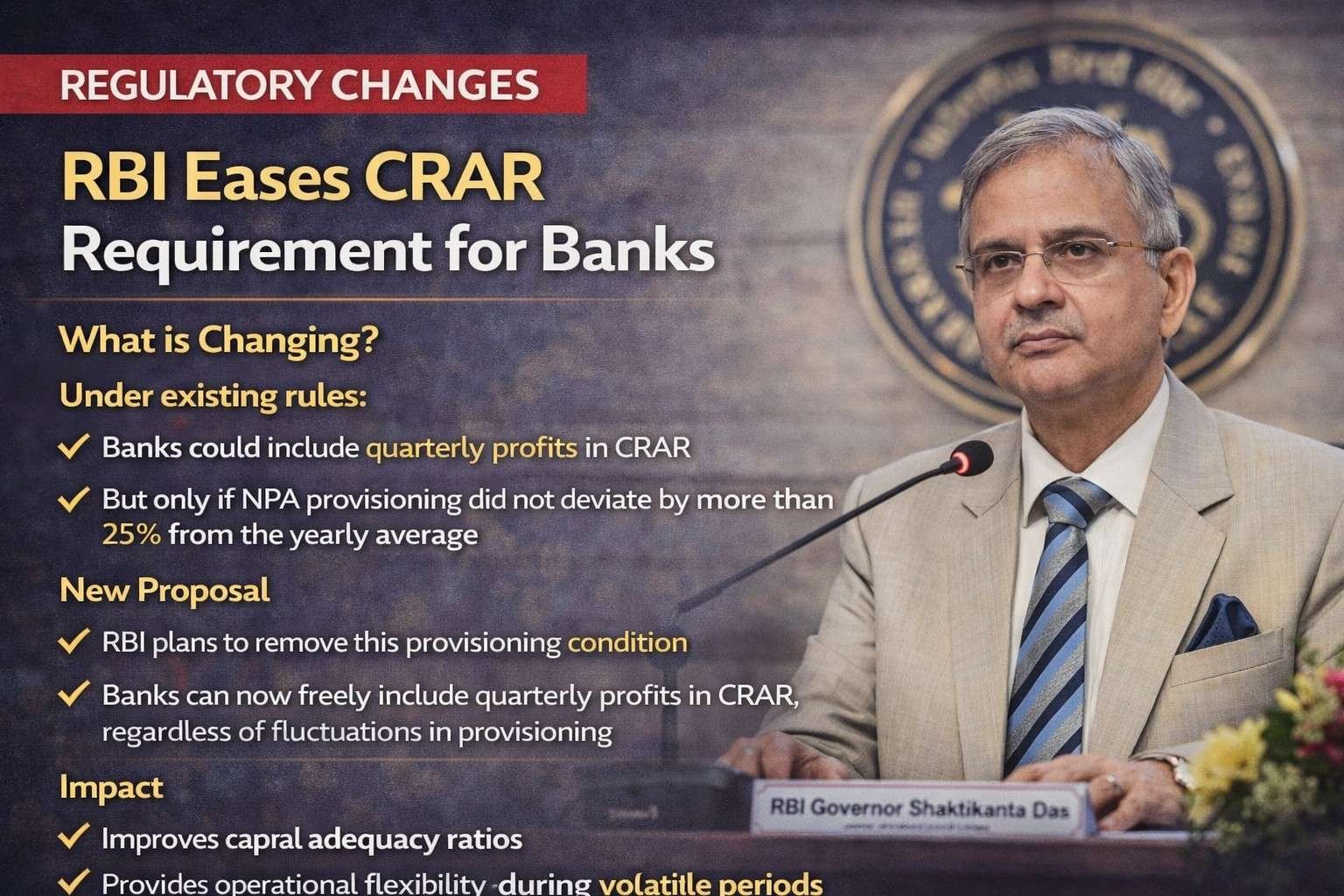
The Reserve Bank of India has proposed key regulatory changes aimed at providing greater flexibility to banks in capital management. The proposals focus on easing norms related to Capital-to-Risk Weighted Assets Ratio (CRAR) and removing certain reserve requirements.
The announcement was made by RBI Governor Sanjay Malhotra during the latest policy developments.
Relief in CRAR Calculation
What is Changing?
Under existing rules:
- Banks could include quarterly profits in CRAR
- But only if NPA provisioning did not deviate by more than 25% from the yearly average
New Proposal
- RBI plans to remove this provisioning condition
- Banks can now freely include quarterly profits in CRAR, regardless of fluctuations in provisioning
Impact
- Improves capital adequacy ratios
- Provides operational flexibility
- Reduces regulatory constraints during volatile periods
Removal of Investment Fluctuation Reserve (IFR)
Current Requirement
Banks maintain an Investment Fluctuation Reserve (IFR) as a buffer against:
- Decline in value of investments
- Mark-to-Market (MTM) risks
Proposed Change
- RBI plans to eliminate IFR requirement for most commercial banks
Exception
The exemption will NOT apply to:
- Small Finance Banks
- Payment Banks
- Regional Rural Banks (RRBs)
Reason Behind IFR Removal
The RBI noted that:
- Banks already maintain capital for market risks
- Updated prudential norms for investment valuation and classification are in place
Thus, IFR is now considered:
- Redundant
- An additional compliance burden
Regulatory Harmonisation
- RBI also plans to revise IFR-related guidelines for other categories of banks
- Objective:
- Address operational challenges
- Ensure uniformity across banking system
- Improve regulatory clarity and consistency
Draft guidelines will be released soon for public consultation.
Overall Impact on Banking Sector
These proposed changes are expected to:
- Enhance capital efficiency
- Reduce compliance burden
- Improve financial flexibility of banks
- Support credit growth
Conclusion
The RBI’s move reflects a shift towards simplified and pragmatic regulation, aligning capital norms with evolving banking practices. By easing CRAR calculations and removing redundant buffers like IFR, the central bank aims to strengthen the banking system’s ability to manage risks while supporting growth.