

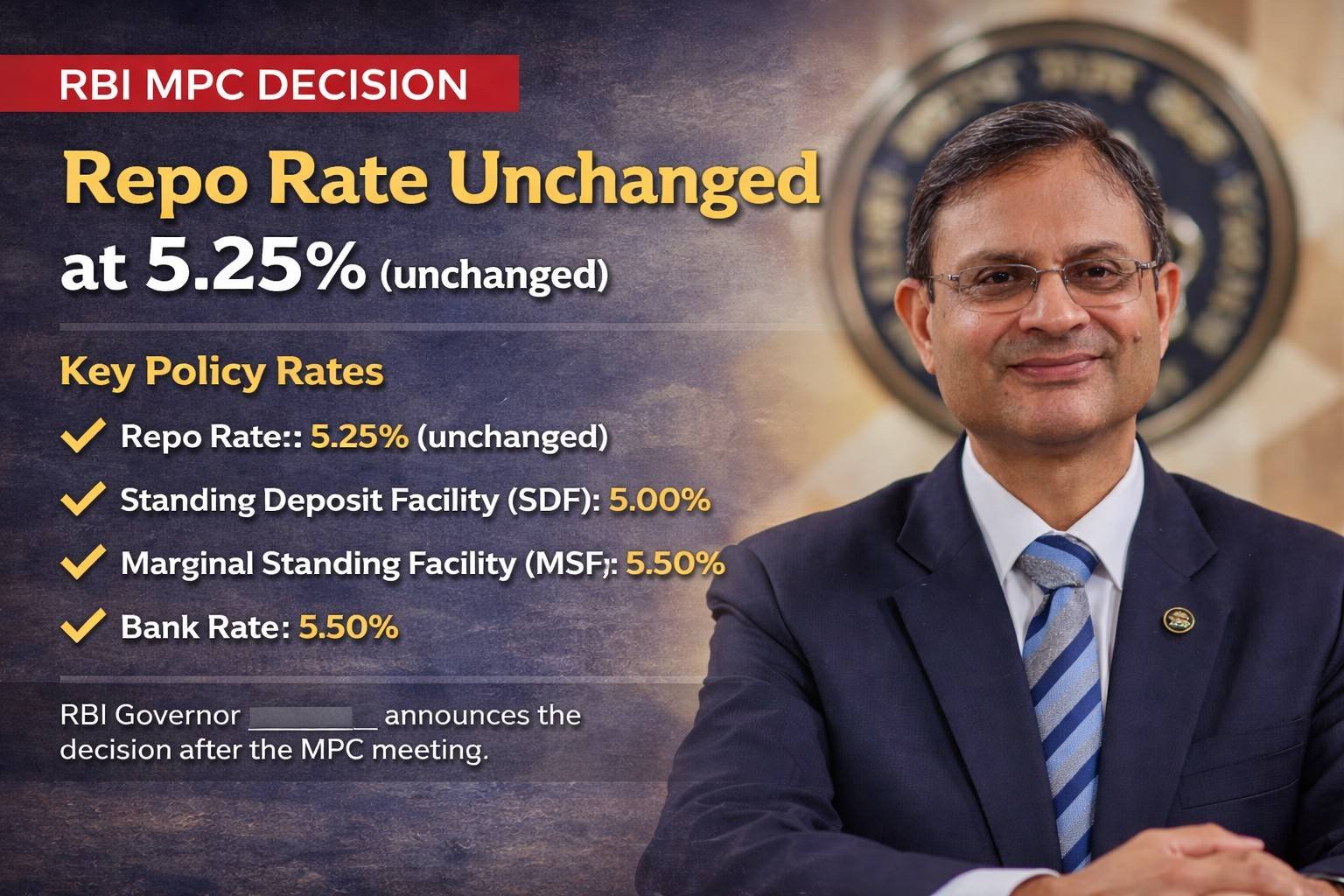
The Reserve Bank of India Monetary Policy Committee (MPC), in its first meeting for FY27, has decided to keep the repo rate unchanged at 5.25%.
The decision was announced by RBI Governor Sanjay Malhotra after the policy meeting held from April 6–8, 2026.
The MPC also retained its ‘neutral’ policy stance, indicating flexibility to respond to evolving economic conditions.
Key Policy Rates
- Repo Rate: 5.25% (unchanged)
- Standing Deposit Facility (SDF): 5.00%
- Marginal Standing Facility (MSF): 5.50%
- Bank Rate: 5.50%
This follows the RBI’s earlier decision in February 2026 to pause after cumulative 125 basis points rate cuts in 2025.
Context Behind the Decision
The policy decision comes amid rising global uncertainties:
- Ongoing West Asia conflict
- Surge in crude oil prices
- Depreciation of the rupee
These factors have increased risks to both inflation and growth, prompting the RBI to adopt a cautious approach.
GDP Growth Outlook for FY27
The RBI has projected real GDP growth at 6.9% for FY27, reflecting resilience in the domestic economy.
Growth Drivers & Risks
- Positive Factors:
- Strong services exports
- Benefits from recent trade agreements
- Risks:
- Disruptions in global shipping routes
- Higher freight and insurance costs
- Weak global demand
Inflation Outlook
The RBI has projected CPI inflation at 4.6% for FY27, within its target range but with upward risks.
Key Inflation Factors
- Upside Risks:
- Rising global energy prices due to geopolitical tensions
- Comfort Factors:
- Strong rabi crop production
- Adequate reservoir levels
- Sufficient food grain buffer stocks
Overall Policy Assessment
The RBI’s decision to pause rate changes reflects a balanced approach:
- Supports growth momentum
- Keeps inflation under watch
- Maintains flexibility under a neutral stance
Conclusion
The April 2026 MPC decision highlights RBI’s cautious stance amid global uncertainty. By keeping rates unchanged, the central bank aims to balance inflation control with economic growth, while closely monitoring external risks such as geopolitical tensions and energy prices.