

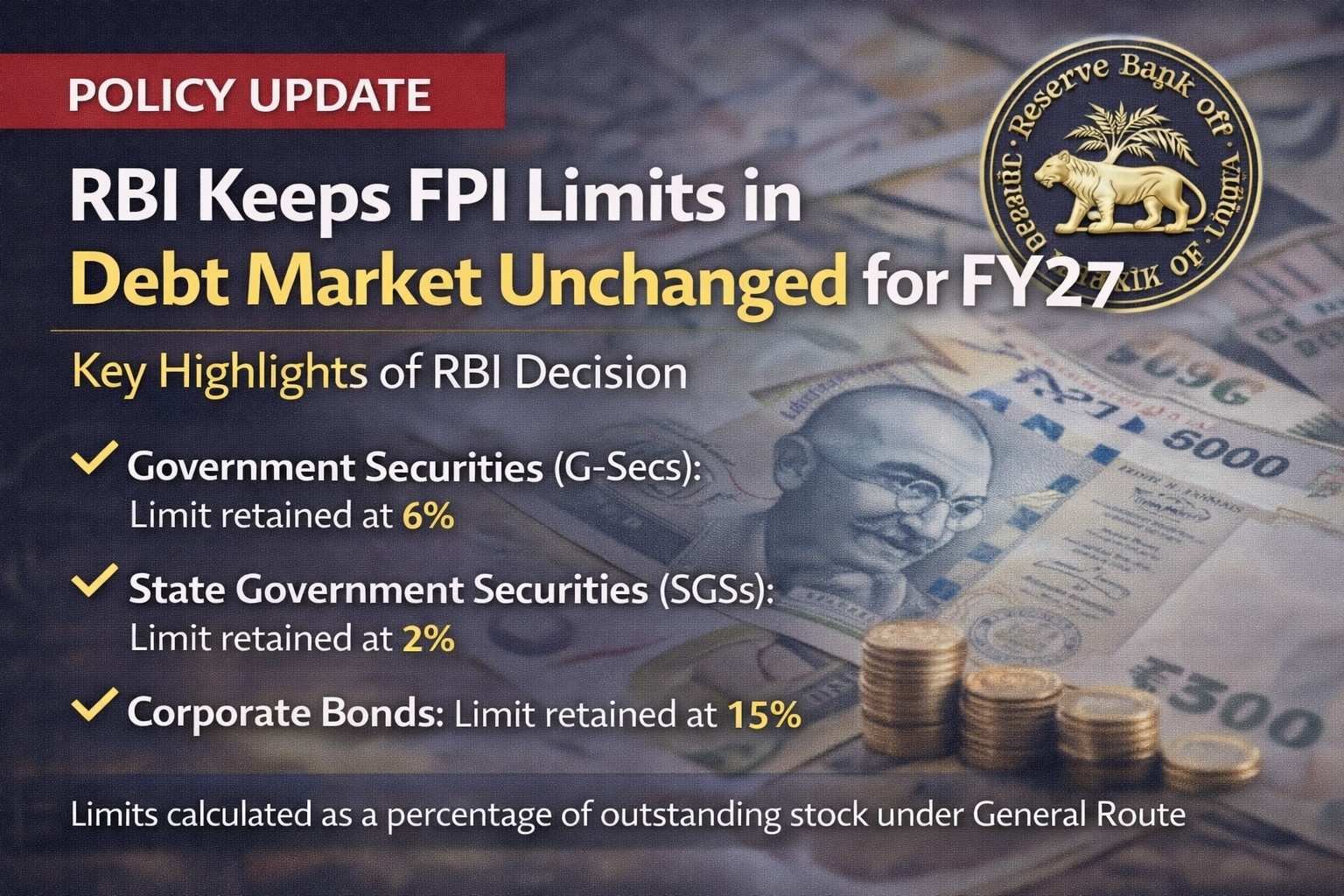
The Reserve Bank of India has decided to retain the existing investment limits for Foreign Portfolio Investors (FPIs) in the Indian debt market for the financial year 2026–27. The move reflects a stable policy stance aimed at ensuring orderly capital flows and market stability.
Key Highlights of RBI Decision
- Government Securities (G-Secs): Limit retained at 6%
- State Government Securities (SGSs): Limit retained at 2%
- Corporate Bonds: Limit retained at 15%
These limits are calculated as a percentage of the outstanding stock of securities under the General Route.
Sub-Category Allocation Remains Unchanged
The RBI has also maintained the 50:50 allocation split between:
- General category
- Long-term category
for incremental changes in G-Sec investment limits.
Credit Default Swaps (CDS) Limit
- FPIs can sell Credit Default Swaps (CDS) up to 5% of the outstanding corporate bonds
- An additional limit of ₹3,30,464 crore has been set for FY27
This allows FPIs to participate in risk management instruments while keeping exposure under control.
Changes in State Government Securities (SGSs)
- Any increase in SGS investment limits (in absolute terms) will be allocated entirely to the General category
- This simplifies allocation and enhances accessibility for FPIs
Fully Accessible Route (FAR) Clarification
The RBI reiterated that:
- Investments in specified securities will continue under the Fully Accessible Route (FAR)
- Under FAR, eligible investors can invest without being constrained by limits
Voluntary Retention Route (VRR) Update
A key change has been introduced regarding the Voluntary Retention Route (VRR):
- From April 1, 2026, all existing and future VRR investments will be aligned with General Route limits
- This indicates a move towards harmonisation of investment frameworks
Conclusion
By keeping FPI investment limits unchanged, the RBI aims to:
- Maintain stability in debt markets
- Ensure predictable capital flows
- Balance foreign participation with financial stability concerns
The decision also reflects confidence in the current framework while making minor adjustments to improve clarity and consistency.