

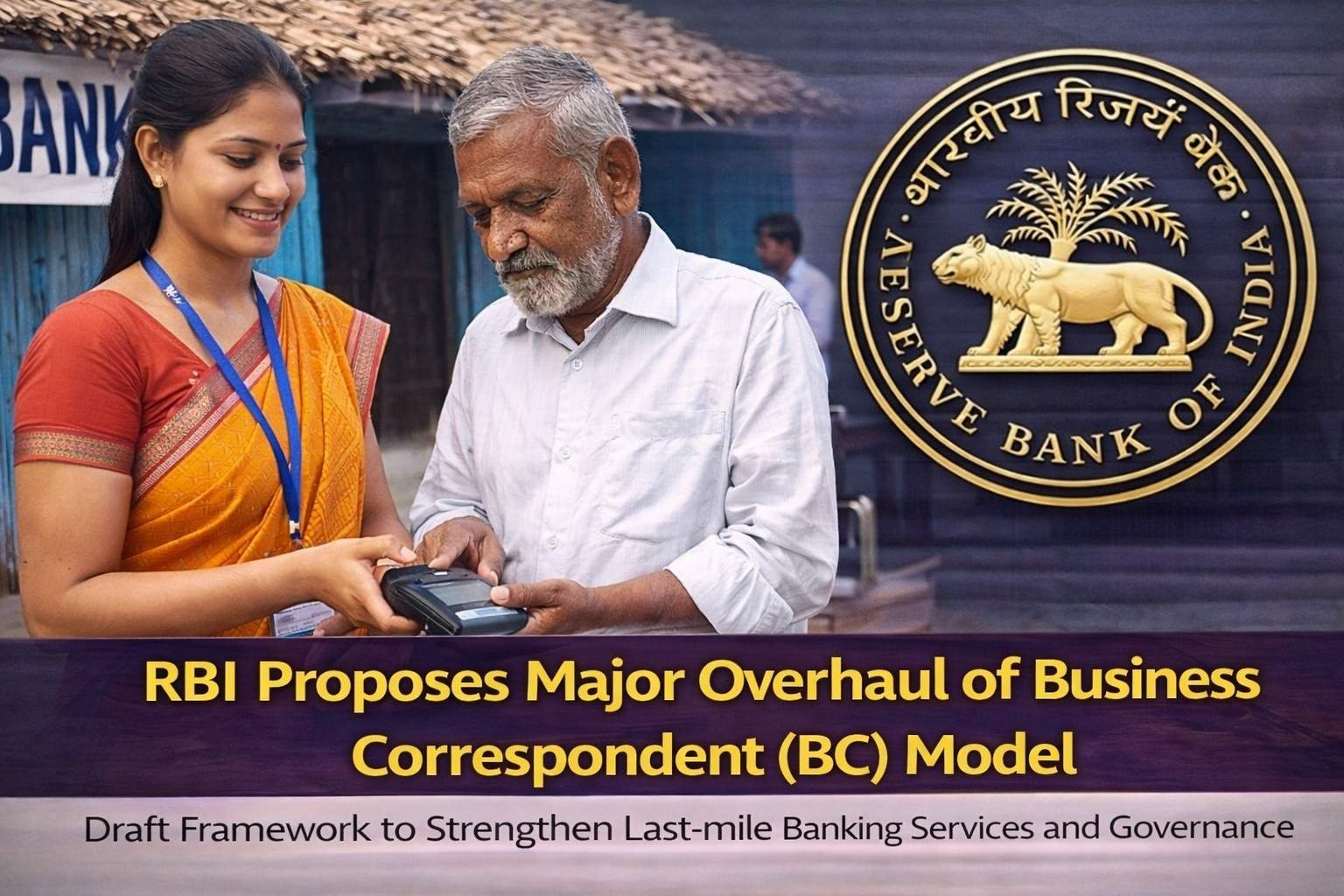
The Reserve Bank of India has proposed a major overhaul of the Business Correspondent (BC) model, aiming to strengthen last-mile banking services, improve governance, and enhance customer protection.
The draft framework introduces a structured two-tier model, formalises remuneration, and tightens oversight mechanisms. The new guidelines are proposed to come into effect from July 1, 2026, with transition timelines extending up to September 30, 2026.
Key Highlights of the Proposal
- Introduction of two-tier BC structure:
- BC–Banking Outlet (BC-BO)
- BC–Banking Touchpoint (BC-BT)
- Business Facilitator (BF) model to be discontinued
- Standardised remuneration structure
- BC-BOs to be treated as formal banking outlets
- Expanded scope of services including deposits, credit, and KYC
- Stronger governance, risk management, and customer protection norms
- Mandatory training and certification requirements
New Two-Tier Structure Explained
1. BC–Banking Outlet (BC-BO)
BC-BOs will function as fixed-location banking units:
- Minimum operation: 4 hours per day, 5 days a week
- Dedicated to one bank
- Will be counted as banking outlets, improving financial inclusion metrics
- Offer a wide range of banking services
2. BC–Banking Touchpoint (BC-BT)
BC-BTs will be flexible service points:
- Operate with no fixed hours
- Provide limited services, mainly small-value transactions and remittances
- Work within thresholds set by banks
End of Business Facilitator Model
The RBI has proposed to eliminate the Business Facilitator (BF) model. Existing BFs must transition into either:
- BC–Banking Outlet
- BC–Banking Touchpoint
by September 30, 2026, subject to compliance with new norms.
Expanded Scope of BC Activities
BC–Banking Outlets will now be allowed to perform a broader range of services, including:
- Account opening and KYC updation
- Cash deposits and withdrawals
- Fund transfers and remittances
- Debit card and cheque-related services
- Aadhaar and mobile seeding
- Utility bill payments
- Small-value credit disbursal and recovery follow-up
- Sale of micro-insurance, mutual funds, and pension products
- Customer grievance handling
BC–Banking Touchpoints, however, will be restricted to basic interoperable services.
Remuneration Structure Formalised
- BC-BOs: Fixed + Variable pay
- BC-BTs: Variable pay only
The fixed component will be benchmarked through the Indian Banks’ Association, while variable pay will depend on:
- Transaction volumes
- Customer satisfaction
Governance and Oversight Strengthened
Banks will now be required to:
- Formulate Board-approved BC policies
- Conduct half-yearly reviews
- Perform strict due diligence (financial soundness, reputation, tech capability)
- Ensure periodic KYC updates of BCs
Technology & Operational Norms
- All transactions must be real-time and core banking integrated
- Instant confirmation must be provided to customers
- BC operations must use designated accounts to avoid fund mixing
Risk Management Measures
- Limits on cash holding and transactions
- Mandatory insurance for cash-in-transit
- Strong monitoring and control systems
The RBI has also proposed gradual reduction in prefunding requirements, linked to performance and service quality.
Customer Protection Measures
The framework focuses heavily on customer safety:
- Mandatory display of bank & BC details
- No forced bundling of banking services
- Banks held fully responsible for BC actions
- Strong grievance redressal systems
- Business continuity arrangements
Inactivity & Compliance Norms
- BC-BOs will be marked inactive after 60 days of no transactions
- Reactivation will follow prescribed procedures
Training and Certification
- BC-BO operators: Advanced certification required
- BC-BT operators: Basic certification/training required
All certifications must be completed within 9 months of starting operations.
Conclusion
The proposed framework marks a significant step toward formalising and strengthening India’s BC ecosystem. By introducing structure, improving accountability, and expanding services, the RBI aims to enhance financial inclusion, efficiency, and trust in last-mile banking delivery.