

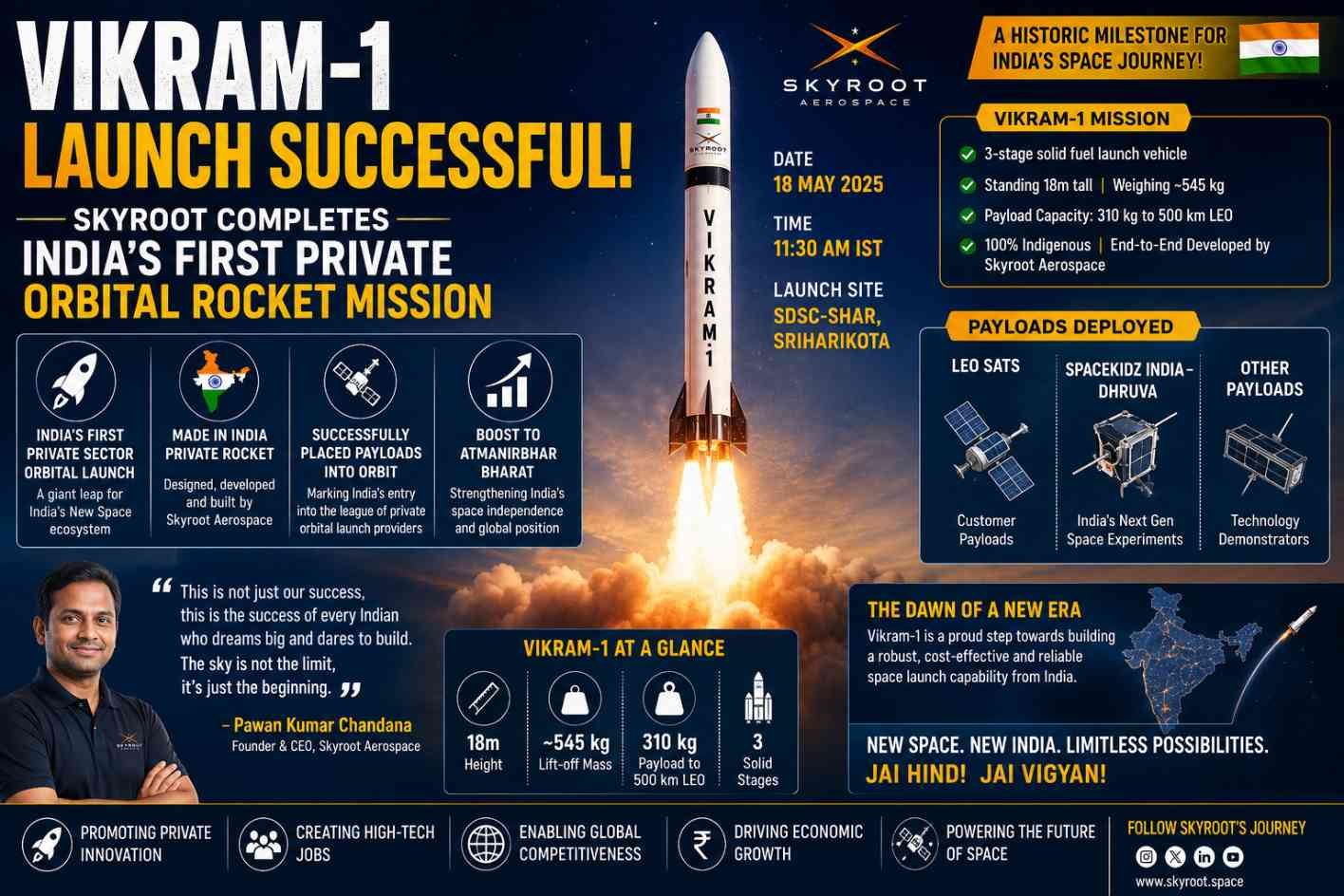
- India’s private space industry has crossed a historic milestone with the successful maiden flight of Skyroot Aerospace’s Vikram-1, the country’s first privately developed rocket to complete an orbital mission.
- The four-stage launch vehicle lifted off from the Batish Dhawan Space Centre in Sriharikota under Mission Aagaman.
- It successfully deployed multiple commercial and technology-demonstration payloads into a Low Earth Orbit of around 450 kilometres.
What Is Mission Aagaman?
- Mission Aagaman was the maiden orbital flight of Skyroot Aerospace’s Vikram-1 launch vehicle.
- The Hindi word “Aagaman” means arrival, reflecting the company’s entry into the commercial orbital-launch market.
- The mission was designed to validate the rocket’s propulsion, guidance, navigation, structural and stage-separation systems while delivering multiple payloads into Low Earth Orbit.
- The successful mission represents a transition from technology demonstration to orbital launch capability for Skyroot, which had previously launched the suborbital Vikram-S rocket in November 2022.
What Is Vikram-1?
- Vikram-1 is a privately developed launch vehicle designed by Hyderabad-based Skyroot Aerospace to carry small satellites into Low Earth Orbit.
- The rocket is named after Dr Vikram Sarabhai, widely regarded as the father of India’s space programme. Skyroot has also named several of its propulsion systems after prominent Indian scientists.
- Vikram-1 has been designed to support responsive, flexible and potentially on-demand launch services for commercial and institutional satellite operators.
Major Features of Vikram-1
Four-Stage Configuration
- Vikram-1 uses a four-stage configuration designed to progressively accelerate payloads to orbital velocity.
- The multi-stage architecture allows empty stages to be discarded during flight, reducing the vehicle’s mass and increasing efficiency as it travels towards orbit.
Carbon-Composite Structure
- The launch vehicle uses extensive carbon-composite materials.
- These materials offer a high strength-to-weight ratio and can help reduce the rocket’s structural mass, allowing a larger share of its total weight to be devoted to propellant and payload.
- The maiden flight successfully tested this composite structure under actual launch conditions.
3D-Printed Engine Technology
- Skyroot has used additive manufacturing to produce key engine components.
- Three-dimensional printing can reduce the number of individual parts, joints and manufacturing stages needed to build a rocket engine. It also enables faster design modifications and production.
- The Vikram-1 mission provided real-flight validation of Skyroot’s advanced manufacturing and engine technologies.
Small-Satellite Launch Capability
Vikram-1 has been designed to serve the growing small-satellite market.
Such missions may include:
- Earth-observation satellites
- Communication payloads
- Scientific instruments
- Technology demonstrations
- Internet-of-Things constellations
- Academic and research satellites
Dedicated small launch vehicles can offer customers greater control over launch schedules and orbital destinations than conventional rideshare missions.
How Much Payload Can Vikram-1 Carry?
- Vikram-1 is designed to carry payloads of up to approximately 350 kilograms to Low Earth Orbit, depending on the target orbit and mission configuration.
- This places the rocket in the small-satellite launch category, a segment attracting growing demand from start-ups, research institutions, governments and commercial constellation operators.
Which Payloads Were Launched?
Mission Aagaman carried a combination of commercial, experimental and symbolic payloads.
The main technology payloads included systems from:
- Skyroot Aerospace
- Grahaa Space
- Cosmoserve Space
- Germany-based DCUBED
These payloads were deployed sequentially into an orbit of approximately 450 kilometres.
Skyroot’s SCOPE Payload
- Skyroot’s in-house SCOPE payload was developed as an experimental platform for testing technologies intended for future missions.
- The payload is expected to help the company collect data on the performance of space systems in an orbital environment.
- Such internal payloads allow launch companies to validate technologies without depending entirely on external customer missions.
Grahaa Space’s SOLARAS S3
- Grahaa Space’s SOLARAS S3 was included as a compact satellite technology-demonstration mission.
- Its deployment represents the growing participation of Indian start-ups not only in launch vehicles but also in satellite systems, data services and space-based applications.
Cosmoserve Space’s Embrace Mission
Cosmoserve Space’s Embrace payload was designed to demonstrate robotic-arm technologies that could eventually be used for activities such as:
- Capturing orbital debris
- Servicing satellites
- Inspecting spacecraft
- Supporting in-orbit assembly
- Handling objects in space
Space-debris management is becoming increasingly important as the number of satellites and spent rocket components in orbit continues to grow.
Why Vikram-1’s Launch Is Historic
The mission is important because it demonstrates that an Indian private company can design, build, test and operate an orbital-class launch vehicle.
Until the space sector was opened more broadly to private participation, India’s orbital launch capability was primarily concentrated within ISRO and government-controlled entities.
Vikram-1’s success therefore represents:
- The entry of private Indian industry into orbital launches
- Validation of the government’s space-sector reforms
- Expansion of India’s commercial launch capacity
- New competition and innovation in launch technologies
- Greater opportunities for satellite start-ups
- Potential growth in international launch contracts
From Vikram-S to Vikram-1
- Skyroot Aerospace previously made history in November 2022 with the launch of Vikram-S under Mission Prarambh.
- Vikram-S was a suborbital technology demonstrator. It crossed into space but did not place a satellite into Earth orbit.
- Vikram-1 represents a far more demanding technological achievement because an orbital mission requires the vehicle to achieve sufficient speed and precision to insert payloads into a stable orbit around Earth.
- The progression can be summarised as follows:
| Mission | Rocket | Achievement |
|---|---|---|
| Mission Prarambh | Vikram-S | First privately developed Indian rocket launched into space on a suborbital flight |
| Mission Aagaman | Vikram-1 | First privately developed Indian rocket to successfully complete an orbital mission |
Why Reaching Orbit Is Difficult
Reaching space and reaching orbit are not the same.
A suborbital rocket may cross the generally recognised boundary of space and then return to Earth. An orbital launch vehicle must also achieve very high horizontal velocity so that its payload continuously falls around Earth rather than returning immediately to the surface.
An orbital mission requires precise management of:
- Propulsion
- Flight trajectory
- Stage separation
- Guidance and navigation
- Structural loads
- Aerodynamic forces
- Payload deployment
- Orbital velocity and altitude
Vikram-1’s successful payload insertion therefore represents a significantly more complex achievement than Skyroot’s earlier suborbital mission.
Significance for ISRO
Private launch companies are not necessarily intended to replace ISRO.
Instead, they can complement the national space agency by handling commercial and small-satellite missions while ISRO focuses more resources on:
- Scientific exploration
- Human spaceflight
- Heavy launch vehicles
- Strategic missions
- Planetary missions
- Advanced research
- New launch technologies
A successful private ecosystem could therefore increase India’s total launch capacity and create a broader national space-industrial base.
Challenges Ahead for Skyroot
Despite the successful maiden mission, Skyroot faces several commercial and technical challenges.
Reliability
Launch customers require a strong record of successful missions before entrusting valuable satellites to a new rocket.
Cost Competitiveness
Vikram-1 must compete with established international launch providers and rideshare services offered by larger rockets.
Production Capacity
The company will need to demonstrate that it can manufacture rockets consistently and at commercially viable rates.
Launch Frequency
A viable launch business depends on attracting enough missions to sustain regular operations.
Regulatory Coordination
International payloads, launch safety, frequency allocation and export controls require coordination with multiple authorities.
Global Competition
The small-launch market includes several international companies, while falling rideshare prices can create pressure on dedicated launch providers.
Why Mission Aagaman Matters for Viksit Bharat
A domestic commercial launch industry can contribute to national development by:
- Creating high-skilled employment
- Supporting advanced manufacturing
- Encouraging research and development
- Attracting private capital
- Generating export revenue
- Strengthening strategic technology capabilities
- Retaining engineering talent
- Developing intellectual property in India
The mission also provides a visible example of how public-policy reforms can create opportunities for private innovation in high-technology sectors.
Conclusion
- The successful launch of Skyroot Aerospace’s Vikram-1 marks a defining moment in India’s space journey.
- By deploying multiple payloads into a 450-km Low Earth Orbit, Mission Aagaman demonstrated that an Indian private company can independently develop and fly an orbital-class launch vehicle.
- The achievement builds on the foundation created by the Vikram-S suborbital mission and reflects the growing impact of India’s space-sector reforms.
- The next challenge will be converting this technological success into a reliable, scalable and globally competitive commercial launch service. Nevertheless, Vikram-1 has opened a new chapter in which private Indian enterprises can operate alongside ISRO and contribute directly to India’s ambitions in the global space economy.