

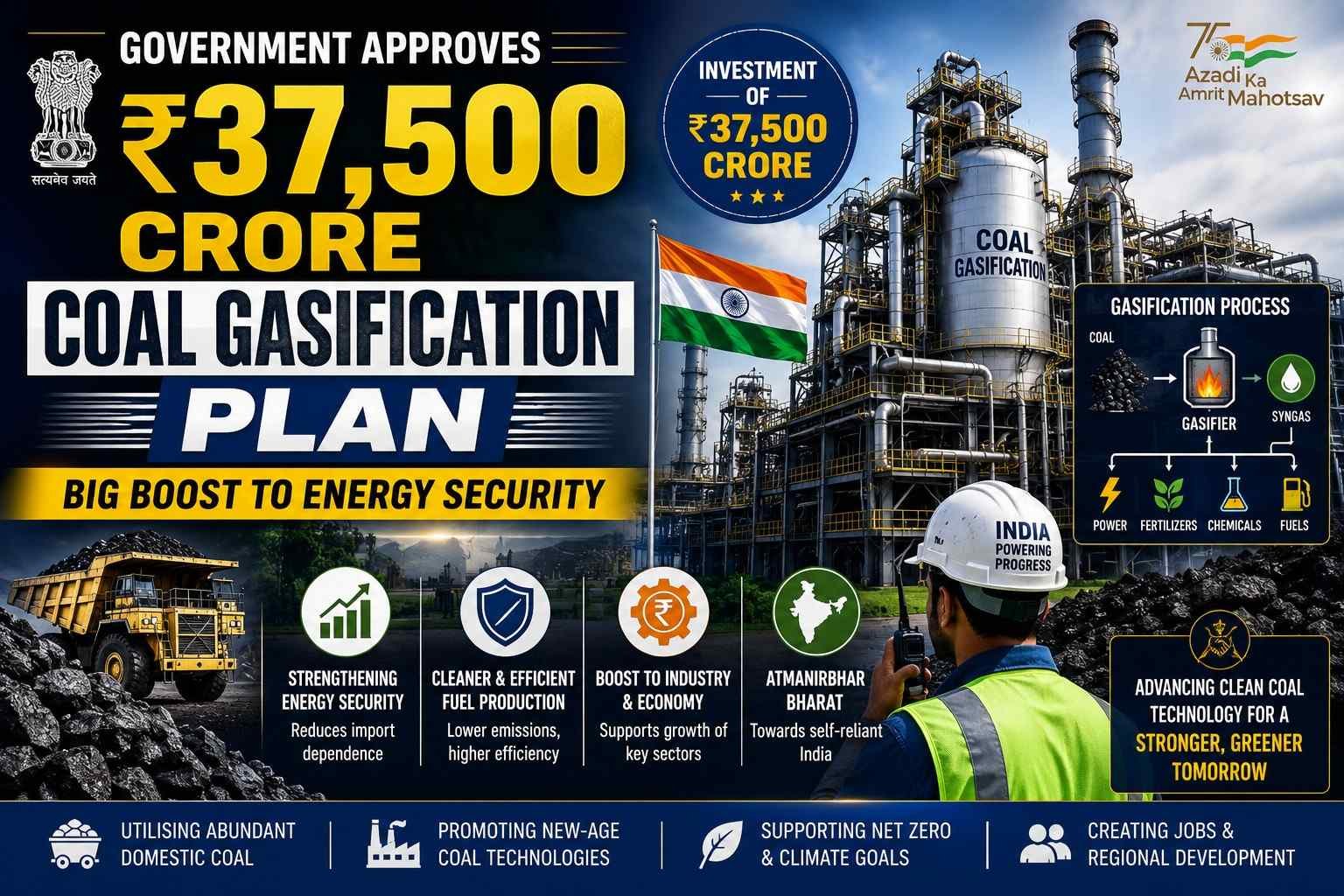
The Union Cabinet has approved a ₹37,500 crore incentive scheme to promote coal gasification projects in India, aiming to strengthen energy security, reduce import dependence, and support cleaner utilisation of the country’s abundant coal reserves.
The scheme is designed to accelerate India’s coal and lignite gasification programme and help achieve the national target of gasifying 100 million tonnes of coal by 2030.
Objective of the Scheme
The initiative seeks to:
- promote clean energy production,
- reduce dependence on imported fuels and chemicals,
- encourage domestic industrial production,
- and support long-term energy security.
The government expects the programme to reduce imports of:
- Liquefied Natural Gas (LNG),
- urea,
- ammonia,
- methanol,
- and other downstream chemical products.
What is Coal Gasification?
Coal gasification is a process in which coal or lignite is converted into synthetic gas (syngas) through controlled chemical reactions.
Syngas can then be used for:
- power generation,
- fertilizer production,
- chemicals,
- synthetic natural gas,
- and industrial fuel applications.
The technology is viewed as a cleaner alternative to conventional coal combustion when combined with advanced emission-control systems.
Financial Incentives Under the Scheme
Under the approved programme:
- financial incentives of up to 20% of plant and machinery costs will be provided,
- specifically for new surface coal and lignite gasification projects.
The projects will produce:
- syngas,
- and downstream products derived from gasification.
The scheme targets gasification of around 75 million tonnes of coal and lignite.
Project Selection and Incentive Structure
Projects will be selected through a competitive bidding process based on:
- project cost,
- coal input,
- and syngas output.
Incentives will be released in four equal instalments linked to project milestones.
Caps on Financial Assistance
- Maximum support for a single project: ₹5,000 crore
- Maximum support for a single product category (except synthetic natural gas and urea): ₹9,000 crore
- Maximum support for one business group across all projects: ₹12,000 crore
Long-Term Coal Linkage Support
- The government has also extended coal linkage tenure up to 30 years under the “Production of Syngas leading to Coal Gasification” category in the Non-Regulated Sector linkage auction framework.
- This move is intended to provide long-term policy stability and improve investor confidence in large-scale gasification projects.
Investment and Employment Potential
According to the government:
- the scheme could mobilise investments worth ₹2.5–3 trillion,
- and generate nearly 50,000 direct and indirect jobs.
Around 25 projects are expected to come up, mainly in coal-bearing regions of the country.
Role in India’s Energy Transition
NITI Aayog has earlier highlighted that India’s large coal reserves, combined with technologies such as Carbon Capture, Utilisation and Storage (CCUS), could support cleaner coal utilisation while balancing economic and energy needs.
The scheme is expected to contribute toward:
- industrial growth,
- energy diversification,
- and reduced external vulnerability in critical energy and fertilizer sectors.
Key Takeaway
The ₹37,500 crore coal gasification incentive scheme represents a major push toward cleaner coal utilisation and energy self-reliance. By encouraging large-scale domestic gasification projects, the government aims to reduce import dependence, create employment, attract investment, and strengthen India’s long-term energy security.