

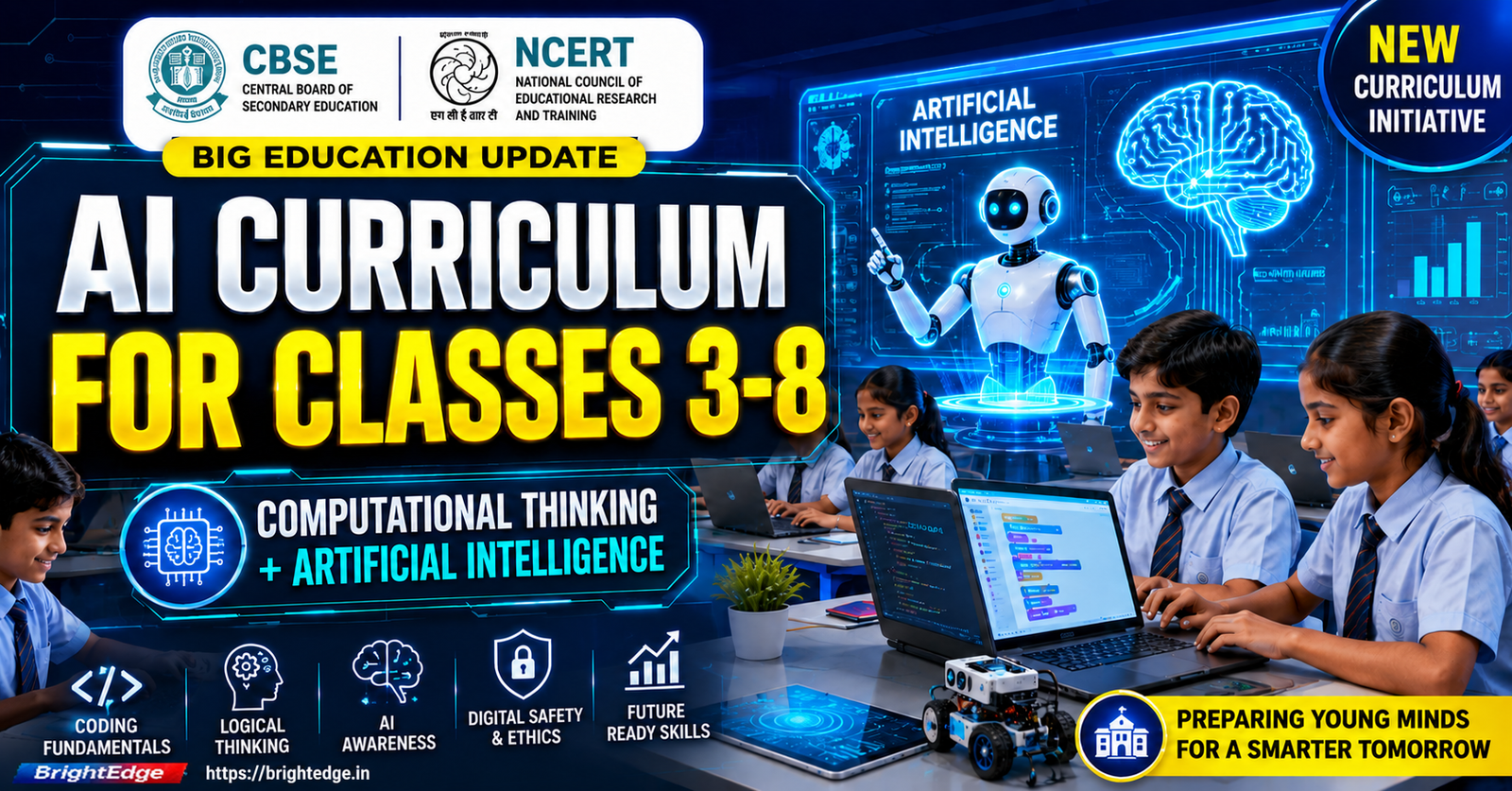
- The Centre has introduced a Computational Thinking and Artificial Intelligence curriculum for Classes 3 to 8, with teacher training scheduled during the summer break.
- This initiative is part of a broader push to integrate technology‑driven learning into schools, supported by AI textbooks and an expanded network of Atal Tinkering Labs.
- The initiative aims to prepare students for the rapidly evolving digital world by introducing foundational technology skills, logical reasoning, coding concepts, and AI awareness from an early stage.
- The curriculum has been jointly developed by the National Council of Educational Research and Training (NCERT) and the Central Board of Secondary Education (CBSE) as part of a wider effort to introduce technology‑oriented learning in schools from an earlier stage.
- The development reflects a broader transformation in India’s school education system, where digital learning, coding skills, and technology‑based subjects are steadily becoming integral to mainstream classrooms.
- The labs, established under the Atal Innovation Mission of NITI Aayog, are designed to expose students to practical innovation and experimentation.
- Schools selected under the programme are provided with equipment for robotics, electronics, sensors, coding, and 3D design, fostering a culture of hands‑on learning.
Why the New Curriculum Matters:
With Artificial Intelligence becoming an essential part of industries, education systems worldwide are focusing on future-ready learning. The newly introduced curriculum is designed to help students:
- Develop logical and analytical thinking
- Understand basic coding and problem-solving
- Learn ethical use of AI technologies
- Improve creativity and innovation skills
- Build digital literacy from the primary school level
The curriculum aligns with the goals of the National Education Policy, which emphasizes experiential and skill-based learning.
What Students Will Learn:
According to education experts, the curriculum will include age-appropriate activities and project-based learning modules.
Key Topics Expected in the Curriculum
- Basics of Computational Thinking
- Pattern Recognition and Logic Building
- Introduction to Coding Concepts
- Understanding Artificial Intelligence
- Responsible Use of Technology
- Data Awareness and Digital Safety
- Interactive Activities and AI-Based Projects
Students in lower classes will mainly focus on fun activities, puzzles, and logical exercises, while middle-school students may gradually explore coding platforms and beginner AI tools.
All about Atal Tinkering Labs:
- Atal Tinkering Labs are innovation workspaces in Indian schools designed to foster creativity, STEM learning, and problem-solving skills among students.
- It was launched in 2016.
- ATLs are part of the Atal Innovation Mission (AIM), a flagship initiative by the Government of India aimed at promoting a culture of innovation and entrepreneurship in schools across the country.
- ATLs provide students with hands-on experience in science, technology, engineering, and mathematics (STEM), encouraging them to explore, experiment, and develop innovative solutions for real-world challenges.
Focus on Practical Learning:
The new curriculum emphasizes hands-on learning instead of rote memorization. Schools are expected to conduct:
- Activity-based sessions
- Group projects
- Digital experiments
- Problem-solving tasks
- Interactive classroom discussions
Experts believe this approach will help students become more adaptable and technologically confident.
Benefits for Indian Students:
Education analysts say introducing AI education at an early age can help Indian students stay globally competitive. Some major advantages include:
- Better preparedness for future careers
- Improved digital confidence
- Enhanced creativity and innovation
- Stronger problem-solving abilities
- Early exposure to emerging technologies
The initiative is also expected to bridge the digital skills gap among school students in India.
Implementation in Schools:
Schools affiliated with CBSE are likely to receive:
- Teacher training support
- Curriculum guidelines
- Digital learning resources
- Activity books and practical modules
Teachers may also undergo orientation programs to effectively deliver AI and computational thinking lessons in classrooms.
A Major Shift in Indian Education:
The introduction of AI education for students from Classes 3 to 8 marks a significant transformation in India’s school system. As technology continues to shape industries and careers, early exposure to Artificial Intelligence and computational thinking could help students become future-ready learners.
The move reflects India’s growing focus on innovation, digital learning, and 21st-century skills development in school education.