

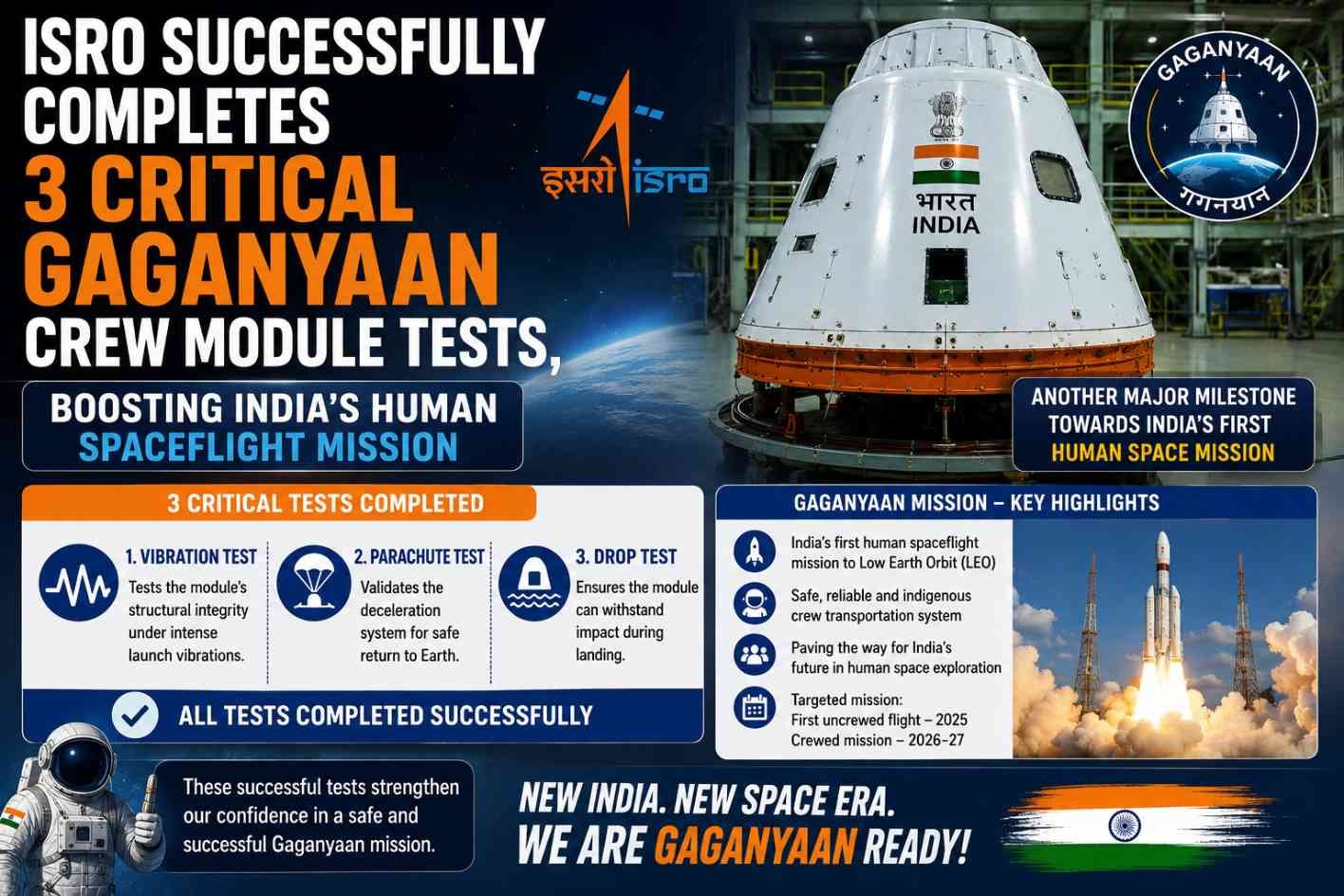
- The Indian Space Research Organisation (ISRO) has successfully carried out three major qualification tests for the Gaganyaan mission’s crew module, marking another significant milestone on India’s road to its first human spaceflight.
- The tests validated critical safety systems that will protect astronauts during splashdown, module separation, and re-entry.
What ISRO Tested and Why It Matters
- The crew module is the part of the Gaganyaan spacecraft that will actually carry India’s astronauts, known as Gaganyatris, into low-Earth orbit and back.
- Ensuring every safety system on this module works flawlessly is essential before any crewed mission can be cleared for launch.
1. Crew Module Uprighting System (CMUS)
- The first test focused on the module’s ability to right itself after splashing down in the ocean — a crucial safety requirement, since a capsule that lands upside down could put astronauts at serious risk.
- ISRO developed a stored cold-gas-based uprighting system for this purpose.
- During the test, engineers used a complete system-level setup and successfully demonstrated the inflation of flotation devices by releasing stored gas from a high-pressure bottle through control valves.
- ISRO confirmed the system met all operational requirements across different gas-pressure conditions.
2. Crew Module–Service Module Separation
- The second test examined the umbilical separation mechanism connecting the crew module, where astronauts will live, to the service module, which supplies power and propulsion throughout the mission.
- This mechanism has two connectors: CSU-1 on the crew module side and CSU-2 on the service module side. During re-entry, the service module detaches after CSU-1 disconnects, and CSU-2 separates shortly before the crew module re-enters Earth’s atmosphere.
- ISRO’s test confirmed clean separation and structural stability under simulated mission conditions.
3. Structural Strength During Parachute Deployment
- The third test assessed the crew module’s structural integrity during the separation of the Apex Cover, the component that shields the parachutes throughout the mission.
- This test ensures the module can withstand the physical forces generated when the parachute system deploys during descent.
Building on Earlier Milestones
- These latest tests come shortly after ISRO completed the Integrated Main Parachute Air Drop Test (IMAT), which validated one of the mission’s most critical recovery systems.
- Earlier in the year, ISRO also conducted its second Integrated Air Drop Test, in which a dummy crew module was dropped from an Indian Air Force Chinook helicopter and recovered by the Indian Navy — part of a broader series of trials refining the spacecraft’s recovery mechanisms.
- Together, these tests build on previous progress with parachute, propulsion, and crew-escape systems, steadily strengthening the mission’s overall readiness.
Why Gaganyaan Matters for India
- Gaganyaan is India’s first human spaceflight programme, designed to send Indian astronauts into low-Earth orbit before safely returning them to Earth.
- If successful, it will make India only the fourth nation — after the United States, Russia, and China — to independently launch humans into space and bring them home.
- Several uncrewed missions are planned before the first crewed flight, allowing ISRO to validate every system for reliability.
- Beyond national prestige, the programme is expected to advance India’s capabilities in space medicine, life-support systems, crew safety, and spacecraft recovery operations.
What’s Next for Gaganyaan
With crew module safety systems now qualified, ISRO’s focus shifts to further integrated testing ahead of the uncrewed demonstration flights that will precede India’s first crewed mission to space.
FAQs
Q: What tests did ISRO just complete for Gaganyaan? A: ISRO completed three qualification tests: the Crew Module Uprighting System (CMUS), the crew module–service module separation mechanism, and structural strength during parachute Apex Cover separation.
Q: What is the Crew Module Uprighting System? A: It’s a cold-gas-based safety system that automatically flips the crew module upright after it splashes down in the ocean, protecting astronauts inside.
Q: Which country will Gaganyaan make India the 4th to achieve independent human spaceflight after? A: The United States, Russia, and China.
Q: Is Gaganyaan a crewed mission yet? A: Not yet — ISRO plans several uncrewed test flights before the first crewed Gaganyaan mission.