

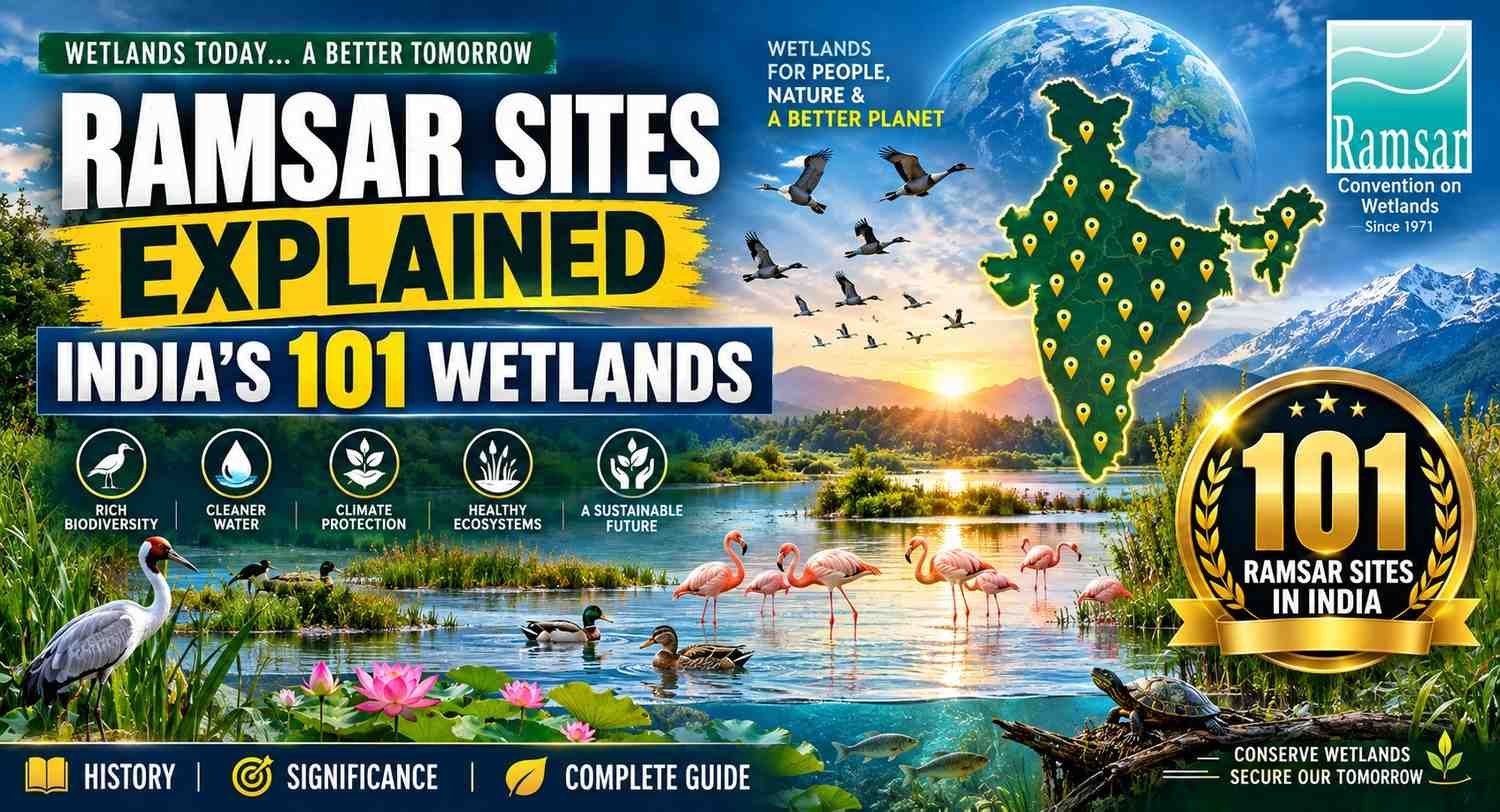
Wetlands are among the world’s most valuable ecosystems, providing freshwater, supporting biodiversity, regulating climate, and protecting communities from floods and droughts. Recognizing their global importance, countries across the world have joined the Ramsar Convention, an international treaty dedicated to conserving wetlands.
India has emerged as a global leader in wetland conservation, with 101 Ramsar Sites spread across diverse ecosystems, from the Himalayan lakes and river floodplains to mangrove forests, lagoons, marshes, and coastal wetlands. These sites play a vital role in protecting biodiversity, supporting livelihoods, and ensuring ecological balance.
What Is a Ramsar Site?
A Ramsar Site is a wetland designated as a Wetland of International Importance under the Ramsar Convention on Wetlands, an international treaty that promotes the conservation and sustainable use of wetlands.
These sites are recognized for their exceptional ecological, hydrological, botanical, zoological, and environmental value. They provide habitat for numerous plant and animal species, including migratory birds and endangered wildlife.
History of the Ramsar Convention
The Ramsar Convention was adopted on 2 February 1971 in the city of Ramsar, Iran, and came into force in 1975.
Its primary objective is to promote the conservation and wise use of wetlands through national policies, international cooperation, and sustainable management practices.
India became a Contracting Party to the Convention in 1982, marking the beginning of its organized efforts to identify and protect wetlands of international importance.
Every year, 2 February is observed as World Wetlands Day, commemorating the adoption of the Ramsar Convention and raising awareness about the importance of wetland conservation.
Why Are Ramsar Sites Important?
Wetlands are often called the “kidneys of the Earth” because they naturally filter water, recharge groundwater, and support rich biodiversity.
Key benefits of Ramsar Sites include:
- Conserving biodiversity and endangered species
- Providing habitat for migratory birds
- Recharging groundwater resources
- Reducing the impact of floods and droughts
- Improving water quality through natural filtration
- Acting as carbon sinks to combat climate change
- Supporting fisheries, agriculture, and livelihoods
- Promoting eco-tourism and scientific research
Criteria for Becoming a Ramsar Site
A wetland may qualify for Ramsar recognition if it:
- Represents a rare or unique wetland ecosystem.
- Supports vulnerable or endangered species.
- Provides habitat for migratory waterbirds.
- Maintains regional biodiversity.
- Supports significant fish populations.
- Plays an important role in ecological processes.
Sites are evaluated against internationally agreed criteria before being designated under the Ramsar Convention.
India’s Journey in Wetland Conservation
India has steadily expanded its network of Ramsar Sites over the past decades.
Today, the country’s wetlands include:
- High-altitude Himalayan lakes
- River floodplains
- Freshwater marshes
- Mangrove forests
- Coastal lagoons
- Estuaries
- Peatlands
- Reservoirs of ecological importance
The recognition of Glaw Lake as Arunachal Pradesh’s first Ramsar Site has increased India’s total to 101 Ramsar Sites, reflecting the country’s continued commitment to environmental conservation.
State-wise Distribution of Ramsar Sites
Ramsar Sites are distributed across almost every region of India, showcasing the country’s remarkable ecological diversity.
Major categories include:
- Himalayan wetlands
- Indo-Gangetic floodplains
- Desert wetlands
- Coastal wetlands
- Mangrove ecosystems
- Delta wetlands
- Freshwater lakes
- Brackish water lagoons
States such as Tamil Nadu, Uttar Pradesh, Punjab, Gujarat, Odisha, Maharashtra, Kerala, and Jammu & Kashmir are home to several internationally recognized wetlands.
Famous Ramsar Sites in India
Some of the country’s best-known Ramsar Sites include:
- Chilika Lake (Odisha)
- Keoladeo National Park (Rajasthan)
- Loktak Lake (Manipur)
- Wular Lake (Jammu & Kashmir)
- Sundarban Wetland (West Bengal)
- Bhitarkanika Mangroves (Odisha)
- Ashtamudi Wetland (Kerala)
- Harike Wetland (Punjab)
- Nalsarovar Bird Sanctuary (Gujarat)
- Glaw Lake (Arunachal Pradesh)
Challenges Facing Wetlands
Despite legal protection, many wetlands continue to face serious threats:
- Urban encroachment
- Pollution
- Plastic waste
- Illegal construction
- Climate change
- Excessive groundwater extraction
- Invasive species
- Unsustainable tourism
Conservation requires coordinated efforts by governments, scientists, local communities, and citizens.
Government Initiatives
India has introduced several programmes to strengthen wetland conservation, including:
- National Plan for Conservation of Aquatic Ecosystems (NPCA)
- Wetlands (Conservation and Management) Rules, 2017
- National Biodiversity Action Plan
- Community-based wetland management
- State Wetland Authorities
- Digital mapping and monitoring of wetlands
These initiatives complement the objectives of the Ramsar Convention and encourage the wise use of wetland ecosystems.
India’s Ramsar Sites at a Glance
| Feature | Details |
|---|---|
| International Treaty | Ramsar Convention |
| Adopted | 2 February 1971 |
| Location of Adoption | Ramsar, Iran |
| India Joined | 1982 |
| Total Ramsar Sites in India | 101 |
| Purpose | Conservation and wise use of wetlands |
| World Wetlands Day | 2 February |
Below is the updated list of India’s 101 Ramsar Sites, arranged state-wise. (Total: 101 sites, including Glaw Lake as Arunachal Pradesh’s first Ramsar Site.) As of 5th August 2026
| State / UT | Ramsar Site(s) |
|---|---|
| Andhra Pradesh | Kolleru Lake |
| Arunachal Pradesh | Glaw Lake |
| Assam | Deepor Beel |
| Bihar | Kabar Taal |
| Chandigarh (UT) | None |
| Chhattisgarh | None |
| Delhi (NCT) | None |
| Goa | None |
| Gujarat | Nalsarovar Bird Sanctuary, Khijadia Wildlife Sanctuary, Thol Lake Wildlife Sanctuary, Wadhvana Wetland |
| Haryana | Sultanpur National Park, Bhindawas Wildlife Sanctuary |
| Himachal Pradesh | Pong Dam Lake, Renuka Wetland, Chandertal Wetland |
| Jammu & Kashmir (UT) | Wular Lake, Hokersar Wetland, Surinsar–Mansar Lakes |
| Jharkhand | None |
| Karnataka | Ranganathittu Bird Sanctuary, Aghanashini Estuary |
| Kerala | Ashtamudi Wetland, Sasthamkotta Lake, Vembanad-Kol Wetland |
| Ladakh (UT) | Tso Kar Wetland Complex |
| Madhya Pradesh | Bhoj Wetland, Sirpur Wetland, Sakhya Sagar |
| Maharashtra | Nandur Madhameshwar, Thane Creek Flamingo Sanctuary |
| Manipur | Loktak Lake |
| Meghalaya | None |
| Mizoram | None |
| Nagaland | None |
| Odisha | Chilika Lake, Bhitarkanika Mangroves, Satkosia Gorge |
| Punjab | Harike Wetland, Ropar Wetland, Keshopur-Miani Community Reserve, Beas Conservation Reserve, Nangal Wildlife Sanctuary |
| Rajasthan | Keoladeo National Park, Sambhar Lake |
| Sikkim | Khecheopalri Wetland |
| Tamil Nadu | Point Calimere Wildlife & Bird Sanctuary, Pichavaram Mangrove, Pallikaranai Marsh Reserve Forest, Karikili Bird Sanctuary, Vedanthangal Bird Sanctuary, Gulf of Mannar Marine Biosphere Reserve, Vaduvur Bird Sanctuary, Chitrangudi Bird Sanctuary, Suchindram–Theroor Wetland Complex, Udhayamarthandapuram Bird Sanctuary, Vellode Bird Sanctuary, Kanjirankulam Bird Sanctuary, Nanjarayan Bird Sanctuary, Kazhuveli Bird Sanctuary, Longwood Shola Reserve Forest, Nanjadan Wetland, Karaivetti Bird Sanctuary, Koonthankulam Bird Sanctuary, Gulf of Mannar Marine National Park |
| Telangana | None |
| Tripura | Rudrasagar Lake |
| Uttar Pradesh | Upper Ganga River (Brijghat to Narora Stretch), Nawabganj Bird Sanctuary (Shaheed Chandra Shekhar Azad Bird Sanctuary), Saman Bird Sanctuary, Samaspur Bird Sanctuary, Sandi Bird Sanctuary, Sur Sarovar, Parvati Arga Bird Sanctuary, Sarsai Nawar Jheel, Haiderpur Wetland, Bakhira Wildlife Sanctuary |
| Uttarakhand | Asan Conservation Reserve |
| West Bengal | East Kolkata Wetlands, Sundarban Wetland |
States with the Highest Number of Ramsar Sites
| Rank | State | No. of Ramsar Sites |
|---|---|---|
| 1 | Tamil Nadu | 19 |
| 2 | Uttar Pradesh | 10 |
| 3 | Punjab | 5 |
| 4 | Gujarat | 4 |
| 5 | Madhya Pradesh | 3 |
| 5 | Kerala | 3 |
| 5 | Himachal Pradesh | 3 |
| 5 | Jammu & Kashmir | 3 |
| 5 | Odisha | 3 |
Frequently Asked Questions
What is a Ramsar Site?
A Ramsar Site is a wetland recognized internationally under the Ramsar Convention for its ecological importance.
Why is the Ramsar Convention important?
It provides a global framework for conserving wetlands and promoting their sustainable use.
How many Ramsar Sites does India have?
India currently has 101 Ramsar Sites.
Which is India’s latest Ramsar Site?
The latest addition is Glaw Lake in Arunachal Pradesh, the state’s first Ramsar Site.
Why are wetlands important?
Wetlands conserve biodiversity, regulate water cycles, store carbon, support livelihoods, and reduce the impacts of floods and climate change.