

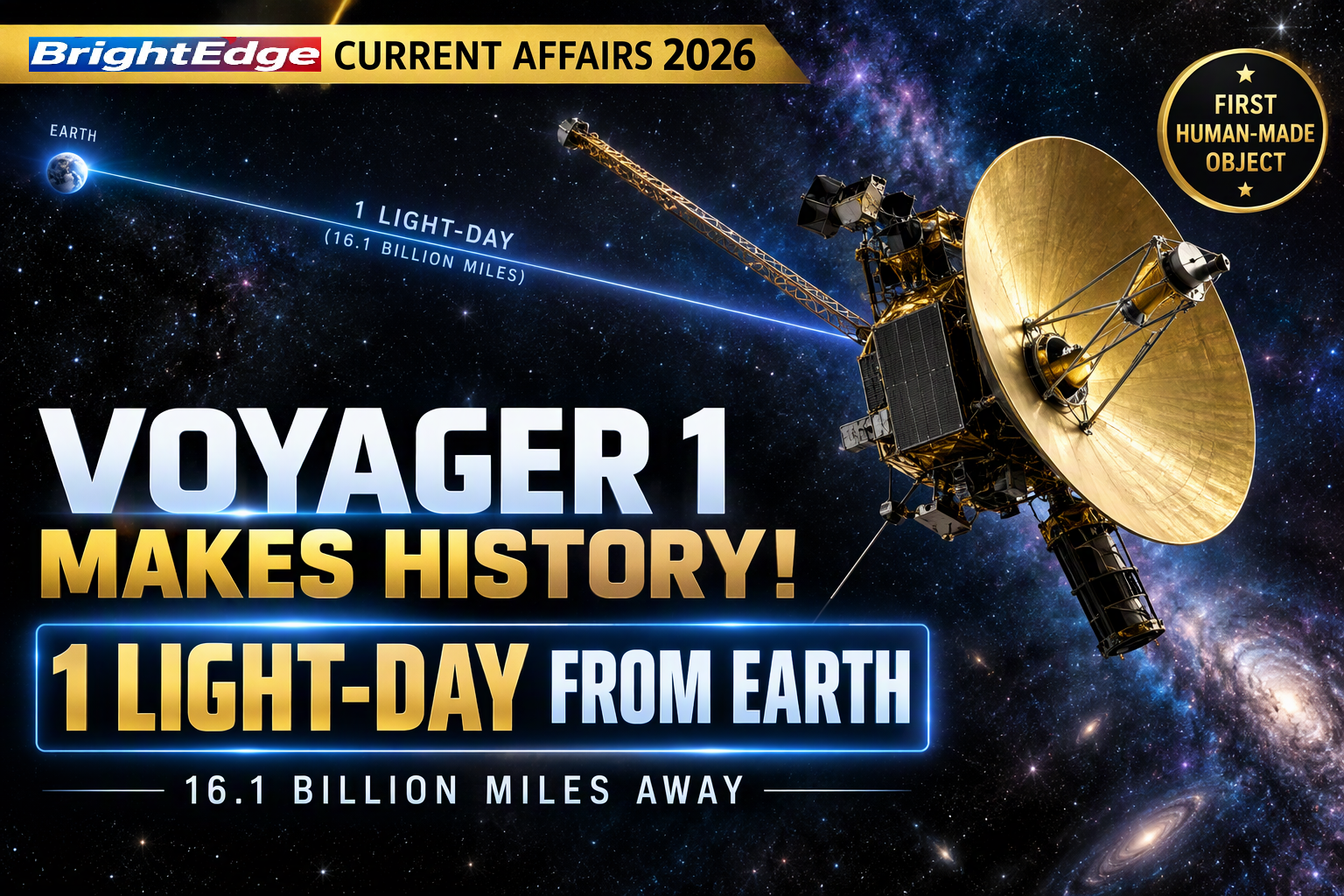
NASA’s Voyager 1 spacecraft has achieved an extraordinary milestone in space exploration by reaching a distance of one light-day from Earth on November 18, 2026. It has become the first human-made object to travel so far from our planet, marking a historic achievement after nearly 50 years in space.
Launched by NASA on September 5, 1977, Voyager 1 has travelled approximately 16.1 billion miles (25.9 billion kilometres) from Earth. At this distance, a radio signal travelling at the speed of light takes approximately 24 hours to reach the spacecraft and another 24 hours for its response to return.
The achievement represents a remarkable milestone in humanity’s exploration of interstellar space.
However, NASA is currently investigating a spacecraft data-transmission problem. Although the probe’s carrier signal remains detectable, it stopped transmitting science and engineering data on November 14, 2026. NASA planned to confirm the one-light-day milestone using the carrier signal and trajectory calculations on November 19.
What Is the One-Light-Day Milestone Achieved by Voyager 1?
A light-day is a unit of astronomical distance that measures how far light travels in 24 hours.
Since light travels at approximately 299,792 kilometres per second, one light-day equals approximately:
- 25.9 billion kilometres
- 16.1 billion miles
- 173 astronomical units (AU)
Voyager 1 reached this extraordinary distance on November 18, 2026.
This means that even a radio message travelling from Earth at the speed of light requires approximately one full day to reach the spacecraft.
Similarly, a response sent by Voyager 1 takes another 24 hours to return to Earth.
Consequently, communication between NASA’s mission control team and Voyager 1 involves an approximately 48-hour round-trip signal delay.
Key Facts About NASA’s Voyager 1 Mission
| Particulars | Details |
|---|---|
| Spacecraft | Voyager 1 |
| Space Agency | NASA |
| Launch Date | September 5, 1977 |
| Launch Site | Cape Canaveral, Florida, USA |
| Mission Management | NASA’s Jet Propulsion Laboratory (JPL) |
| Primary Mission | Exploration of Jupiter and Saturn |
| One-Light-Day Milestone | November 18, 2026 |
| Distance from Earth | Approximately 25.9 billion km |
| Distance in Miles | Approximately 16.1 billion miles |
| Speed | Approximately 61,000 km/h |
| Current Region | Interstellar space |
| Special Achievement | First human-made object to reach one light-day from Earth |
History of Voyager 1: From Jupiter and Saturn to Interstellar Space
- NASA launched Voyager 1 on September 5, 1977, as part of its ambitious Voyager planetary exploration programme.
- The spacecraft was initially designed to study the outer planets of our Solar System, particularly Jupiter and Saturn.
- During its journey, Voyager 1 made several important scientific discoveries.
1. Exploration of Jupiter
- Voyager 1 conducted a close flyby of Jupiter in March 1979.
- It provided detailed observations of Jupiter’s atmosphere, magnetic environment and moons.
- One of its significant discoveries was volcanic activity on Io, one of Jupiter’s largest moons.
2. Exploration of Saturn
- In November 1980, Voyager 1 flew past Saturn.
- It captured valuable information about Saturn’s atmosphere, rings and largest moon, Titan.
- Its observations significantly improved scientific understanding of the Saturnian system.
3. Entry into Interstellar Space
- On August 25, 2012, Voyager 1 crossed the heliopause, the boundary marking the transition from the Sun’s heliosphere into interstellar space.
- It became the first spacecraft to enter interstellar space.
- This achievement opened a new chapter in humanity’s exploration beyond the influence of the solar wind.
Why Is the One-Light-Day Distance So Important?
The one-light-day milestone is significant for several reasons.
1. A New Record in Human Space Exploration
- Voyager 1 has become the first human-made object to reach a distance of one light-day from Earth.
- No other human-built spacecraft has travelled this far.
2. A 48-Hour Communication Delay
- The spacecraft is now so distant that radio communications require approximately 24 hours in each direction.
- This creates significant challenges for NASA engineers, who cannot control the spacecraft in real time.
3. A Remarkable Achievement of Engineering
- Voyager 1 has continued its journey for nearly five decades despite operating with technology developed in the 1970s.
- Its longevity demonstrates the importance of engineering reliability and long-term scientific planning.
4. Scientific Exploration of Interstellar Space
- Voyager 1 continues to represent humanity’s ability to explore regions beyond the heliosphere and investigate the environment between stars.
Voyager 1 Faces a New Technical Challenge
- Despite achieving its historic distance milestone, Voyager 1 is currently experiencing a technical problem.
- According to NASA’s November 18, 2026 update, the spacecraft stopped transmitting science and engineering data on November 14.
- NASA’s Deep Space Network antenna in Canberra, Australia, detected the spacecraft’s carrier signal but did not receive the expected data.
- The carrier signal indicates that Voyager 1’s antenna and radio transmission equipment are still functioning.
- However, engineers suspect a problem involving the onboard computer responsible for collecting information from the spacecraft’s various systems and scientific instruments.
- NASA engineers are investigating the issue and working to restore normal data transmission.
- Because of the enormous distance involved, diagnosing and resolving the problem could take weeks or longer.
- Importantly, NASA can still determine the spacecraft’s distance using its carrier signal and trajectory calculations.
What Is the Difference Between Voyager 1 and Voyager 2?
NASA launched two spacecraft under its Voyager programme: Voyager 1 and Voyager 2.
Both spacecraft have made historic contributions to planetary science and interstellar exploration.
| Feature | Voyager 1 | Voyager 2 |
|---|---|---|
| Launch Date | September 5, 1977 | August 20, 1977 |
| Launch Position | Second spacecraft launched | First spacecraft launched |
| Jupiter Flyby | 1979 | 1979 |
| Saturn Flyby | 1980 | 1981 |
| Uranus Exploration | No | 1986 |
| Neptune Exploration | No | 1989 |
| Interstellar Space Entry | 2012 | 2018 |
| Major Achievement | First human-made object to reach one light-day from Earth | First spacecraft to visit Uranus and Neptune |
Voyager 1 and Voyager 2 are the only spacecraft operating outside the heliosphere.
Both carry the famous Golden Record, containing sounds, images and greetings representing Earth and humanity.
What Is the Golden Record?
The Golden Record is a special phonograph record carried aboard both Voyager spacecraft.
It was designed to communicate information about Earth and human civilisation to any potential extraterrestrial intelligence that might encounter the spacecraft.
The record contains:
- Greetings in 55 languages.
- Music from different cultures.
- Natural sounds from Earth.
- Images representing human life and civilisation.
- Scientific information about Earth and the Solar System.
The Golden Record was developed under the leadership of a team that included renowned astronomer Carl Sagan.
It represents humanity’s symbolic message to the universe.