

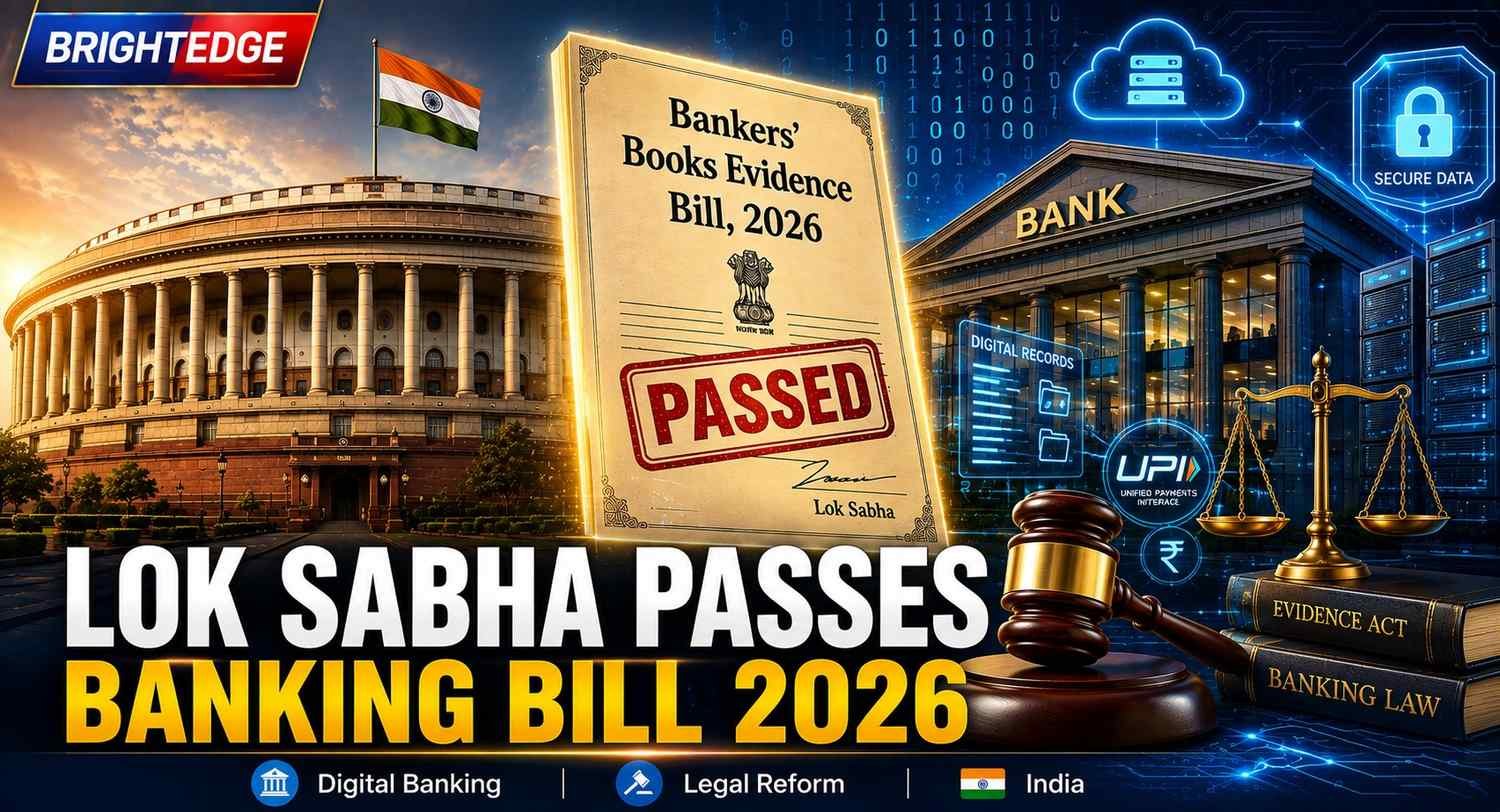
In a significant move to modernize India’s banking and legal framework, the Lok Sabha has passed the Bankers’ Books Evidence Bill, 2026. The legislation aims to align banking laws with the realities of the digital era by updating the legal treatment of banking records and facilitating the use of electronic records in judicial and regulatory proceedings.
The Bill is part of the government’s broader efforts to strengthen digital governance, improve ease of doing business, and enhance the efficiency of India’s financial sector.
What is the Bankers’ Books Evidence Bill, 2026?
The Bankers’ Books Evidence Bill, 2026 updates the legal framework governing the admissibility of banking records as evidence in courts and other legal proceedings.
Historically, the law focused on physical ledgers and paper-based banking records. With banking operations now largely digital, the Bill seeks to ensure that electronic records receive appropriate legal recognition while maintaining standards for authenticity and reliability.
Why Was the Bill Introduced?
India’s banking sector has undergone a rapid digital transformation driven by internet banking, mobile banking, UPI, core banking systems, and electronic record management.
The legislation has been introduced to:
- Modernize outdated banking laws.
- Recognize digital banking records in legal proceedings.
- Simplify documentation and evidence procedures.
- Support paperless banking.
- Improve judicial efficiency.
- Reduce dependence on physical records.
- Strengthen trust in digital financial systems.
Key Provisions of the Bill
The Bill introduces several important reforms, including:
Recognition of Electronic Records
Digital banking records receive legal recognition in accordance with applicable legal standards.
Simplified Evidence Procedures
Banks can produce certified electronic records more efficiently during court proceedings.
Support for Digital Banking
The legislation reflects the shift from paper-based banking to digital record management.
Improved Legal Clarity
The Bill updates terminology and procedures to match modern banking technologies.
Stronger Record Authentication
Electronic records must continue to meet prescribed standards of authenticity before being accepted as evidence.
Why Is This Reform Important?
India is among the world’s fastest-growing digital economies. Millions of banking transactions take place electronically every day through UPI, internet banking, NEFT, RTGS, IMPS, and mobile banking platforms.
The updated legal framework helps ensure that digital banking records can be handled more efficiently in legal and regulatory matters while supporting the country’s broader Digital India initiatives.
Expected Benefits
The legislation is expected to provide several advantages:
- Faster legal proceedings involving banking documents.
- Reduced paperwork for banks.
- Greater efficiency in evidence management.
- Better support for digital banking operations.
- Enhanced legal certainty for electronic records.
- Improved administrative efficiency.
Impact on Banks and Customers
For Banks
- Simplified compliance.
- Easier production of records during litigation.
- Reduced physical document storage.
- Better digital record management.
For Customers
- Faster verification of banking transactions.
- Improved transparency.
- Better support for digital financial services.
- More efficient legal processes involving banking records.
Part of India’s Digital Governance Reforms
The Bill complements India’s ongoing digital transformation initiatives, including:
- Digital India Mission.
- Core Banking Solutions (CBS).
- Unified Payments Interface (UPI).
- Aadhaar-enabled services.
- Paperless governance.
- e-Courts initiatives.
- Financial sector digitization.
Together, these reforms aim to create a more efficient, transparent, and technology-driven financial ecosystem.
Key Facts at a Glance
| Feature | Details |
|---|---|
| Bill | Bankers’ Books Evidence Bill, 2026 |
| Passed By | Lok Sabha |
| Objective | Modernize banking evidence laws |
| Focus | Recognition of electronic banking records |
| Beneficiaries | Banks, courts, regulators, customers |
| Expected Impact | Faster legal procedures and stronger digital banking framework |
Frequently Asked Questions (FAQs)
What is the Bankers’ Books Evidence Bill, 2026?
It is a legislative measure that modernizes the legal framework governing the use of banking records as evidence, particularly electronic records.
Why was the Bill introduced?
The Bill was introduced to update banking laws in line with digital banking practices and reduce reliance on paper records.
Will electronic banking records become legally valid?
The Bill aims to provide a modern legal framework for the use of electronic banking records, subject to applicable legal requirements for authenticity and admissibility.
How will customers benefit?
Customers are expected to benefit from improved efficiency, quicker document verification, and smoother legal processes involving banking records.